Champagne adapts vineyards and winemaking as warmer seasons threaten its signature style
Producers are broadening vine genetics, tightening plant-health controls and adjusting cellar practices to preserve Champagne’s freshness, moderate alcohol and acidity as earlier ripening, drought and disease alter regional conditions.
A changing climate challenges Champagne’s identity
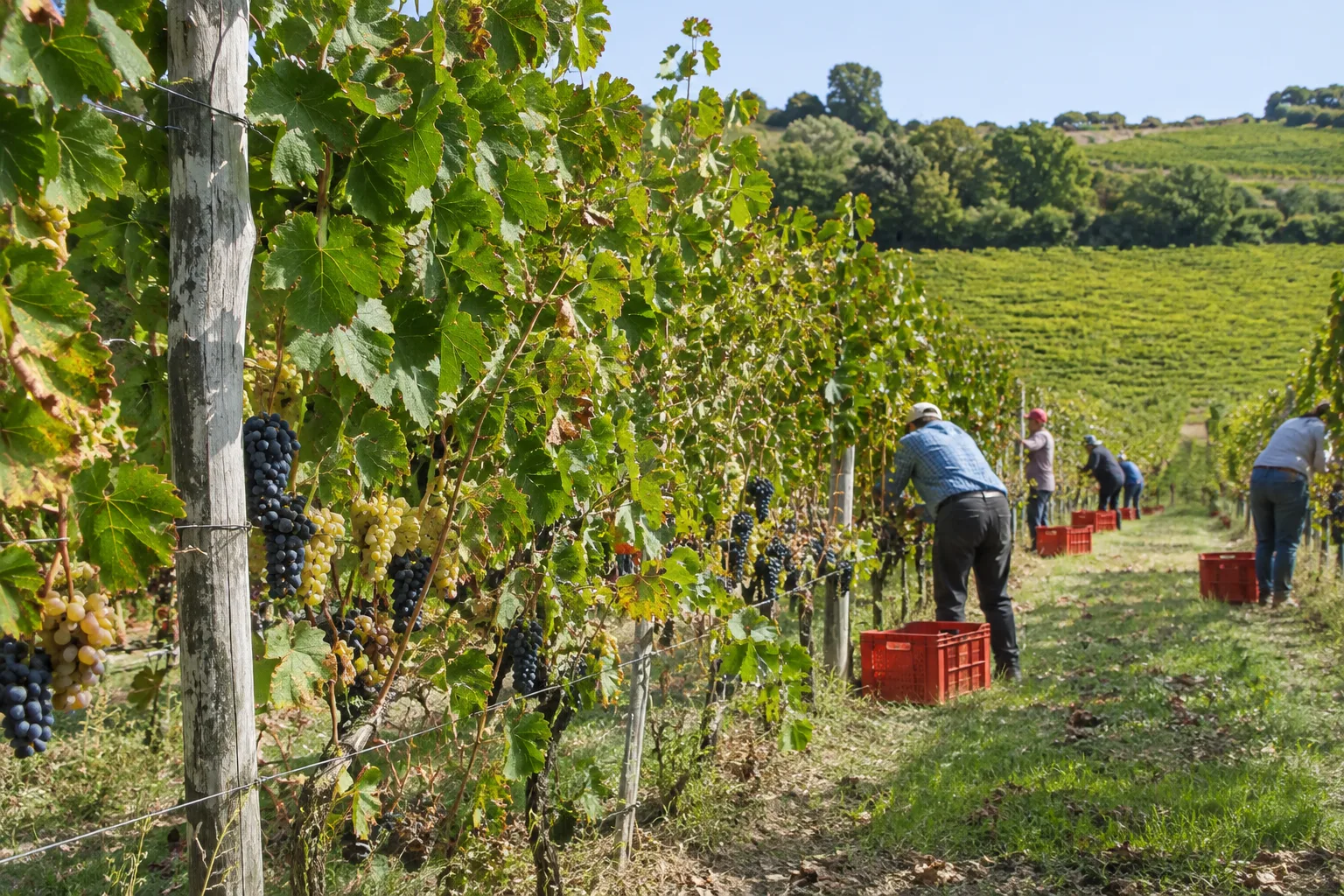
Champagne producers are turning to new vine material, stricter plant-health measures and technical changes in the cellar as climate change alters the cool, wet conditions that historically shaped the region. The urgency increased after several unusual seasons, including the 2025 harvest, which Perrier-Jouët cellar master Séverine Frerson described as unlike anything she had previously experienced.1
The region’s cool climate traditionally produced still wines whose light body and pronounced acidity made them particularly suitable for sparkling wine made by the traditional method. As warmer seasons bring earlier ripening and greater sugar accumulation, growers and houses are seeking to retain freshness, moderate alcohol and high acidity without losing Champagne’s defining style.1
Voltis and late-ripening regional grapes
In 2022, the French appellation authority INAO approved the disease-resistant grape Voltis for experimental use in Champagne. The authorization limits it to 5% of an estate’s vineyard area and 10% of a finished blend, with a review scheduled for 2032. Planting began in 2023; by May 2026, about 10 hectares were under vine, equivalent to roughly 0.03% of Champagne’s total vineyard area.1
Producers are also reconsidering Petit Meslier and Arbane, older regional varieties whose late ripening and high acidity could slow sugar accumulation and help preserve freshness. Their presence remains marginal: together they account for less than 0.1% of the appellation’s vineyard area.1
The Comité Champagne, also known as the CIVC, is vinifying prospective varieties in small trial batches to assess whether they match Champagne’s expected sensory profile. CIVC sustainable development manager Pierre Naviaux said results vary considerably, and some wines are much more aromatic than the restrained character associated with Pinot Noir, Chardonnay and Meunier. He regards new varieties as one option for adaptation, but not the region’s principal instrument.1
Louis Roederer expands genetic diversity
Louis Roederer is focusing on diversity within Champagne’s established grapes through massal selection, using genetically varied material from existing vineyards instead of standardized commercial clones. Cellar master Jean-Baptiste Lécaillon said the objective is to recover vines that may require a longer growing season and tolerate heat more effectively.1
The program began in 2002 with material from pre-clonal vines planted before 1960 in what is now Domaine Cristal. Working with vine specialists and its vineyard team, Roederer selected cuttings for quality and resilience and replanted them in four propagation conservatories. More than 100 variants are now being propagated, chiefly Pinot Noir alongside other traditional Champagne grapes.1
Roederer is applying the same approach to rootstocks. Lécaillon said low genetic diversity can increase exposure to disease and climatic shocks, whereas varied material within one plot can strengthen resilience because vines do not all reach vulnerable stages such as flowering simultaneously.1
Regional conservation through Qanopée and Essentia
The CIVC is participating with Burgundy, Beaujolais and Jura in Qanopée, a €10 million project designed to secure the long-term viability of more than 20 grape varieties and protect genetic diversity. Its Champagne facilities include a 4,500-square-meter, insect-proof bioclimatic greenhouse at Oger in the Marne department, where disease-free material is prepared for grafting and rootstocks. This work previously took place in open fields, which have become more vulnerable to sanitary risks and climate pressure.1
Moët & Chandon is pursuing a related conservation strategy through Essentia, part of its wider Natura Nostra program launched in 2021. In 2022, the company planted a four-hectare vineyard conceived as a living library of genetically diverse vines from multiple varieties, including material collected from old vines.1
Disease pressure and ecological corridors
Flavescence dorée, a bacterial disease transmitted by leafhoppers, is a major concern. Warmer temperatures have supported its northward movement from southern France into areas including Champagne, while earlier springs make leafhopper eggs hatch sooner. Faster insect development and warmer conditions may also favor the disease itself.1
These risks are changing the purpose assigned to biodiversity projects. Trees and hedgerows, previously promoted mainly for landscape diversity and local microclimates, are increasingly intended to attract birds and bats that may control insects. Moët & Chandon has planted 20 kilometers of ecological corridors across the region and plans a substantial expansion to connect existing biodiversity areas and support species capable of regulating pests.1
Managing heat and drought in the vineyard
Frerson said regenerative measures such as cover crops can cool the soil and have reduced alcohol by 0.3 points in some plots. The practice entails a trade-off during drought because ground cover can compete with vines for water. The especially dry 2025 and 2026 seasons made that balance more difficult.1
Cellar changes to preserve acidity
Perrier-Jouët, which previously carried out malolactic fermentation as standard practice, is now blocking it in some wines. Malolactic conversion changes sharper malic acid into softer lactic acid; preventing it can retain a brighter acid profile when grapes arrive at greater ripeness. Frerson said stopping the conversion is among the cellar interventions with the greatest effect.1
Other adaptations include lowering dosage—the sugar solution added before release—selecting different yeasts and changing aging periods. Producers increasingly view yeasts and other microorganisms as an important area of climate research. At Moët Hennessy’s Robert-Jean de Vogüé Research Centre, Moët & Chandon is using a proprietary yeast strain and developing others intended to cope better with higher alcohol and lower nutrient levels in must from warmer seasons.1
Research director Marc Brevot said microbiology could also contribute beyond fermentation, including to soil and plant health, recycling and packaging materials. The outcome has implications beyond Champagne: as one of France’s most profitable wine regions and a global benchmark for sparkling wine, its response could influence vineyard investment, plant-health management and consumer expectations, while informing decisions by wine groups, growers and suppliers facing similar pressures.1
Sources
Written by the Dionysus editors from the sources above.