About this wine
Vineyard and terroir
The grapes come from Montemarano in the province of Avellino. The 90-year-old vines retain the traditional Avellinese raggiera training system.
Grapes
Coda di Volpe Bianca.
Vinification
The grapes are harvested by hand in the first week of October. Fermentation begins spontaneously, with four days of skin maceration.
Ageing
The 2023 wine spends one year in a chestnut barrel and another year in bottle before release. The 2022 matured for almost one year in chestnut barrels and was bottled on 18 September 2023. Extended bottle ageing improves the wine's stability.
Technical data
Campania Coda di Volpe IGP. Alcohol: 12% vol for both the 2023 and 2022 wines.
The 2022 production comprised 5,380 bottles of 0.75 L, 90 magnums, 12 bottles of 3 L, 10 of 4.5 L, four of 6 L, two of 12 L and one of 15 L. No sulphites were added; only sulphites naturally produced during spontaneous fermentation are present.
Vintage notes
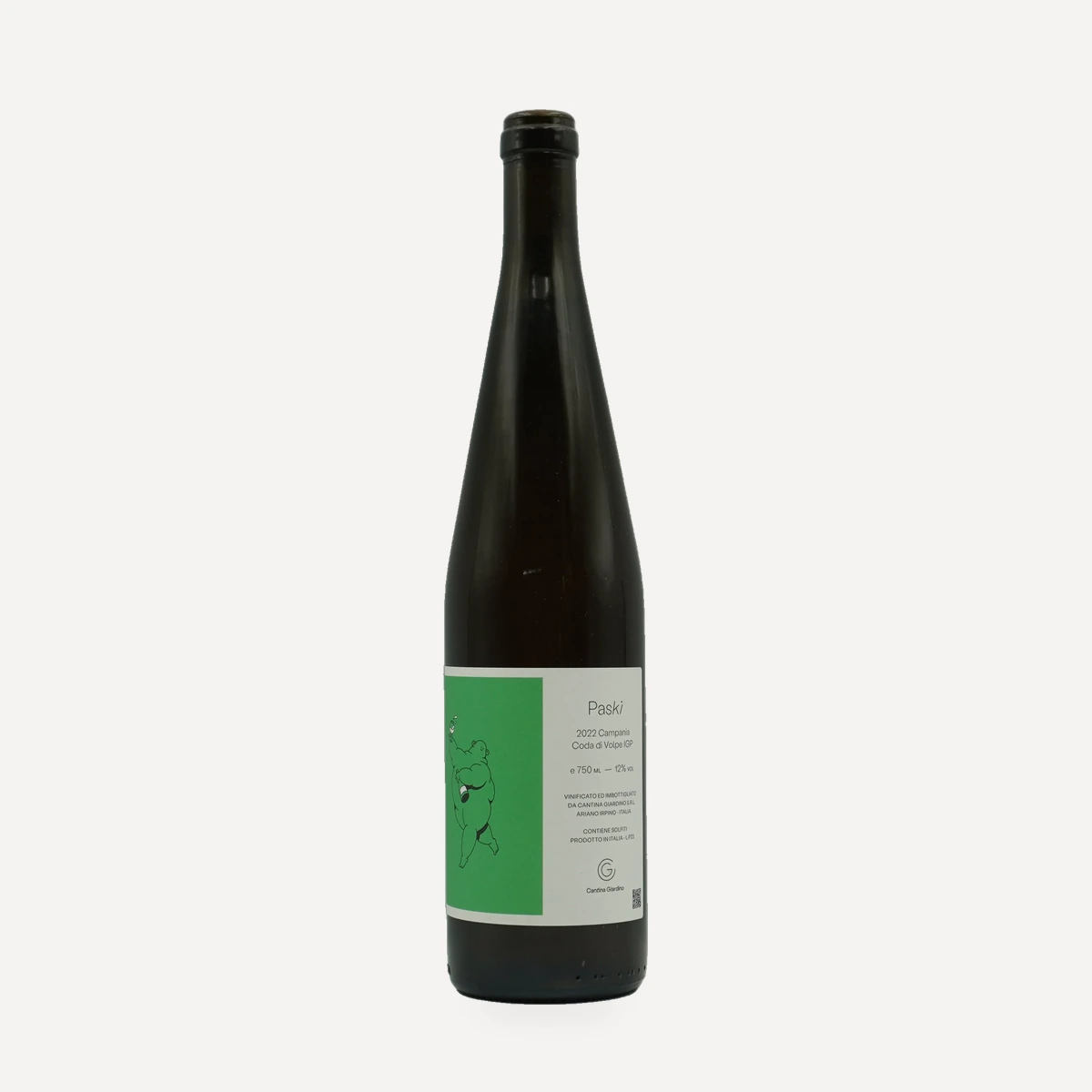
The page presents the 2023 release together with detailed production information for 2022. Both underwent four days of skin contact and chestnut-barrel maturation; the 2023 also received one year of bottle ageing before release.
Label / history
Paski was created in 2005 for La Catagna, a trattoria in Bacoli closely connected with Cantina Giardino. Early releases were sold in demijohns to keep prices accessible at a time when the Italian market had little familiarity with skin-macerated wines made without added sulphites. The relationship with La Catagna continues, and several important figures in the cellar's history were first encountered there. Jonas Mosesson created the label artwork.