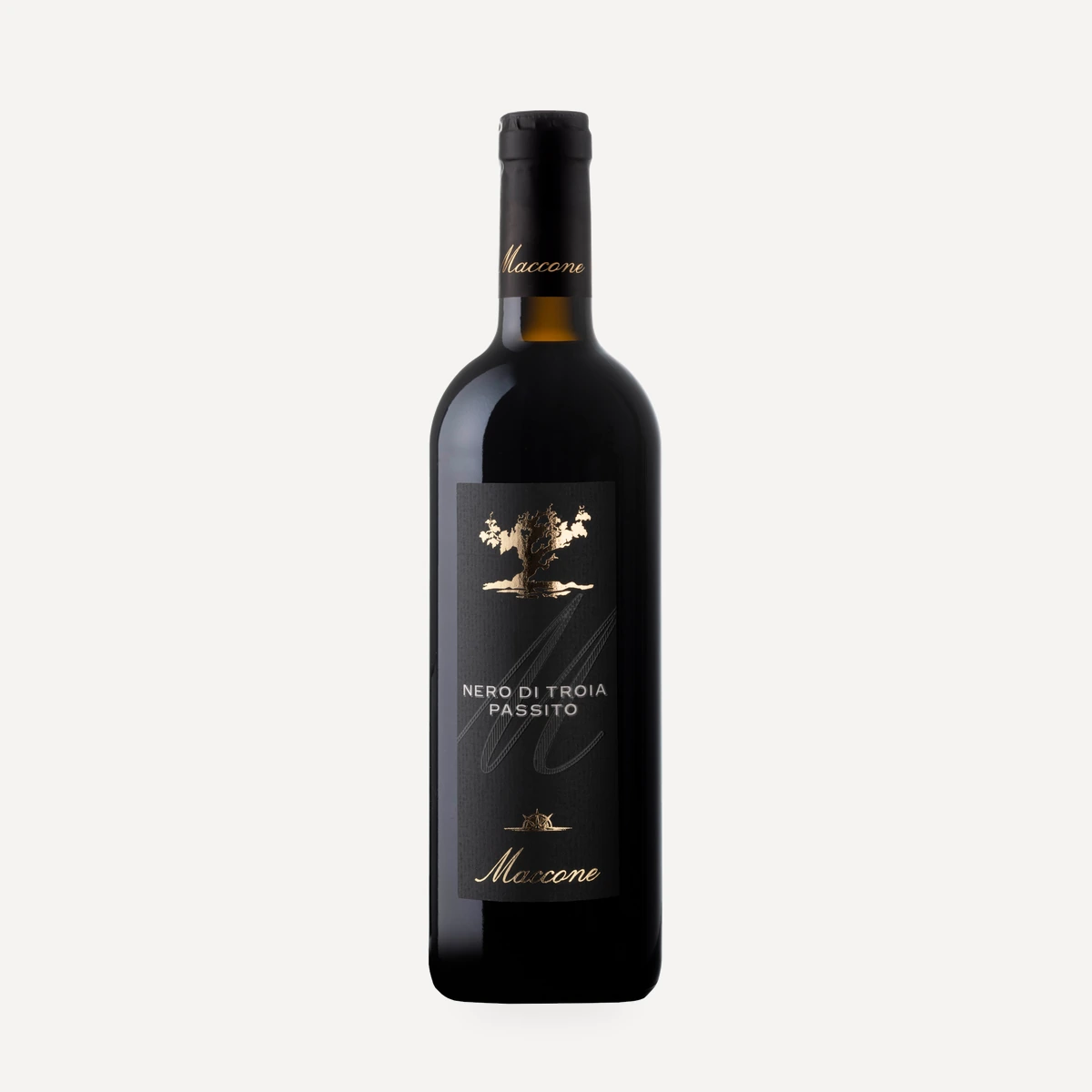
Questo vino
Vineyard and terroir
Uva di Troia is a late-ripening native Puglian variety cultivated in the Murgia Barese and northern Puglia. It can struggle to reach full maturity in difficult seasons, while a dry, ventilated beginning to autumn favors high-quality fruit.
The current vineyard information places the vines in contrada Torre Quadra, in the Agro di Mariotto, on clay soil. They are trained to the traditional Puglian pergola and dry-farmed. The vineyard selected for the 2019 wine was instead in contrada Rogadeo, also in the Agro di Mariotto, at approximately 400 metres above sea level. Its deep, fertile clay soil supported a low, non-irrigated espalier vineyard planted in 1990, at 3,500 vines per hectare and a yield of approximately 60–80 quintals per hectare.
Grapes
100% Uva di Troia, also identified as Nero di Troia.
Vinification
Harvest is manual and scheduled by following the fruit's ripening curves. The grapes are selected again upon arrival at the winery before crushing. Fermentation takes place at controlled temperature in small stainless-steel fermenters, with frequent manual punch-downs. The current specification gives skin contact of more than 20 days.
For the 2019 wine, healthy, dry and overripe bunches were carefully selected in the vineyard and harvested into small crates from 14 October. The grapes had already begun to dry on the vine and measured 25° Babo. They then continued drying outdoors in crates for another two months. Crushing took place at the end of December, followed by approximately one month of fermentation and more than 30 days of maceration on the skins. Fermentation stopped naturally at 14.5% alcohol, leaving approximately 100 g/L of residual sugar.
The 2019 wine received coarse filtration in spring after malolactic fermentation, followed by sterile filtration before bottling. Depth membrane filtration was performed at low pressure, 0.3 bar.
Ageing
The 2019 wine matured in stainless steel for approximately 12 months before release.
Technical data
The current specification gives an alcohol level of 16% vol. The 2019 analytical values are 14.5% vol. alcohol, 7.8 g/L total acidity, pH 3.80, approximately 100 g/L residual sugar and 54 g/L net dry extract.
Tasting profile
Ruby red in color. The nose recalls red and black forest fruits. The palate is soft and balanced, with dense tannins. The 2019 wine combines sweetness with a savory, balanced structure, concentrated but refined tannins, wild-fruit and jam-like aromas, and retained acidity despite the overripeness of the grapes.
Serving and pairing
Serve at 16–18°C in a small wine glass. Pair with dry pastries, chocolate desserts, or desserts featuring red and black berries.
Vintage notes
The 2019 season enabled the first documented production of this passito. Dry, ventilated weather between mid-September and mid-October allowed the grapes to reach exceptional maturity. Harvest began on 14 October, and the fruit continued drying in outdoor crates for two months. The 2019 wine differs from the current specification in vineyard location and training system, classification, alcohol, and stated maceration time.
Both the 2019 and 2020 harvests achieved particularly high levels of grape maturity.
Label / history
The project developed from long-term study of Uva di Troia vineyards, old plantings and local clones around Castel del Monte. In 2018, naturally drying bunches were found in an old, low-yielding pergola vineyard on a hilltop. Their concentration of anthocyanins, tannins and extract, together with good acidity, inspired an experiment with a sweet, crate-dried Nero di Troia.
The family's grandparents had cultivated small proportions of the variety in bush-trained vineyards, although it was then valued mainly for productivity. Collaboration with experienced local growers later made it possible to examine numerous vineyards and select suitable fruit for this passito project.