France plans nationwide Pomme vineyard-surveillance rollout for 2027
Following trials in 8 wine regions in 2026, France expects to make Pomme available for vineyard scouting in 2027. The platform is intended to organize inspections, capture field observations and accelerate the sharing of data used against flavescence dorée.
A national field-surveillance platform
French researchers and vineyard organizations are preparing a national rollout of Pomme, a digital surveillance tool for flavescence dorée developed under the National Vineyard Sustainability Plan. Expected to become available for vineyard scouting in 2027, the project was initiated by Gdon des Bordeaux and developed with partners in Bordeaux and Alsace.1
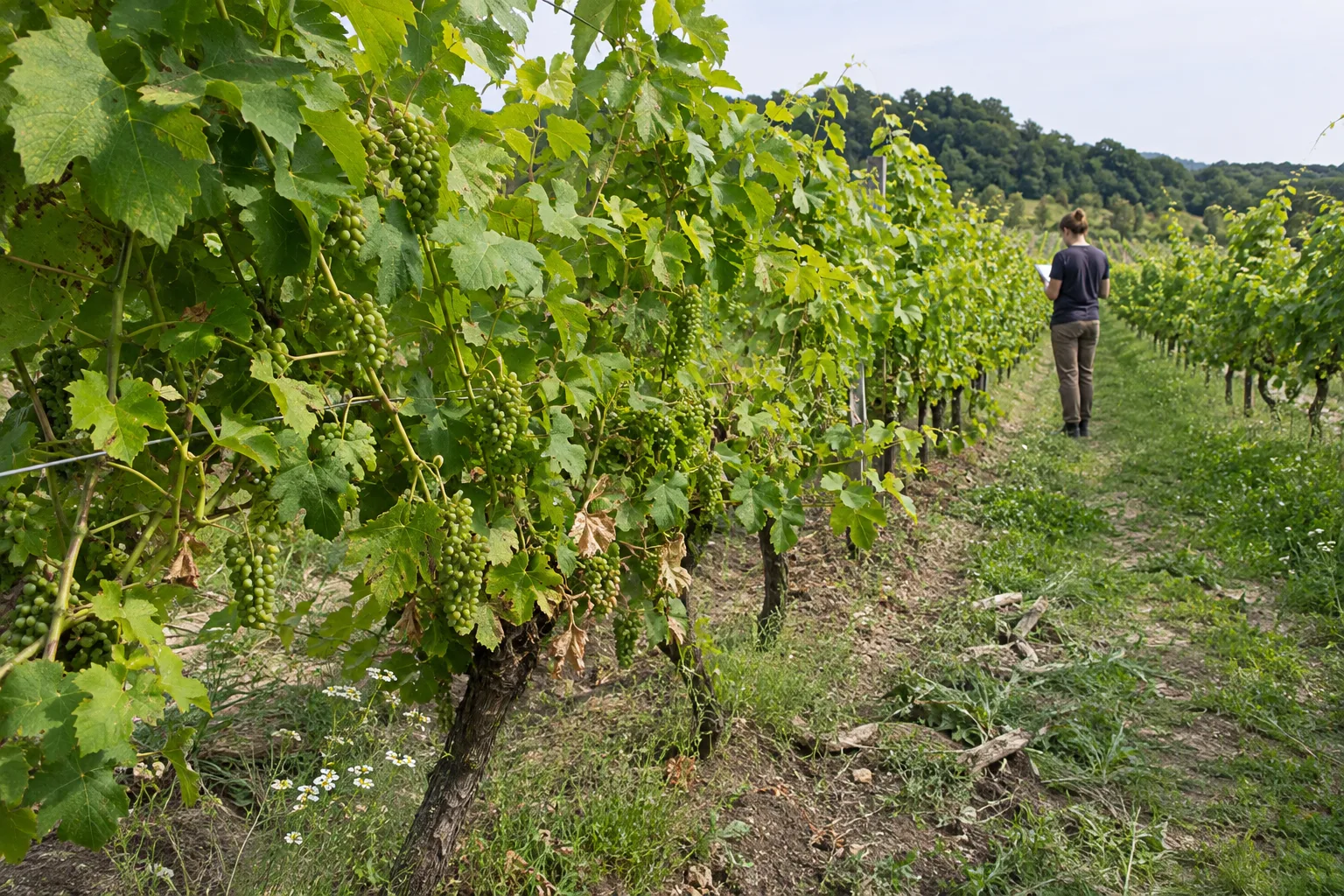
Pomme allows users to plan inspections, map vineyard blocks and scouting areas, register teams and record observations in the field. Sophie Bentéjac, director of Gdon des Bordeaux, said paper maps are still used in some areas, slowing data entry and making information less reliable and harder to share or analyze.1
A PC version has been tested since 2025. Trials covered 5 wine-growing areas in 2025 and expanded in 2026 to 8: Bordeaux, Bergerac-Duras, the Loire, Alsace, Burgundy, Charentes, Beaujolais and Pyrénées-Atlantiques. Connected smartphone and tablet versions were also being tested in 2026, while an offline mobile version was under development for vineyards with weak or absent network coverage. The French Vine and Wine Institute, or IFV, is expected to provide training resources for users.1
Why faster detection matters
Flavescence dorée is a quarantine grapevine disease transmitted by a leafhopper. French control measures combine hot-water treatment of planting material, vineyard inspections, management of the insect vector and removal of symptomatic vines. Rapid identification and removal of infected plants, supported by faster handling of field data, are considered important for limiting its spread.1
More timely and reliable surveillance could let producers target control measures more efficiently and reduce losses to yields and grape supplies. Shared data could also encourage more consistent decisions among wine regions supplying the wider beverage industry.1
Mapping infection risk
National observations entered through Pomme are to be sent to France’s plant-health epidemiological surveillance platform, giving researchers information in real time. The data could extend INRAE’s work on the biological and environmental conditions that shape infection risk within individual vineyard parcels.1
INRAE analyzed Gdon des Bordeaux scouting records collected from 2012 to 2016 across 89,000 hectares in 350 municipalities. Its model identified 9 parcel characteristics and 6 landscape variables associated with risk. Grape variety was significant: Merlot was 2 times as sensitive as Cabernet Sauvignon, Cabernet Franc or Muscadelle. Risk decreased with altitude, while wetlands near waterways were more favorable to the disease and its vector; proximity to forests and urbanized areas was also associated with higher risk.1
Frédéric Fabre of INRAE said areas near forests and urban development often contain rootstock regrowth that may harbor leafhoppers and phytoplasmas, while vineyards near towns may receive less treatment. A large proportion of vineyard land within 150 to 200 meters was associated with lower risk, possibly because of stronger insecticide coverage or dilution of infection pressure. On average, 50% of new infections occurred within 10 meters of a source vine and 80% within 22 meters.1
The historical records also supported a forecasting model for flavescence dorée. In tests identifying municipalities where more than 10% of parcels were infected, it achieved 89% sensitivity but 50% precision: it detected most municipalities above the threshold, yet only 50% of those flagged actually exceeded it. Fabre called this a proof of concept that still requires improvement. The longer-term objective is to combine data across successive years and automatically produce maps that guide inspections without displacing the judgment of field technicians.1
Innova-Vigne extends the work
Development will continue through Innova-Vigne, an IFV-led project funded by Parsada and scheduled for 2026–2031. It seeks pest-management strategies without synthetic insecticides by combining early detection, alternative controls and targeted prevention. Alongside completion of Pomme, planned additions include leafhopper counts, checks that vines have been removed, verification of treatments and monitoring of emerging threats.1
New diagnostic methods
At IFV Grau-du-Roi, researchers are testing PCR analysis of wood samples for the phytoplasma associated with black wood disease. Anastasia Rocque of IFV said the method could also detect the flavescence dorée phytoplasma in principle, but it is much less sensitive than testing leaves. Because flavescence dorée is a quarantine disease, formal confirmation will still require a leaf test. Wood testing could nevertheless be useful outside the growing season, when leaves are unavailable, and Rocque said this work is nearing completion.1
Innova-Vigne also plans to study a molecular assay that could be performed in the vineyard in less than 1 hour. Rocque said it could shorten detection times and improve scouting efficiency, with initial trials potentially taking place in 2028 and 2029.1
No complete short-term insecticide replacement
Researchers say no short-term alternative currently provides the leafhopper control achieved with insecticides, a particular difficulty for organic production. France has authorized 2 biological-control products: Pyrévert, whose effectiveness is variable, and Lumière, authorized since 2024. IFV recommends applying Lumière together with Pyrévert and advises against depending on Lumière in areas where only 1 treatment is allowed.1
Trials have examined removal with pressurized water, mechanical bark stripping, calcium dihydroxide, mineral oil and glue. Audrey Petit of IFV said none has yet eliminated leafhoppers completely, while their cost-benefit balance and practical usability remain unfavorable for deployment at scale. Innova-Vigne will conduct further trials of insecticide alternatives. INRAE is separately investigating whether transmission can be disrupted through the pathogen’s surface proteins and the insect genes involved in its attachment and entry into the leafhopper.1
Sources
Written by the Dionysus editors from the sources above.