IRTA tests AI vineyard yield forecasting at Raimat
The YIELD4CAST project is combining crop models with satellite, drone and field-sensor data to forecast grape production earlier and assess how water scarcity, heat waves and other weather conditions affect vineyards.
Trials begin at Raimat
The Institute of Agrifood Research and Technology, IRTA, said on November 27, 2026, that it had begun vineyard trials at Raimat using artificial intelligence, field sensors and remote sensing to improve grape-harvest forecasts amid tighter water supplies and more frequent heat stress. The work forms part of YIELD4CAST, a project intended to predict production earlier and more accurately and measure the effects of water scarcity and weather on yields.1
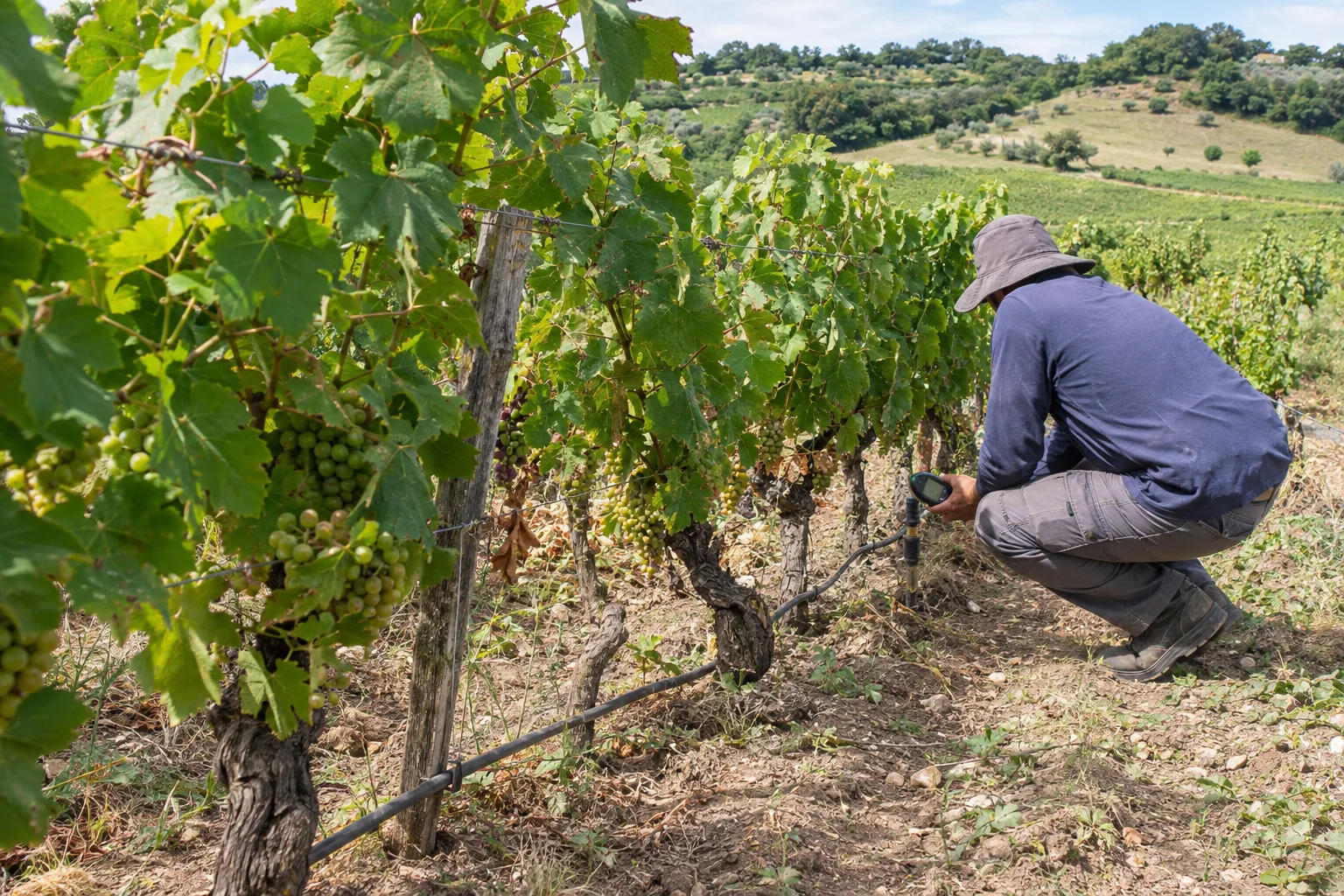
During the initial trials on a Raimat estate, researchers installed sensors to monitor soil, vines and surrounding environmental conditions. Drone flights used thermal and multispectral cameras, while instrumented ground vehicles gathered detailed information about vine condition and output.1
Forecasting from plot to territory
YIELD4CAST integrates agronomic crop models with observations from satellites, drones and field equipment. IRTA aims to develop tools capable of estimating output both for individual plots and for larger production areas, while providing growers with information about vineyard conditions during the season instead of only at harvest.1
The collected data will be used to develop and validate models for forecasting harvest size and assessing how water availability and heat waves influence vineyard performance. The planned tools are also expected to estimate plant water status, vegetative growth and crop load, measurements relevant to farm planning and irrigation management.1
Climate scenarios and real-time estimates
Jordi Gené, a researcher in IRTA’s efficient water use program, said the project connects agronomic knowledge embedded in crop models with satellite and field-sensor information. According to Gené, this combination can support real-time production estimates and tests of how different climate scenarios could alter a harvest.1
The research seeks to improve on conventional field estimates, which can be slower and less precise when conditions change rapidly. If the models work as intended, growers could follow crop development more closely during the season and examine how different climate pressures might change production outcomes.1
Research partnership and open science
Part of the project is being conducted with Raimat through the joint IRTA–Raventós Codorníu unit, a wine-sector research and innovation partnership. Other participants include Vicent Altava of the Meteorological Service of Catalonia, a specialist in meteorology and climate projections, and Enrique Moltó of the Valencian Institute for Agricultural Research, whose expertise covers precision agriculture and woody crops.1
IRTA said YIELD4CAST is intended to generate models, methods and technical knowledge that can be shared with scientists and the wider agrifood sector under open-science principles.1
Potential uses for wineries and growers
More reliable vineyard forecasts could help wineries plan harvest logistics, tank capacity, labor and grape purchases with less uncertainty. Estimates of vine water stress could also inform irrigation decisions as drought becomes a more significant commercial risk for wine production.1
The project belongs to a broader movement toward data-led agricultural management in crops exposed to volatile weather. In vineyards, changes in water availability or temperature can influence grape volume, ripening speed and harvest timing, increasing the value of earlier and more dependable forecasts.1
IRTA gave no timetable for broader deployment of the forecasting tools. It said, however, that the project is working toward scalable methods suitable for farm and territorial applications, potentially making them relevant to individual vineyards, cooperatives, wine groups and regional planners managing water and production risks over larger areas.1
Sources
Written by the Dionysus editors from the sources above.