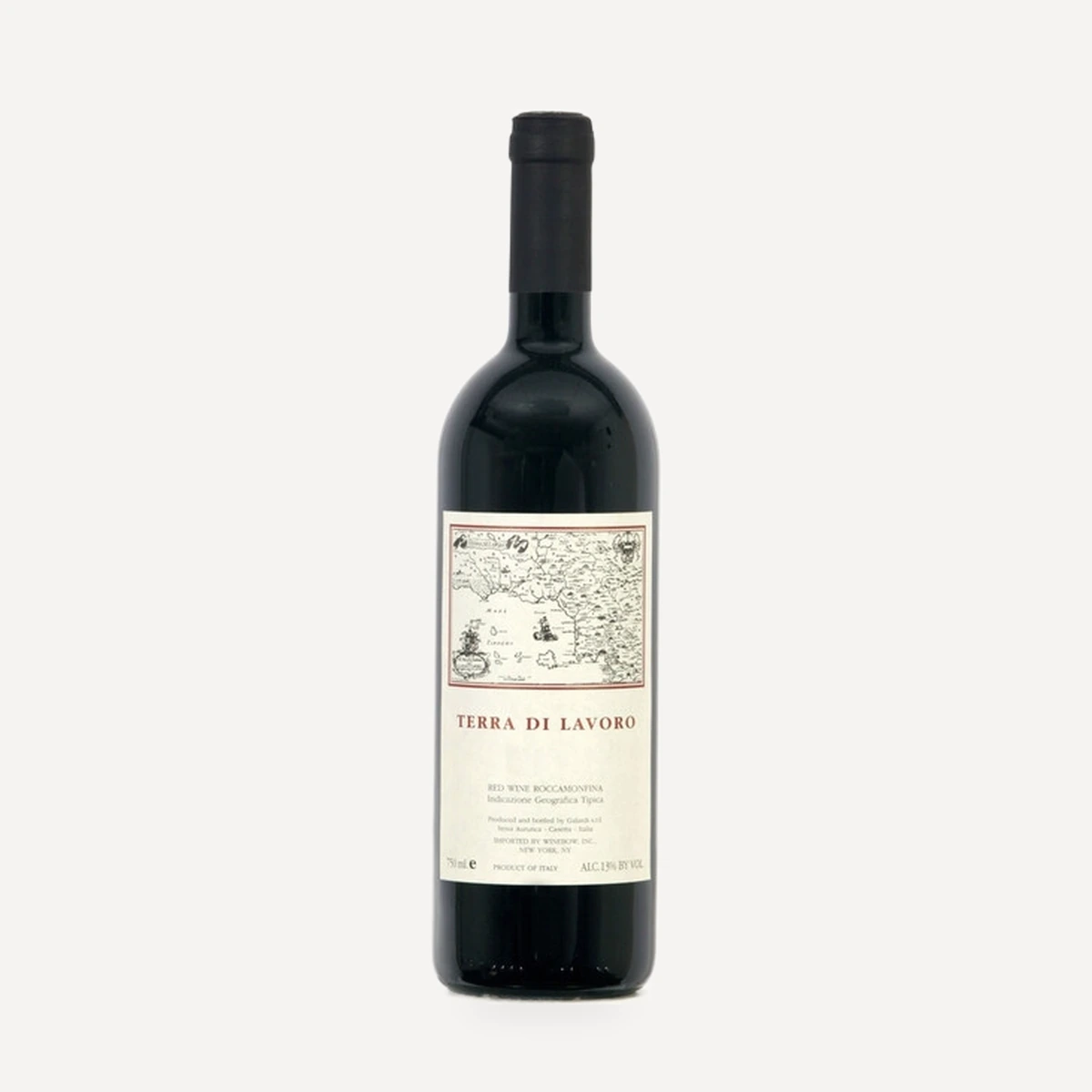
About this wine
Vineyard and terroir
The 9-hectare production area lies at S. Carlo di Sessa Aurunca, approximately 500 metres above sea level on the slopes of the extinct Roccamonfina volcano. The vineyards face south-west towards the Gulf of Gaeta, whose cool, persistent breezes moderate the site, particularly during wet seasons.
Roccamonfina was active between approximately 630,000 and 50,000 years ago. Its earlier activity produced leucite-bearing lava and its later phase basaltic lava. The resulting rocky soils are rich in silt, clay and mineral salts and act as conduits for underground springs. These water reserves allow the vines to be grown without irrigation.
Olive groves, fruit trees, spontaneous vegetation and extensive chestnut woods surround the vineyards. Grass cover and green manure are used to maintain fertility, and vineyard work follows organic-farming principles. The vines are trained to spurred cordon at a density of 4,500 vines per hectare. For the 2022 vintage, 75% of the producing vines were 22–25 years old, 20% were 14–18 years old and 5% were six years old. Production was 5,000 kg per hectare, with a wine yield of 60%.
Canopy management and selection respond to the season. Hot years call for less leaf removal and stricter selection near harvest when bunches become excessively concentrated. Wet years require more vineyard cleaning and green pruning to manage humidity. Bunch selection is central to the vineyard work; the site description records one bunch per vine and four to six bunches per plant.
Grapes
Latest published vintage (2022): 80% Aglianico and 20% Piedirosso.
Vinification
The wine remains in contact with the skins for approximately 20 days. The cap is submerged regularly: the general cellar description specifies twice daily, while the 2022 technical data says several times per day. Malolactic fermentation is completed in stainless steel, with its duration varying from vintage to vintage. The winemaking approach is described as non-invasive.
Ageing
Final maturation lasts approximately 12 months in French oak barriques. Forty percent of the barrels are new; the remainder are second- and third-use. The 2022 technical data identifies the new barrels as Allier and Nevers oak.
At bottling, the bottles are placed upright to help the wine settle. The English page specifies another 12 months of bottle maturation, whereas the Italian page specifies 18 months. A small quantity is bottled in magnum and double-magnum formats, with the large-format bottles numbered by hand.
Technical data
For 2022: 13.5% alcohol, total acidity of 4.1 g/L, pH 3.78 and net dry extract of 32.1 g/L. Production comprised 24,500 Bordeaux bottles, 250 magnums and 100 double magnums.
Tasting profile
Terra di Lavoro has a deep, impenetrable ruby colour whose nuances vary with the season: warmer vintages develop garnet notes, while rainy years tend towards violet.
The climatic character remains perceptible on both nose and palate. Sunny vintages initially emphasize black fruit, followed as the wine opens by balsamic and volcanic notes. Cooler, wetter years reveal graphite, metallic tones and leather more immediately, followed by eucalyptus and liquorice. Rainy, cool vintages tend towards softness, elegance and balance; warmer years show greater tannic presence and a long finish. Across the variations, the tannins remain soft, freshness is evident, and the palate is broad and enveloping.
With bottle age, the profile develops associations with the surrounding landscape: undergrowth, chestnuts and fallen olives. The wine is intended for long ageing.
Vintage notes
The 2022 season was dominated by sunshine, heat and prolonged drought. Budbreak, flowering and véraison were early, but the grapes ultimately ripened slowly. Underground water within the volcanic terrain sustained the vines without irrigation. After an initial thinning, a further selection was made in the vineyard. Harvest began on 5 October, later than initially expected. The technical data also prints the harvest dates as “35, 11, 12, 14 and 15 October”; the first figure is anomalous in the published text.
Tasted in February 2025, the 2022 showed an impenetrable colour with a ruby rim and little of the violet tone associated with wetter years. The warm season appeared immediately on the nose alongside a distinctive cherry note. Leather and chocolate emerged after time in the glass, followed by further aromatic layers. The palate was notably youthful, with red fruit shading towards woodland berries, then balsamic and metallic notes. Its finish was exceptionally long. It was expected to have substantial ageing potential but still required additional bottle maturation to gain balance while retaining its broad complexity.