History
Family roots: mid-nineteenth century to 1977
The family’s connection with the Roccamonfina volcano began in the second half of the nineteenth century. Pasquale Galdieri acquired several hectares of oak woodland, a farm and a palazzo on the volcano. He converted the oak woods into chestnut groves and diversified the property by planting olive trees.
In 1943, German forces occupied the palazzo as their headquarters and subsequently blew it up when American forces arrived. Pasquale’s daughter Virginia and her husband, Guido Bartoli, then converted the Vallemarina farm into a country residence capable of accommodating their large family.
In 1977, Roberto Selvaggi visited the family and met Maria Luisa Murena, a great-granddaughter of the last finance minister of the Kingdom of the Two Sicilies. Family memories and documents preserved in the house prompted Roberto to begin a long study of Southern Italian history and the Bourbon Kingdom.
From an experiment to Galardi: 1990–1994
Roberto, an admirer of Bordeaux wines, set out to make a high-quality red wine. A half-hectare parcel on the Bartoli property was then planted with non-native vines. He involved his wife Maria Luisa and the cousins Arturo Celentano, Dora Catello and Francesco Catello in the project, and persuaded oenologist Riccardo Cotarella to assess the potential of this little-known and difficult-to-reach place.
Cotarella decided to graft the half-hectare parcel with the Campanian varieties Aglianico and Piedirosso. Galardi was formally created in 1991. It initially operated as a family pastime: its participants came from different professions and worked in the vineyard during weekends and other free time. A grotto beneath the Vallemarina property, previously used for dances and parties, was converted into the cellar.
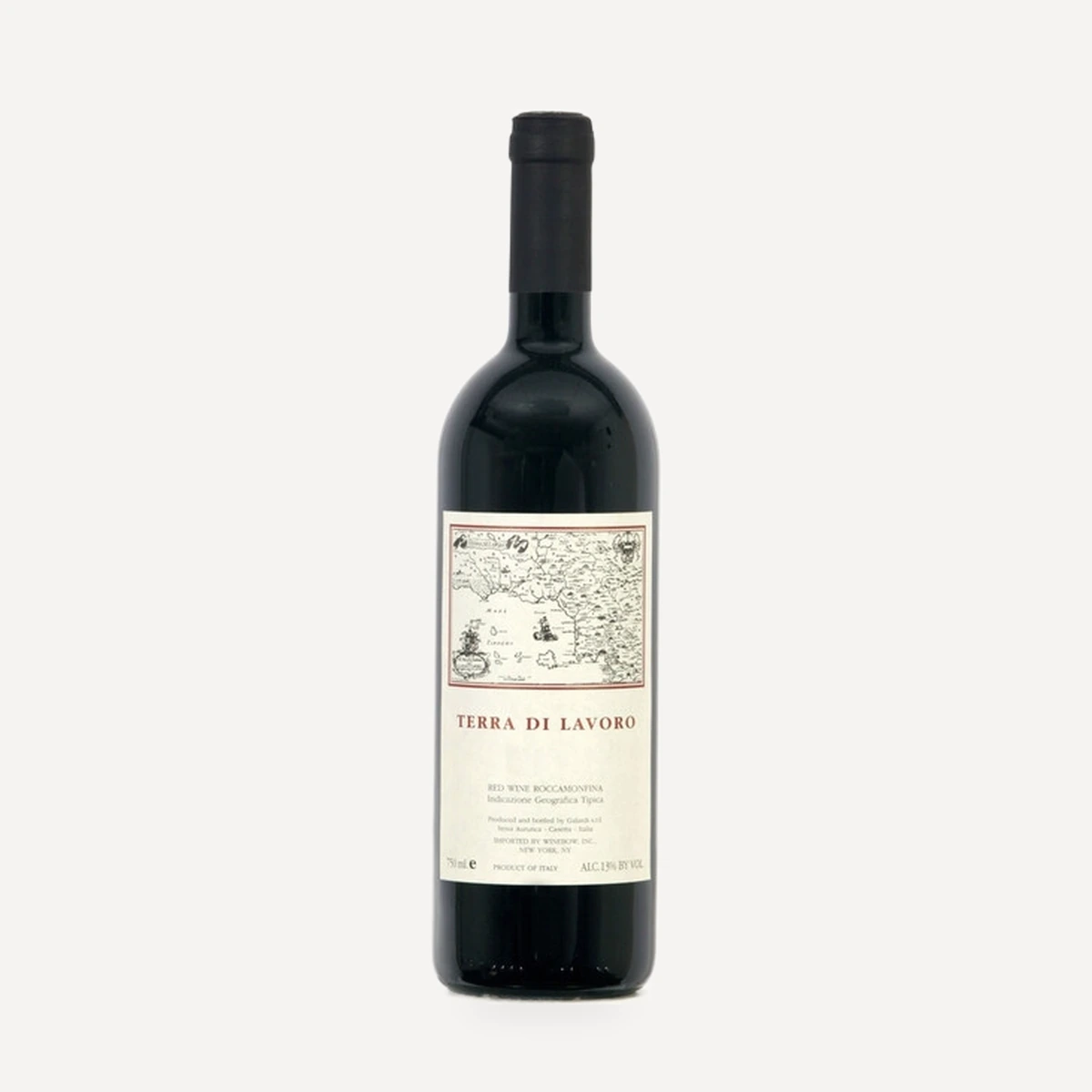
Terra di Lavoro’s first harvest took place in 1994 and yielded 500 bottles. Roberto chose both the name and the label as expressions of his attachment to Southern Italy. At Galardi’s first Vinitaly two years later, the entire production was purchased for the American market. The same happened the following year with the 1995 vintage, establishing immediate overseas demand.
Organic certification and vineyard growth: 1997–2002
By 1997, the vineyards covered 4 ha and Galardi obtained organic certification. Terra di Lavoro began receiving Italian and international recognition in 1999, leading the family to concentrate entirely on that single wine. The estate invested in modern equipment while preserving labor-intensive details such as wax seals and hand-numbered bottles.
Magnums were introduced in 1999 and double magnums in 2002. The vineyard holding expanded to 7.5 ha in 2001.
Recognition and consolidation: 2003–2017
In 2003, Robert Parker awarded 99 points to the 2001 Terra di Lavoro. Roberto Selvaggi had died a few years before the announcement, but his wife and cousins continued to commemorate his foresight in recognizing Galardi’s potential.
Further recognition followed. Several guides selected the 2003 Terra di Lavoro as Italy’s best wine, it received Luigi Veronelli’s highest distinction, and Gambero Rosso’s Slow Wine Guide characterized the project as “One Love. One Wine.” In 2008, Galardi consolidated its vineyards at 9.5 ha. In 2012, Wine Spectator placed Galardi among its 100 leading Italian producers.
Second-generation management: 2018–2023
In 2018, Roberto’s daughter Allegra Selvaggi left a career outside the estate to continue her father’s undertaking. She assumed management of Galardi and became personally involved in both vineyard and cellar work.
Seeking a custodian able to provide continuity while protecting the estate’s identity, she oversaw Galardi’s entry into the Tenute Capaldo Group in 2023. Allegra remained the producer responsible for Galardi, with the declared objective of retaining the estate’s autonomy and philosophy. Riccardo Cotarella continued alongside her.
Longer bottle maturation: 2024
After evaluating the climatic character of recent vintages, Allegra concluded in 2024 that Terra di Lavoro required longer maturation in bottle. The release of the 2021 vintage was consequently postponed by one year.
Terroir
Galardi’s vineyards lie at approximately 500 m above sea level on the slopes of the extinct Roccamonfina volcano. They face south-west towards the Gulf of Gaeta.
Roccamonfina was active between approximately 630,000 and 50,000 years ago. Its first phase emitted leucite-bearing lava, while the second and final phase produced basaltic lava. The resulting soils are fertile and rich in mineral salts, with substantial silt and clay. Their rocky structure channels water from springs created by the volcanic formations, giving the vines access to subsurface moisture during drought and allowing the vineyards to be farmed without irrigation.
The maritime exposure brings a strong, constant current of cool air from the Gulf. This natural ventilation is particularly valuable in rainy seasons because it dries leaves and bunches and reduces humidity-related pressure.
The vineyards form part of a diverse agricultural and woodland environment that includes olive groves, fruit and cherry trees, spontaneous vegetation, oak woods and extensive chestnut groves. The chestnut woods contribute organic matter and nutrients to the already fertile soils. Seasonal reports also record wildflowers, poppies, dandelions, mallow, Judas trees, mimosa, wild strawberries, birds of prey and bees within or around the vineyard landscape.
Conditions vary markedly between vintages. Hot seasons can bring prolonged drought and high concentration, while wet seasons intensify humidity and disease pressure. The volcanic subsoil’s water reserves and the wind from the Gulf moderate these extremes, but vineyard work and crop selection are adjusted to each season.
Winemaking
Galardi has followed organic principles from the beginning and obtained organic certification in 1997. Vineyard management is based on close observation of each growing season, precision work and sacrificing volume in favor of grape quality.
The vines are spur-pruned cordon trained. Permanent or managed grassing and green manure are used to sustain soil fertility. Mulchers and tillers are alternated when cleaning the soil and spaces between rows. The vineyards are not irrigated because roots can draw on the volcanic subsoil’s natural springs.
Canopy and crop management change with the weather. Defoliation is reduced in hot years to shield fruit, while concentrated or heavily loaded bunches are selected closer to harvest. Wet years demand more cleaning, green pruning, canopy thinning and repeated bunch selection to manage humidity and remove damaged fruit. The cool wind from the Gulf helps dry the canopy. The estate describes bunch selection as a central tool for preserving grape quality and keeping yields deliberately low.
Copper and sulphur treatments are adapted to temperature, rainfall and disease pressure. Small quantities were sufficient during the balanced 2019 season, although sulphur was increased slightly when moisture rose. In dry, hot conditions sulphur is reduced to avoid burning the leaves. During 2021, humidity and powdery-mildew pressure required particular vigilance. In 2018, persistent rain led to intensive mulching, tilling, defoliation and extreme crop selection.
A 2020 composting experiment attempted to recycle vine and chestnut prunings in composters near the vineyards, but the material remained too dry and the trial was abandoned for that season. A biostimulant was introduced during the dry 2022 season to support the vines and produced a favorable vegetative response.
Harvest timing follows ripeness and weather rather than a fixed calendar. Recent harvests have ranged from late September to mid-October. Selection may continue repeatedly up to picking, particularly in rainy or excessively productive years. The estate accepts reduced quantities when required to bring only suitable grapes into the cellar.
The original cellar was created by converting a grotto beneath the Vallemarina property that the family had once used for dances and parties. The historic grotto continues to provide a naturally stable temperature for storing and maturing bottles.
Cellar work is conceived as non-invasive. Fermentation proceeds with approximately 20 days of skin contact. The cap is punched down twice daily in the general production description, while the vintage technical sheets describe repeated punch-downs during the day. After alcoholic fermentation, malolactic fermentation develops fully in stainless-steel tanks; its duration varies from vintage to vintage.
Final barrel maturation lasts approximately 12 months in French oak barriques. Forty percent are new, with the remaining 60% made up of second- and third-use barrels. The technical sheets identify Allier and “Never” as the oak origins.
At bottling, the Bordeaux-format bottles are initially kept upright to allow the wine to settle. They are then retained for extended bottle maturation before release. The Italian production text gives this period as a further 18 months. A small allocation is bottled in magnums and double magnums, traditionally numbered by hand; wax sealing and hand numbering were established as quality details during the estate’s early development. In 2024, bottle maturation was lengthened further for the 2021 release.
Output varies substantially with the season and the severity of vineyard selection. The general production level is approximately 20,000 bottles. Recent examples range from 12,000 standard bottles in 2021 to 24,500 in 2022, supplemented by small quantities of magnums and double magnums.
Philosophy
Galardi’s founding commitment is to restore dignity and pride to its land and transmit its historical memory to later generations. Its contemporary goal is to make a wine capable of reaching beyond familiar conventions, regions and grape varieties while conveying an authentic connection to place.
Three linked ideas structure this philosophy. Terra represents land as something to preserve: volcanic soils, subsurface water, maritime wind and surrounding biodiversity are treated as the foundation of the project. Lavoro represents the exacting labor required to care for that land, including the deliberate surrender of volume in favor of quality. History connects the estate with the former province of Terra di Lavoro and Roberto Selvaggi’s study of Southern Italy and the Kingdom of the Two Sicilies.
Climate is treated as an adviser rather than a template to be overridden. Vineyard operations change in response to drought, rain, humidity and ripening conditions, while cellar intervention remains restrained. Vintage differences are therefore allowed to remain perceptible.
The second generation presents itself as the custodian of Roberto’s undertaking. Joining the Tenute Capaldo Group was intended to secure continuity without relinquishing Galardi’s autonomy or its established philosophy. The decision to delay the 2021 release illustrates the priority assigned to maturation and readiness over a fixed commercial schedule.
Wines