History
Reconsidering Montepulciano in Piceno
Oasi degli Angeli developed in Piceno, in the southern part of Marche near Abruzzo. The surrounding agricultural area had experienced abandonment and was associated with low-quality production. Local Montepulciano was regarded as a grape with unrealized potential: earlier examples were often austere and lacked precision.
Marco Casolanetti began by studying the land and observing how its vines responded to changes in vineyard management. He invested his resources in the vineyard and pursued a model based on exceptionally dense planting, the traditional gobelet form of alberello training and extremely low yields. In the cellar, he adopted an approach directed toward extraction and longevity.
The emergence of Kurni
Kurni became the estate’s pioneering wine and was initially made solely from Montepulciano grown across the property’s approximately 10.1 ha of vines. The first releases immediately attracted both consumers and wine critics. For a period, Kurni was the only wine made by Oasi degli Angeli; the range was subsequently broadened.
The estate’s work also had a wider local effect. Its example encouraged younger Piceno producers who had considered abandoning winemaking. This renewed confidence contributed to the formation of Piceni Invisibili, a group created to promote Piceno through its wines.
A broader agricultural and hospitality project
Marco Casolanetti and Eleonora Rossi later expanded Oasi degli Angeli beyond wine. They established a small hotel and restaurant and cultivated vegetables, olives and fruit for friends and guests. These activities formed part of a wider model connecting agriculture, hospitality and the local economy.
Terroir
Oasi degli Angeli lies in Piceno, a narrow, hilly part of Marche close to the Adriatic Sea and the Abruzzo border. The terrain rises quickly inland from the coast. Vineyards occupy a mixed agricultural landscape of olive groves, wheat fields and fruit trees.
Saline breezes arrive from the Adriatic, while the area’s gentle hills provide protection. Clay is the predominant soil component. It can give Montepulciano substantial structure, making vineyard and cellar decisions important to maintaining balance and preventing power from overwhelming elegance.
Winemaking
Oasi degli Angeli is operated biodynamically, linking the character of harvested fruit closely to the natural conditions of each season. The vines were also described as being cultivated without chemical inputs.
Marco Casolanetti’s work began with close observation of the land and of vine responses to changes in vineyard management. The viticultural system combines approximately 15,000 vines per hectare with traditional gobelet training and yields of about 0.23 kg per vine. This high-density, very-low-yield model concentrates production in individual plants while preserving an old alberello form.
The cellar approach was developed to emphasize extraction, longevity and the expression of vintage variation. Because the estate works biodynamically, differences among growing seasons remain a determining influence on the fruit entering the cellar.
Philosophy
The estate’s approach begins with the close study of land, vines and their responses to changes in vineyard management. Its dense planting, traditional gobelet training, very low yields and biodynamic farming place the vineyard at the center of quality and preserve the influence of individual growing seasons.
Oasi degli Angeli also developed as more than a wine project. The addition of accommodation, a restaurant and diversified food crops connected agriculture with hospitality and proposed a broader model for the local economy. Its influence extended to younger Piceno growers, helping restore confidence in the area’s capacity to produce ambitious wines.
Wines
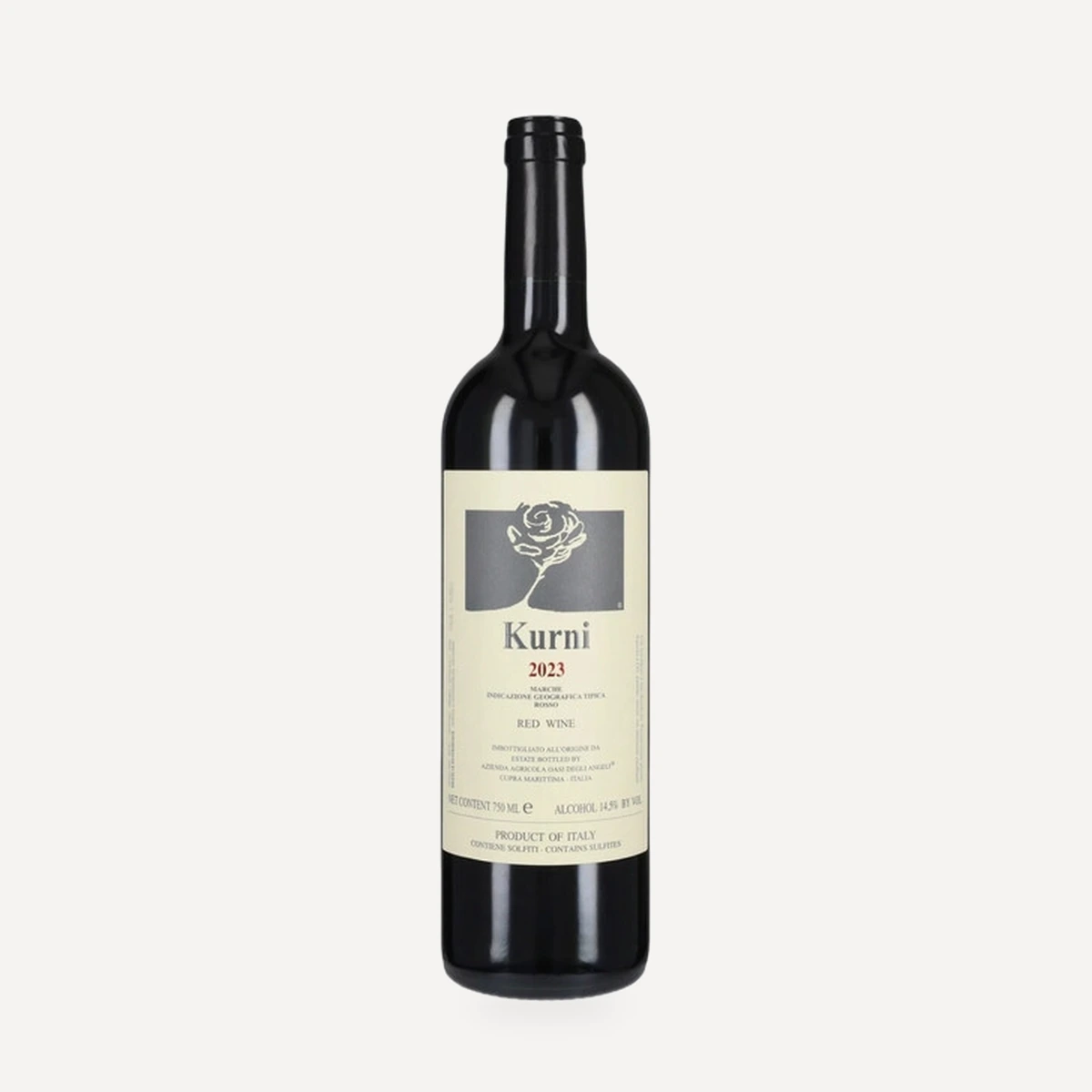
Kurni Marche Rosso IGT