History
A family estate in Apiro
The Felici family has cultivated hillside vineyards between Apiro and Cupramontana for generations. Andrea Felici established the foundations of the modern family business and remained closely associated with the work in the vineyards. The estate is now led by his son, Leopardo “Leo” Felici, the fourth generation of the family to work as winegrowers.
Leopardo Felici’s return
Before assuming responsibility for the estate, Leopardo worked as a sommelier in London and Italy, culminating in a position at Enoteca Pinchiorri. His experience beyond Marche exposed him to Chablis and white Burgundy and strengthened his interest in mineral, terroir-focused white wines. Around 2006, he ended his career in high-level restaurant service and returned to his family home in the countryside to continue the family activity and pursue his aim of producing a Verdicchio with a distinct identity. Andrea transferred control only after Leopardo had gained this wider understanding of wine.
The transition was initially challenging because Leopardo lacked practical experience. His work subsequently became more assured, combining meticulous vineyard management, winemaking, and communication. Oenologist Aroldo Belelli supported the production during this phase.
Vineyard development
By 2007, propagation material from the approximately 50-year-old San Francesco vineyard had been used for new plantings. In 2012, the operation comprised 6 ha and produced approximately 35,000 bottles. Four hectares of owned vineyards lay in Contrada San Francesco at around 400 m, surrounded by woods beneath Monte San Vicino; additional vineyards were leased at Cà di Chiocco and near Cupra. By 2014, the cultivated area had reached 9 ha, while annual production remained approximately 35,000 bottles.
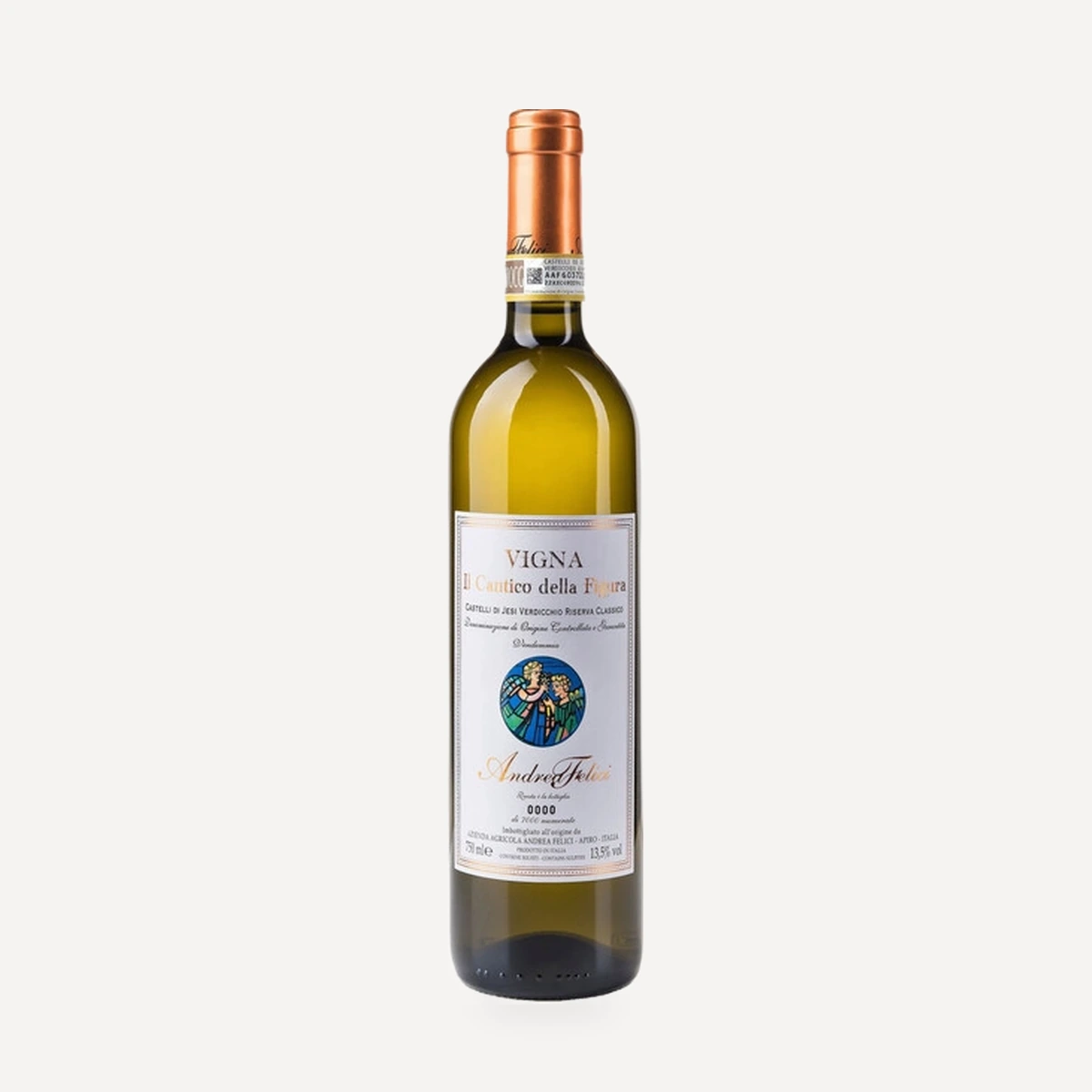
The estate subsequently expanded to 10 ha of vineyards. Its modern presentation identifies Leopardo as Andrea’s son and the family’s fourth generation of winegrowers. The range was deliberately concentrated on two Verdicchio expressions: the multi-vineyard Andrea Felici cuvée and the single-vineyard Il Cantico della Figura from San Francesco.
Recognition and consolidation
Slow Wine awarded the estate its Snail for the 2018 edition. In 2020, Gambero Rosso named Leopardo Felici Winemaker of the Year. The family continues to frame its development as a sequence of incremental improvements in both vineyard and cellar, with Verdicchio and the Apiro landscape remaining the sole focus.
Terroir
Between the Adriatic and the Apennines
The vineyards lie in Marche between Apiro and Cupramontana, between the Adriatic Sea and the Apennines. The landscape consists of valleys that alternate between narrow and gently sloping forms, with substantial elevations, persistent air movement, and marked temperature differences.
Apiro occupies a hill at the foot of Monte San Vicino, whose summit reaches 1,479 m. The town stands at 516 m above sea level. Its green valley has steep sides patterned with woodland and vineyards. The Gran Sasso and Maiella rise toward the southern horizon, while Monte Catria defines the view to the north.
Climate
The climate is warm and temperate, with significant rainfall through the year. Mean annual temperature is approximately 13°C and average annual rainfall is 860 ml. Air currents continue throughout the year, with particularly strong temperature variations in summer and autumn. Apiro has one of the area’s highest and coolest microclimates, receiving cool air from both the Adriatic and the Apennines. Warm, sunny days followed by cool nights help retain acidity and support slow, progressive ripening.
Soils and vineyard settings
Clay-limestone soils are associated with complexity, elegance, and minerality. Individual sites vary: Madonna del Lago and San Francesco have medium-textured, predominantly calcareous soils with a substantial pebble component, while Cà di Chiocco is sandy and dominated by pebbles. The vineyards range from the wooded slopes of Contrada San Francesco to higher sites reaching approximately 600 m.
Winemaking
The vineyard is treated as the centre of the estate’s work. Management responds to the condition and needs of each site rather than following a fixed annual formula. The aim is to let each vineyard express its character without unnecessary stress and to maintain a balanced crop rather than impose extreme yield reductions. Attention extends beyond sugar accumulation to phenolic maturity.
Viticulture is certified organic. Vineyard work is manual, and fertility is maintained with natural manure and green manure. Copper and sulfur are used for plant protection, while weeds are controlled mechanically. Systemic products are avoided so that the vines retain and exercise their natural defences. Heavy winter snowfall has historically helped prevent water stress in the higher vineyards.
Preserving the ecosystem and biodiversity is intended to sustain natural equilibrium, described as homeostasis. Verdicchio is the only grape cultivated and processed. It is vigorous and relatively late ripening, favours well-exposed hills and clay-limestone soils that are not excessively dry, and follows a slow, progressive ripening cycle. This allows it to accumulate sugar while maintaining acidity even in hot years.
Harvesting is carried out exclusively by hand into small crates. The grapes are brought to the cellar and vinified within a few hours of picking.
The estate produces a deliberately concise range comprising one multi-vineyard cuvée and one single-vineyard cru. Grapes are harvested by hand into small crates and processed within hours, limiting the interval between vineyard and cellar.
Skin contact is a defining element: juice remains with the skins for several days, with a longer skin fermentation used for the single-vineyard expression. Temperature control and reductive handling are employed to limit premature oxidation while encouraging Verdicchio’s aromatic character. Both selected and indigenous yeasts have been used, and malolactic fermentation is avoided to preserve freshness and aroma.
Maturation takes place in stainless steel and vitrified cement. Oak is excluded so that it does not mask the vineyards’ identity. Ageing periods exceed the minimum appellation requirements, and contact with the lees can continue for as long as one year. The wines then rest in bottle for additional months before release. The intended result combines immediate drinkability with the structure and acidity required for development over several years.
Philosophy
The vineyard is the heart of the estate’s philosophy and the place where the family spends much of its working life. Its declared approach is to respond to each vineyard’s requirements, reveal its personality, and avoid unnecessary stress. There are no fixed rules because natural conditions and the vines’ needs change from year to year.
Crop levels are kept appropriate to the season without pursuing exaggeratedly low yields. The estate connects quality with ecological balance: certified organic farming, the preservation of biodiversity, and the maintenance of natural homeostasis are intended to support faithful expression of Apiro.
In the cellar, intervention is directed toward clarity rather than imposed flavour. Stainless steel and vitrified cement preserve site character, while oak is avoided. Long maturation is used to build longevity without obscuring Verdicchio’s typicity.
The stated objective is to produce wines defined by quality, longevity, typicity, and personality—wines that invite sensory attention and reflection as well as immediate pleasure. They are intended to be enjoyable on release but capable of reaching a further evolutionary peak after several years in bottle. Leopardo Felici summarizes his work as love joined to exacting attention to detail.
Wines