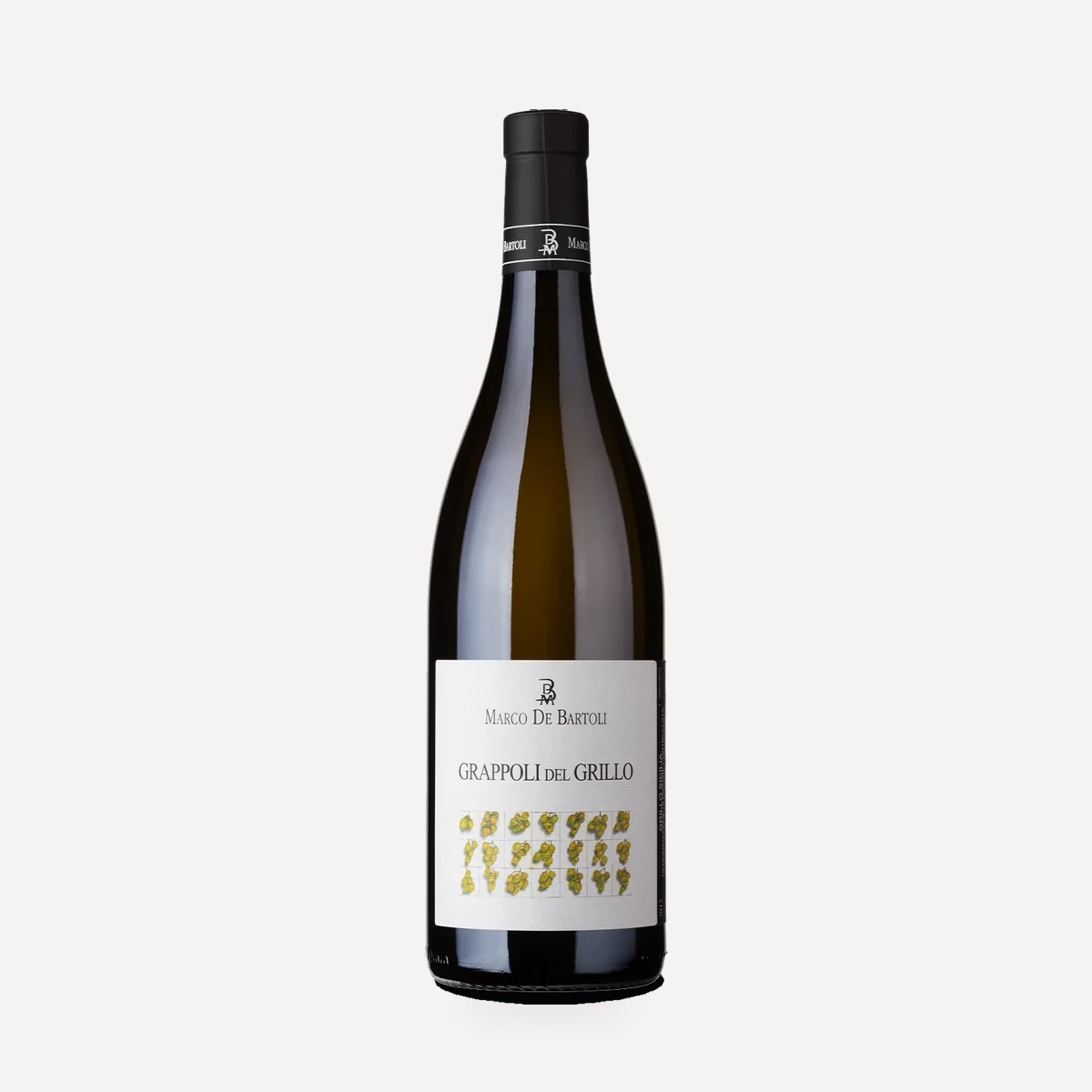
About this wine
Vineyard and terroir
The Grillo comes from a 9 ha vineyard in Contrada Samperi, Marsala, in western Sicily. The level site has limestone-rich sandy-loam soil. The 2023 technical sheet gives a vine age of 20 years, with single-Guyot training at 3,500 vines per hectare and a yield of 35 hl/ha.
Grapes
100% Grillo. Conceived in 1990 and first released from the 1991 vintage, Grappoli del Grillo was created to give an independent identity to a variety then used primarily for Marsala. It became Marco De Bartoli’s first dry table white.
Vinification
The grapes are harvested manually in the first week of September and subjected to rigorous cluster selection. After gentle pressing, the must settles naturally under cool conditions for 48 hours. The clear fraction begins fermentation with indigenous yeasts in temperature-controlled stainless-steel tanks, then completes fermentation in French-oak barrels and vats of 225, 500 and 1,000 L.
Ageing
The wine remains for 12 months on its lees in fine-grained French-oak tonneaux and 10 hl vats, with bâtonnage, followed by six months in bottle.
Technical data
The 2023 wine has 13% alcohol, 5.80 g/L acidity, pH 3.02, 1.20 g/L residual sugar and 37 mg/L total SO₂. Production was 32,600 bottles.
Serving and pairing
Serve at 10–14 °C. The wine suits strongly flavoured dishes and is described as particularly rewarding after ten years of bottle development.
Label / history
The name redirects attention to the grape cluster itself. Marco De Bartoli asked artist Carlo Lauricella to portray Grillo concretely; the resulting label recalls an ampelographic plate through a repeated sequence of grape clusters.