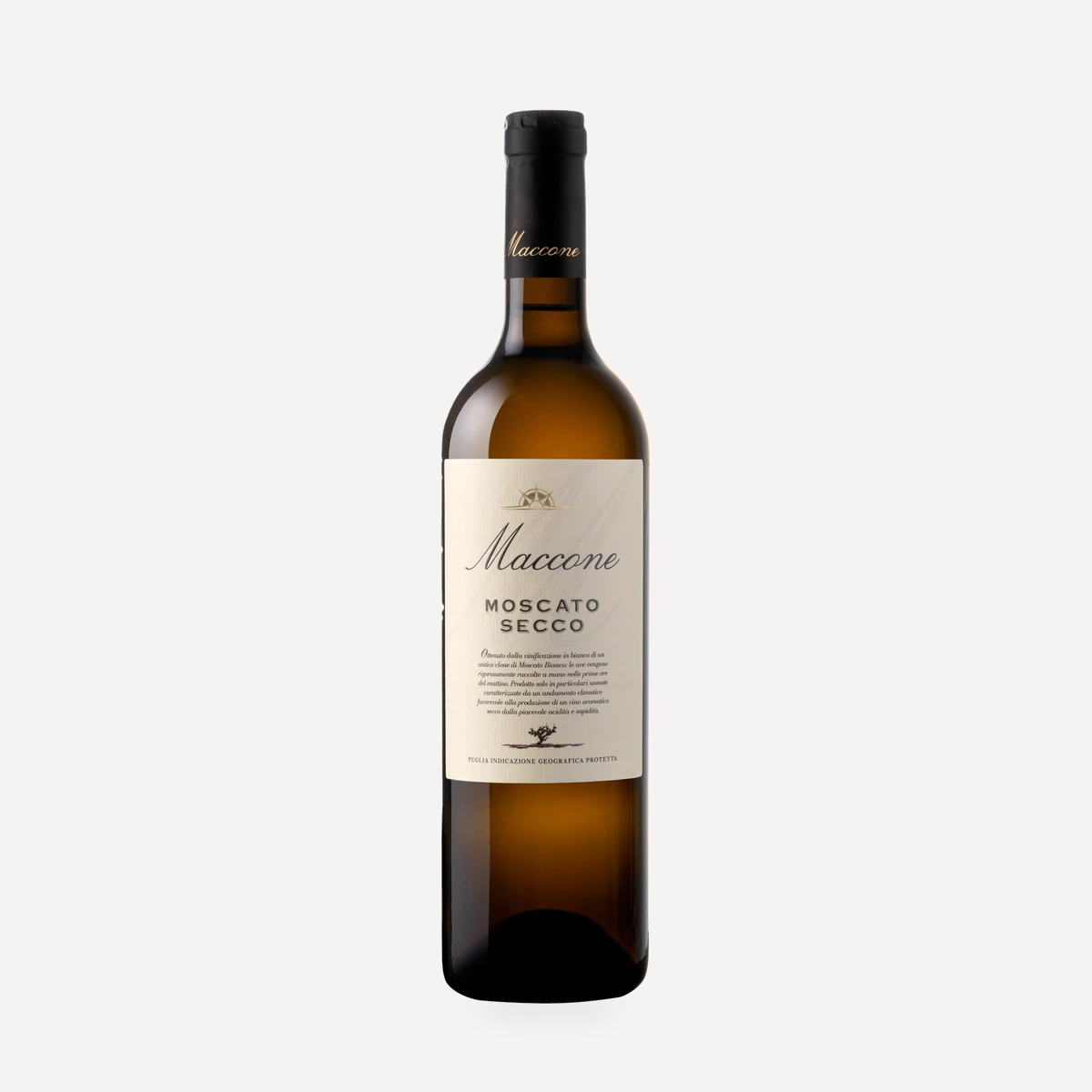
Questo vino
Vineyard and terroir
The grapes come from the Murgia Barese. The current vineyard designation is Adelfia, contrada Sirenga, sheet 21, parcel 56. The vines are trained to the traditional Puglian tendone system, equipped with anti-hail netting and irrigation. The current description specifies sandy clay loam with strong organic-matter and macroelement content; the technical sheet describes the soil as calcareous clay and gives a yield of 80 q/ha.
Grapes
100% Moscato Bianco from an old clone. Production is limited to vintages whose conditions favour a dry aromatic wine with freshness and savoury character.
Vinification
The grapes are picked by hand according to ripeness curves, with the current description placing harvest in the early morning during the second ten days of September. Soft crushing and destemming are followed by 48 hours of cryomaceration, gentle pressing and fermentation of the clarified must in stainless-steel tanks at approximately 12°C.
Ageing
Maturation takes place in stainless steel, followed by one month in bottle before release.
Technical data
Puglia IGT. Alcohol: 13% vol. Bottled in a 75 cl Bordeaux bottle with cork.
Tasting profile
Pale straw yellow with subtle golden highlights. Apricot leads the aromatic profile, joined by sage, mint and floral notes. The palate is dry, light and fresh, with a soft body and persistent savoury character. The technical sheet also describes citrus notes that intensify through the finish.
Serving and pairing
Serve at 8–10°C in a tulip-shaped glass. Its aromatic character suits Oriental cuisine, crustaceans and molluscs. It can also be served as an aperitif or with shellfish starters and lobster.