Storia
Foundation and return of viticulture
ArmosA was created in Scicli in 2002 by Michele Molgg. Its founding purpose was to restore wine-grape cultivation in an area associated with an older winemaking tradition. This connection with Scicli was incorporated into the estate’s identity: its logo is a stylized representation of the three valleys that converge on the town.
The first vineyard
The first Nero d’Avola vineyard was planted in 2003. The chosen site combined sandy soil over calcareous tuff with immediate proximity to the sea. From the beginning, ArmosA’s wines were based exclusively on estate-grown grapes, vinified in the property’s own cellar beside the vineyards.
Development of two terroirs
The vineyard holding subsequently developed across two distinct environments: a marine sector with Curma, Fumaria and Filippa, and a hilly sector near the Irminio valley with Romito and Fossa Stabile. This division allowed Nero d’Avola to be cultivated in contrasting soils and mesoclimates.
In 2009 ArmosA began planting Moscato Bianco in the hilly sector, where persistent breezes and the sea’s moderating influence complement the calcareous soils. The propagation material came from the Noto and Siracusa area.
Conversion of the cellar
The winery occupies restored stone farm buildings dating from the previous century. A small palmento had formerly operated inside them, using sunken stone vats for fermentation. The renovated facility replaced those vats with small temperature-controlled stainless-steel tanks and added a barrel cellar for maturation. The production approach was organized around limited intervention, natural winter clarification and patient maturation.
Terroir
Scicli and the coastal landscape
ArmosA is based at Contrada Pezza Fillippa in the territory of Scicli, in Ragusa province, at approximately 36°45′29.57″ N, 14°39′50.163″ E. The surrounding territory includes the coastal settlements of Donnalucata, Cava d’Aliga and Sampieri. Its landscape progresses from beaches to inland hills characterized by carob and olive groves.
Scicli stands where three valleys converge. These valleys have shaped the town over many centuries and are represented in stylized form in the ArmosA logo. In the first half of the twelfth century, the Arab geographer Edrisi described Siklah as a prosperous and industrious settlement surrounded by fertile, inhabited countryside, productive gardens, cultivated land and watercourses that powered numerous mills.
Marine terroir
Curma, Fumaria and Filippa form the marine sector. Proximity to the sea moderates the local climate: during August and September, average daily maxima remain at or below approximately 35°C, while the day–night temperature difference reaches 15–16°C.
Soils vary within this sector. Curma has sand over calcareous tuff and extends to the shoreline. Fumaria is poor, shallow and calcareous, also over calcareous tuff. Filippa has deeper, medium-textured calcareous soil.
Hilly terroir
Romito and Fossa Stabile occupy the hilly sector near the Irminio valley. Persistent breezes and the sea’s moderating influence distinguish this setting. Romito has deep, medium-textured calcareous soil and a northwestern exposure. Fossa Stabile faces east and has highly calcareous, poor and shallow soil.
Vinificazione
ArmosA cultivates approximately 4.8 hectares of Nero d’Avola and 0.1 hectares of Moscato Bianco. The estate focuses exclusively on varieties regarded as indigenous to Sicily, identifying Nero d’Avola also by its synonym Calabrese.
All five vineyards are planted at approximately 4,400 vines per hectare. The vines are espalier trained and spur-pruned on cordons. Bud numbers are restricted to balance vegetative growth with fruit production and keep yields at no more than approximately 75–80 quintals per hectare, equivalent to 7.5–8 tonnes per hectare.
Harvesting is manual and takes place during the coolest hours, generally early in the morning. Bunches are selected in the vineyard and placed in crates. The fruit is then taken immediately to the adjacent winery. Nero d’Avola generally reaches full maturity during the first or second ten-day period of September, depending on the season.
The viticultural objective is a balanced relationship between vine growth and crop load, supporting healthy, high-quality grapes. Moscato Bianco was introduced to the hilly terroir in 2009 using planting material originating in the Noto and Siracusa area.
Cellar
The winery adjoins the vineyards and occupies restored stone agricultural buildings dating from the previous century. A small traditional Sicilian palmento once operated inside, with fermentation taking place in sunken stone vats. Modern production uses small temperature-controlled stainless-steel tanks, while a dedicated barrel area accommodates maturation in wood.
Nero d’Avola
Fruit picked early in the morning is brought immediately to the cellar and crushed. Fermentation takes place at 28–32°C in stainless-steel tanks holding no more than 40 hl. The cellar also uses tanks ranging from 20 to 40 hl; their relatively high skin-to-must surface-to-volume ratio is intended to improve contact and the transfer of polyphenolic compounds.
Skin maceration lasts approximately 20–25 days, accompanied by frequent pump-overs and punch-downs. After the first racking separates the wine from skins and seeds, malolactic fermentation proceeds naturally.
During winter, low temperatures slowly precipitate tartrates and suspended solids. By the end of January the wine is clear enough to enter small oak barrels without further filtration. Maturation takes place in 225-litre French-oak barriques. The governing principle is to allow time, rather than repeated cellar manipulation, to shape the wine.
Moscato Bianco
Moscato Bianco is also harvested early, transferred directly to the cellar and crushed. Fermentation takes place at 22–24°C in small stainless-steel tanks of no more than 20 hl. Unlike conventional white-wine processing, the must remains with the skins for several days to preserve and emphasize the grape’s complete varietal aromatic profile.
After drawing off, the wine settles naturally throughout winter. It remains in stainless steel rather than wood and is bottled without filtration at the end of spring. This method can leave a slight visual haze.
Filosofia
ArmosA was conceived as a return to wine-grape cultivation in Scicli and as a means of strengthening the identity of Nero d’Avola. Its approach places native varieties in contrasting marine and hilly terroirs so that the resulting wines can express distinct personalities tied to their place of origin.
The stated ambition is to make wines that combine quality with drinking pleasure while conveying the history of the land and the cultures that have succeeded one another there. Territorial expression is understood through the aromas and flavors associated with the vineyards, rather than through a standardized style.
In the cellar, intervention is deliberately restricted to preserve the wine’s integrity. Natural malolactic fermentation, winter settling, avoidance of unnecessary filtration and patient maturation embody the principle that time should work on the wine rather than people repeatedly manipulating it.
The skin-macerated dry Moscato Bianco extends this philosophy through experimentation. It moves away from conventional white-wine processing and returns attention to the whole grape, seeking to preserve the variety’s complete aromatic expression.
Vini
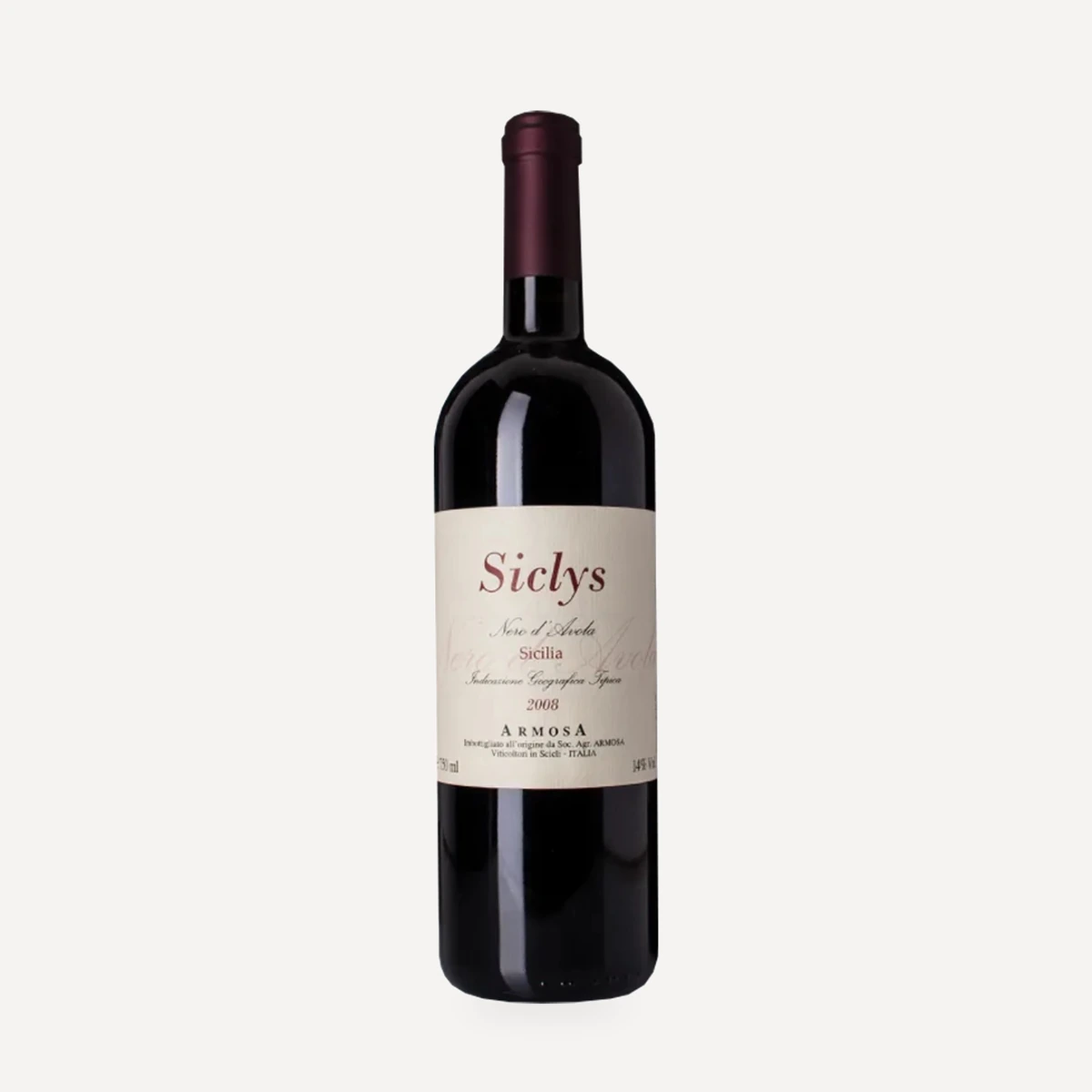
Siclys