Questo vino
Vineyard and terroir
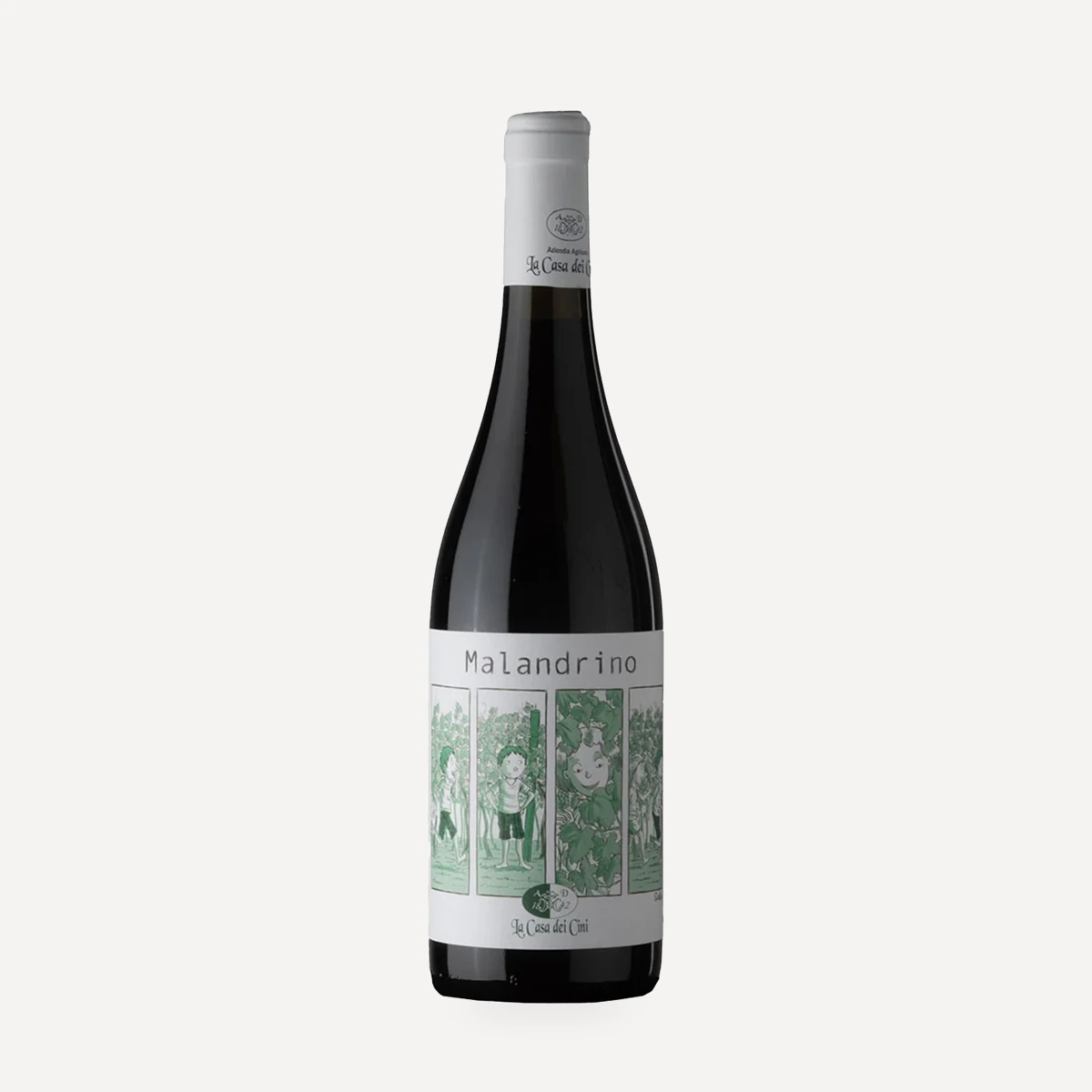
Malandrino 2022 is an IGT Umbria red made from organically grown estate fruit. The Malandrino vineyard lies in the Borgonovo locality on a northeast-facing slope at 340 m a.s.l., with east–west rows. Its soil is clay-loam-sandy, and the permanently grassed vineyard was planted in 2009 at approximately 3,700 vines per hectare, with 2.7 × 1 m spacing. The vines are Guyot-trained on predominantly SO4 and Paulsen rootstocks. Manual summer defoliation is used to improve grape composition.
Grapes
65% Ciliegiolo, 20% Aleatico, 10% Foglia Tonda and 5% Malvasia Bianca. All fruit is estate-grown.
Vinification
The manual harvest generally begins toward the end of the first ten days of September, with grapes collected in crates. After destemming, the wine receives short skin contact and is then pressed very gently with a horizontal disc press. Fermentation continues off the skins in steel. A pied de cuve is used without selected yeasts. No clarification, filtration or stabilization is employed, and the process excludes corrections, concentrated must, concentration and saignée.
The detailed production table records approximately four days of maceration in a wooden vat without temperature control, followed by off-skin fermentation in steel. The introductory description instead gives three days of maceration in steel.
Ageing
No maturation in steel, barrel, barrique or bottle is specified. Malandrino is conceived as a young, fresh wine for early and informal drinking.
Technical data
Vineyard yields are approximately 2 kg per vine and 80–90 q/ha, with a grape-to-wine yield of about 60%. Production is approximately 7,000 bottles, although only half of the wine was bottled. The bottle is Burgundy-shaped and closed with a microcellular cork. Vineyard treatments use copper and sulphur according to seasonal requirements, normally five or six applications in an average year; green manuring uses legumes and manure.
Serving and pairing
Its youthful, fresh and readily drinkable style is presented as suitable for a casual snack.