Questo vino
Vineyard and terroir
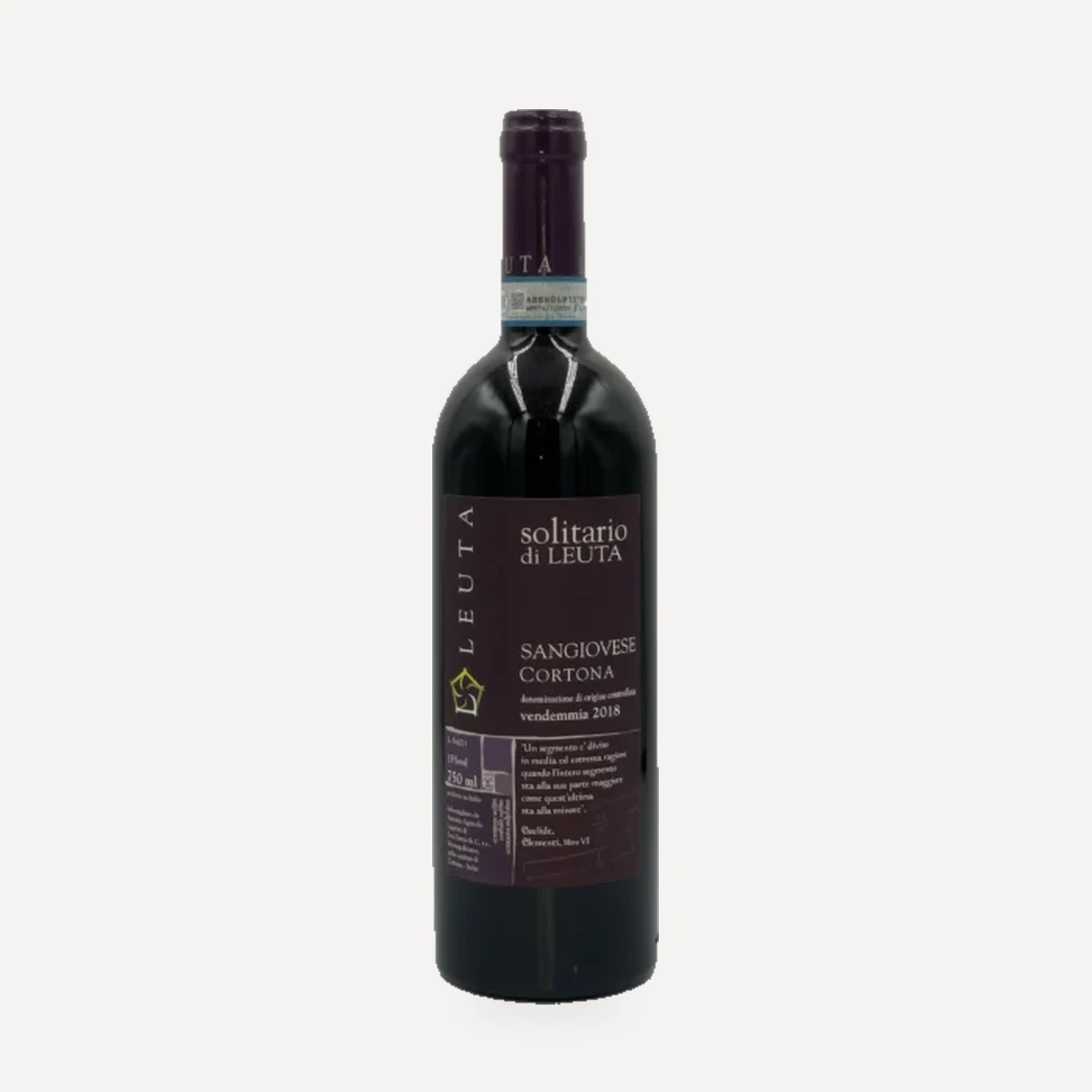
Solitario di Leuta comes from Vigna Chiaramonte within the San Lorenzo vineyard at Tenuta Leuta in Cortona, Val di Chiana, Tuscany. The vineyard was originally planted in 1973, abandoned by its former owner in the late 1980s and restored by Leuta in 2004. Additional vines were planted in 2010.
The certified-organic vineyard covers 1.9 hectares on a mid-slope at 315–325 metres above sea level. It has western exposure, downslope rows and clay-and-silt soils. The vines are listed as 47 years old and are trained to a single arm with spurs. Planting density is 3,500 vines per hectare, with spacing of 3.00 × 1.00 metres. Yield is 40 quintals or 32 hectolitres per hectare, equivalent to 1.2 kg per vine.
Grapes
100% Sangiovese.
Vinification
Selected grapes are harvested manually into small crates from around mid-September. Following destemming and light crushing, fermentation takes place in stainless steel for 25–30 days at 24–27°C with indigenous yeast. Maceration is managed through pump-overs and délestage under controlled temperature. The wine is not pressed. Malolactic fermentation takes place in tonneaux.
Ageing
The wine remains on its lees in tonneaux for six months and then spends another 24 months in tonneaux. Bottle refinement lasts 12 months. Bottling takes place in June or July.
Technical data
The published production is 4,000 bottles. The first harvest and production year was 2007, and every vintage was produced through the published 2019 release.
Tasting profile
Intense, deep ruby red with subtle orange hues. Blackberry, cherry and violet lead the aroma, accompanied by clear tobacco and peat notes. The palate is warm, ripe, elegant and complex, combining pronounced fruit with delicate pepper and tobacco spice. Savouriness contributes to excellent persistence. The tannins are taut and lively yet ripe and velvety.
Serving and pairing
Ideal with grilled meat, including the classic bistecca alla Fiorentina.
Label / history
The wine expresses a historic Sangiovese vineyard recovered after years of neglect. Leuta revived the original 1973 planting in 2004 and supplemented it with new vines in 2010.