Storia
The Frescobaldi precedent
Merlot first arrived in Montalcino during the 1970s through the Frescobaldi family. That pioneering experience later became one of the foundations of the project that would unite Merlot with Montalcino’s Sangiovese.
A meeting and a new project
In the early 1990s, Vittorio Frescobaldi met Robert Mondavi. Drawing on the experience of two historic wine families, they set out to create a Montalcino wine that could move beyond established tradition without rejecting it. The project was named Tenuta Luce, evoking the Montalcino sunlight that sustains life, marks the seasons and determines the rhythm of agricultural work.
The first Luce vintage was 1993. Luce became the first Montalcino wine created from a blend of Sangiovese and Merlot, combining the structure and elegance associated with Sangiovese with Merlot’s roundness and softness. Other wines were subsequently added as distinct interpretations of the estate.
New products and plantings
Grappa di Luce was created in 1998 in partnership with Jacopo Poli to make use of the estate’s Sangiovese and Merlot pomace. The grappa is matured for three years in French-oak barriques.
In 2004, Tenuta Luce planted a 3-hectare Cabernet Sauvignon vineyard on mixed-sandy soils. The vines were observed over the following years, and the quality of their fruit eventually inspired a separate expression of the estate through Cabernet Sauvignon.
The collaboration with the Mondavi family ended in 2004, after which responsibility for the project passed entirely to Lamberto Frescobaldi. In 2005, Lamberto, Vittorio’s son, formally took over the direction of Tenuta Luce. He continues to determine its production guidelines, from decisions in the vineyards through to the creation of each vintage’s blends.
Lux Vitis and the estate winery
The Cabernet Sauvignon planted in 2004 gave rise to Lux Vitis in the 2015 vintage. A small proportion of Sangiovese was added to enrich its character, and the wine was named Lux Vitis.
Following the estate’s latest acquisition in 2016, Tenuta Luce established a new underground winery integrated into the Montalcino landscape. Built beneath a hill crowned by two pre-existing farmhouses, it brought the stages of production together in a single-level structure. The winery also houses Collezione Luce, the historic cellar in which the estate’s vintages are preserved.
Thirty vintages
On 17 September 2024, Lamberto Frescobaldi and Tim Triptree, Master of Wine and International Director of Wine & Spirits at Christie’s, conducted the first complete vertical tasting of all 30 Luce vintages. The resulting anthology contains individual evaluations running from the inaugural 1993 vintage through Luce 2022, the thirtieth vintage.
Terroir
Tenuta Luce extends southwest of the village of Montalcino across gentle Tuscan slopes interspersed with vineyards, olive groves, extensive woodland and wild vegetation. The estate occupies a sparsely populated setting rich in biodiversity within the wider Natural and Cultural Artistic Park of Val d’Orcia.
The vineyards are heterogeneous in altitude, exposure and soil. Elevations range from 280 to 418 metres above sea level. The upper band has schistose soils; the lower areas are mixed with clay; and the central belt contains abundant yellow sands and sandstone. A separate Cabernet Sauvignon site is characterized by mixed-sandy soils, while the Madonnino vineyard has galestro and an exposure considered particularly suited to Sangiovese.
Altitude and southern exposure encourage slow, complete ripening. Cool, breezy nights help retain the grapes’ aromatic complexity. The combination of varied elevations, soils, exposures, bright light and fresh circulating air creates distinct conditions among the estate’s parcels.
Vinificazione
Vineyard planting is determined strictly by the suitability of each parcel rather than by a uniform estate-wide formula. The estate’s work is directed toward preserving the existing balance of a sparsely populated landscape containing vines, olive groves, woodland and wild areas rich in biodiversity.
Vineyard work is presented as continuous, skilled manual care, including winter pruning and the careful harvesting of individual bunches. At maturity, grapes are selected by hand within each parcel and transported separately to the winery’s reception area. This parcel-by-parcel approach preserves the distinctions created by the estate’s varied altitudes, exposures and soils. A further selection takes place after arrival at the winery.
The winery stands at the centre of the estate. It is a single-level, underground structure built beneath the hill occupied by two pre-existing farmhouses, allowing it to accommodate the complete production sequence while remaining integrated into the landscape.
Its rooms are arranged along a corridor that follows the movement of wine from grape reception to bottle. During harvest, ripe bunches selected by hand in each parcel arrive at the collection area in the external courtyard. Following an additional selection, the fruit undergoes gentle pressing and fermentation with indigenous yeasts.
After vinification, the wines rest and develop in the barricaia and bottaia. The estate treats this period of maturation as an essential continuation of the natural cycle rather than a stage to be accelerated. At the end of the winery route lies Collezione Luce, the protected historic cellar where vintages are preserved in a space designed according to the golden ratio.
Filosofia
Tenuta Luce defines wine as a natural expression of its place and of the grapes from which it is made. Care begins among the vines, where the objective is to preserve the balance achieved in each parcel, and continues through detailed work in the winery.
Respect is the estate’s central declared value: respect for the land, the vineyards and the people who work in them. Human intelligence is understood as an interpreter of nature rather than its master. The estate also emphasizes curiosity and a productive dissatisfaction with completed goals as forces for continual improvement.
Beauty is treated as a practical source of inspiration that must be protected in both its large and smallest forms. The same respect extends to people: recognizing individual abilities, valuing accumulated experience and sustaining motivation across vineyard work, fermentation, maturation and preparation of the finished bottles.
The estate describes its relationship with the land through the idea of being a grateful guest. Its objective is to leave the property in better condition for those who follow. Planting according to each parcel’s vocation and safeguarding biodiversity are direct consequences of that principle. Tradition is neither copied mechanically nor rejected: the project seeks to renew Tuscan wine culture while retaining its historical foundations and allowing each vintage to be interpreted on its own terms.
Vini
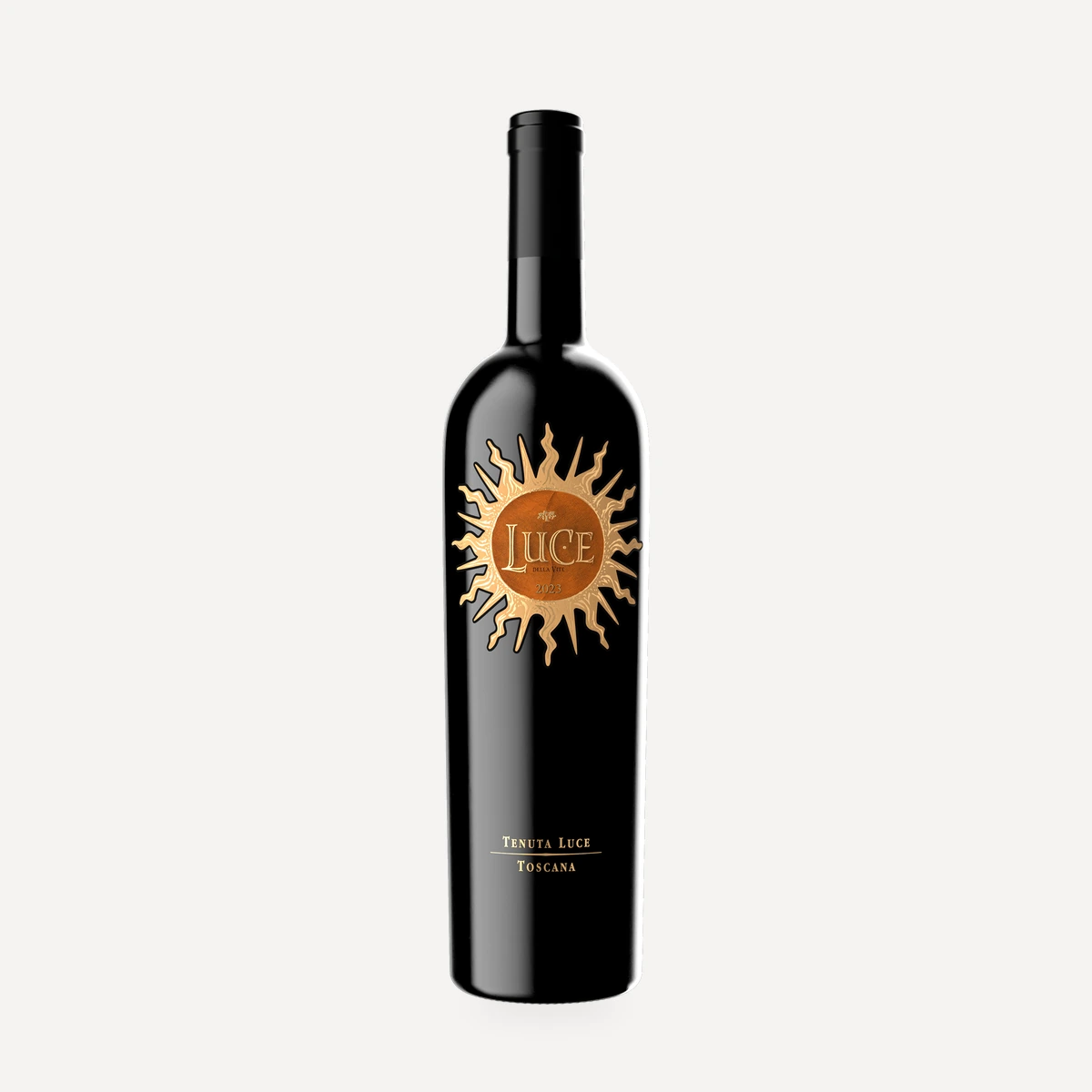
Luce

Luce Brunello
