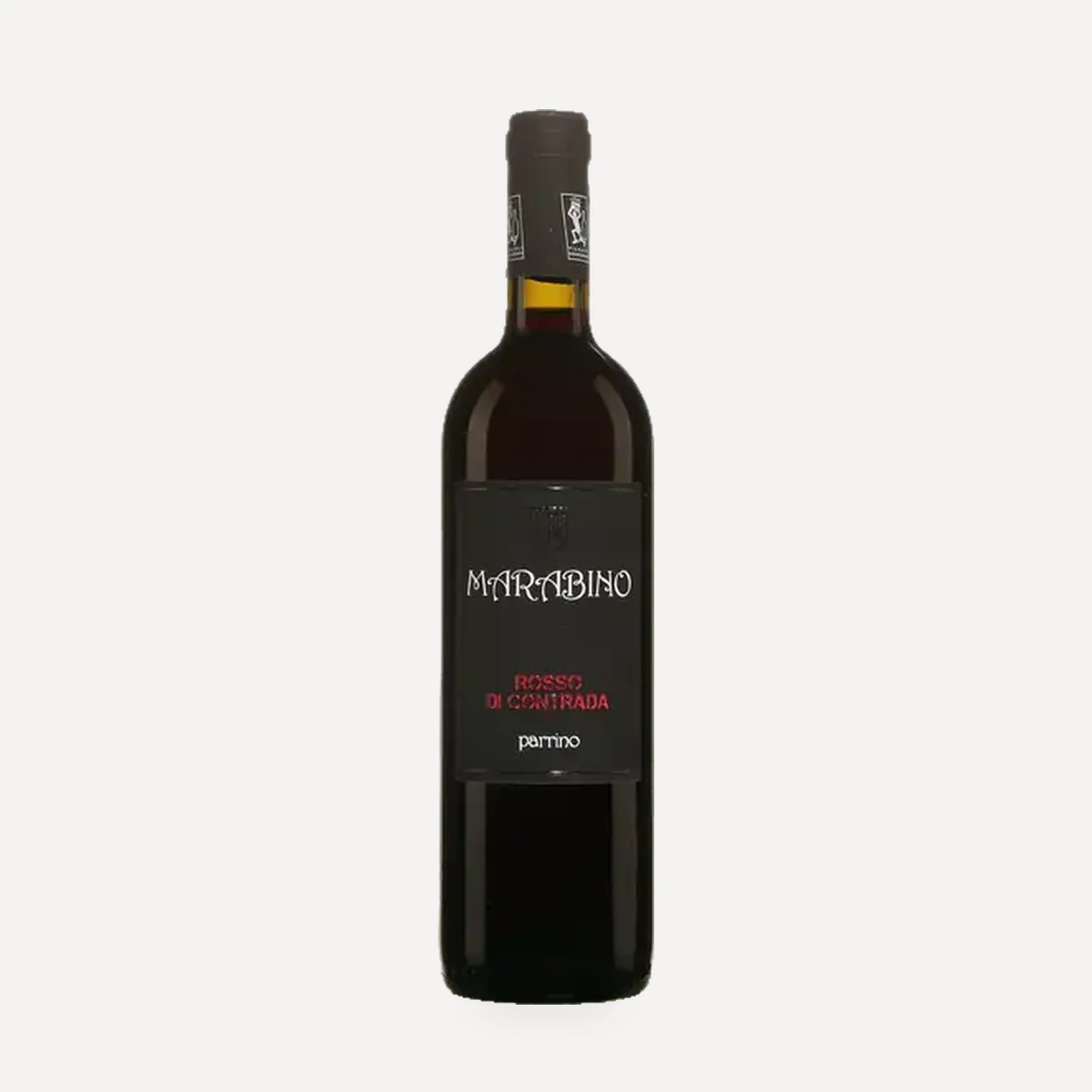
Questo vino
Vineyard and terroir
Parrino comes from Marabino’s southernmost vineyard, a four-hectare site on Cozzo del Parroco in contrada Buonivini, Val di Noto. The hill’s name means “the priest’s head” and gives the wine its name. The land had been left uncultivated for more than 20 years before planting. The vineyard was established through field grafting with a massal selection taken from the oldest Nero d’Avola vines of the Pachino area.
The north-facing site lies between 44 and 66 metres above sea level and is trained as Pachino-style alberello impupato. Its soils form a variegated patchwork ranging from black clay through white limestone to yellow clay. The northern exposure protects the vines from the hot African sirocco, slowing ripening and supporting complete phenolic maturity. Yield is 50 quintals of grapes per hectare, corresponding to 34 hl/ha.
The vineyard is farmed biodynamically without herbicides or chemical or synthetic treatments and fertilisers. Plant protection is limited to low doses of mined sulphur, while fertility management uses biodynamic preparations, shredded pruning material and grass-and-legume green manure.
Grapes
100% Nero d’Avola.
Vinification
Spontaneous fermentation takes place in stainless-steel tanks for at least 15 days, with a long maceration of the must on its skins.
Ageing
The wine matures for one year in a spherical concrete tank before bottling and extended bottle ageing. Total maturation and bottle ageing amount to 44 months.
Technical data
For the 2021 vintage, energy is 75 kcal/100 ml (313 kJ/100 ml), glycerol 7.15 g/l, carbohydrates 0.8 g/100 ml, sugars below 0.5 g/100 ml and total sulphur dioxide 18 mg/l.
Tasting profile
The alberello-trained vines, northern exposure and varied soils shape an elegant Nero d’Avola with considerable capacity to evolve. Its profile recalls mulberry, balancing sweetness and tartness in a full, intense and refreshing palate.
Label / history
The label uses fruit as its central image, reflecting the recurring mulberry character of the wine. Within the four natural elements, fruit represents fire—the energy from which the principle of life emerges.