Questo vino
Vineyard and terroir
The fruit comes from terraced vineyards on the southwestern slope of Mount Etna, at 800 metres above sea level. Young vines grow in volcanic soil formed from solidified lava flows.
Vinification
The grapes are harvested by hand and vinified in truncated-cone oak vats.
Ageing
The wine matures for two years in French oak barriques from Allier and Tronçais, followed by four to five years in bottle.
Label / history
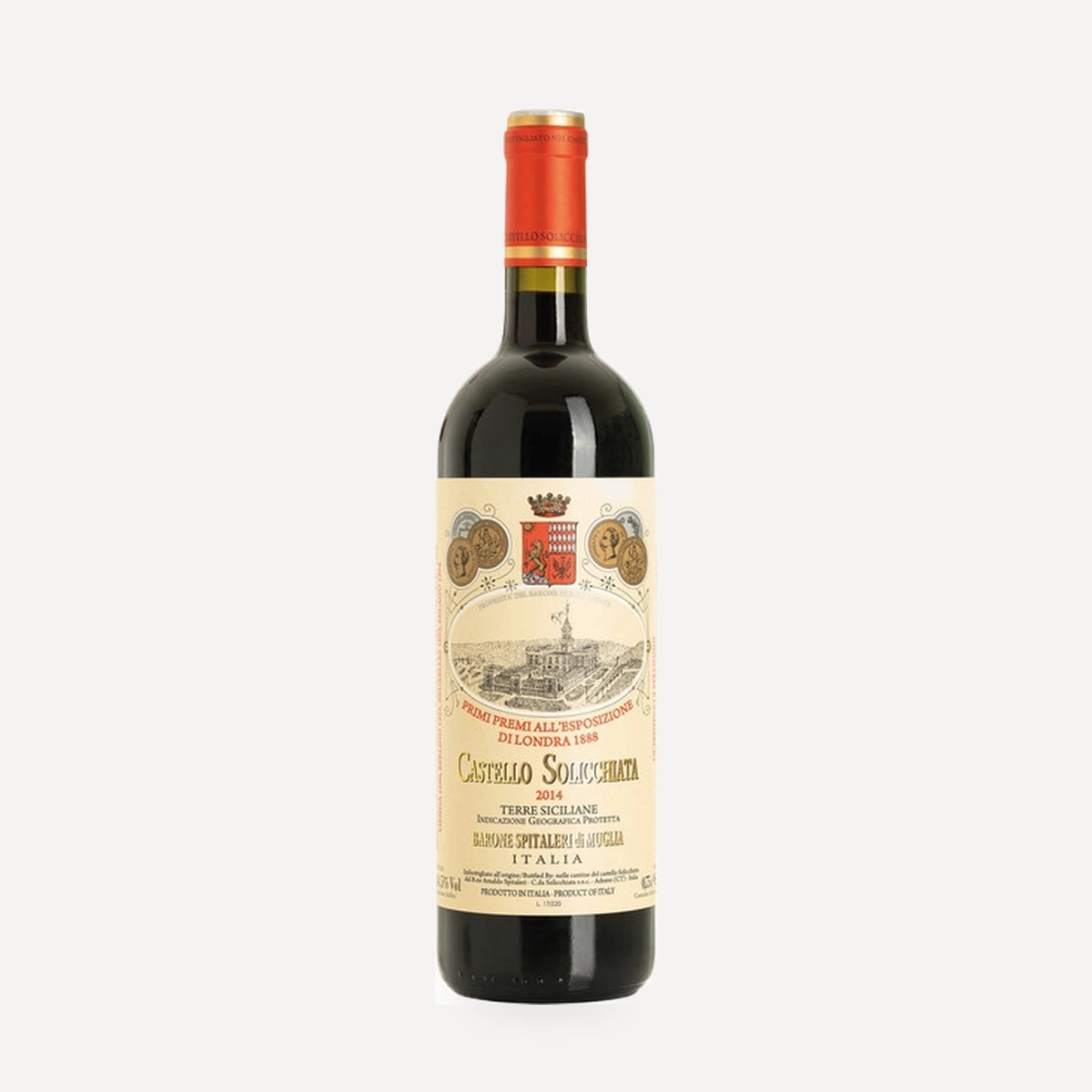
Castello Solicchiata forms part of Planeta’s Ab Insula project, a small collection associated with Sicily; the name Ab Insula means “from the island.” Planeta has managed the wine’s distribution and supported its production and vineyard management since 2022.
The estate was founded in the mid-19th century by the Spitaleri di Muglia family. Its family name derives from the Hospitallers, the Knights of Saint John of Jerusalem, whose members settled on Mount Etna after returning from Jerusalem at the end of the 13th century.
In 1855, Baron Felice Spitaleri conceived a French-style castle on Mount Etna, surrounded by hundreds of terraces cut into the lava rock and organized around a new model of wine production. Experiments with non-native French varieties were entrusted to Father Francesco Tornabene, a geobotanist and ampelographer associated with the Scuola Catanese and founder of the Botanical Garden of Catania. Andrea Scala, architect of the Bellini Theatre in Catania, designed more than 300 hectares of vineyard terraces using the boxes of Italian theatres as inspiration.
The wine was initially named Solicchiata 1858 and later Castello Solicchiata. Historical honours included First Prize at the London Exhibition in 1888, followed by the Grand Diploma of Honour and a Gold Medal in Palermo in 1889, Vienna in 1890, Berlin in 1892, Brussels in 1893 and Milan in 1894. According to Baron Arnaldo Spitaleri, it received nine Diplomas of Honour, seven Gold Medals and two Silver Cups from the Ministry of Agriculture, Industry and Trade, together with honours at exhibitions and competitions in London, Berlin, Vienna, Brussels, Milan, Rome, Palermo and Catania. Castello Solicchiata also became an official supplier to the Italian royal court.