Storia
Origins
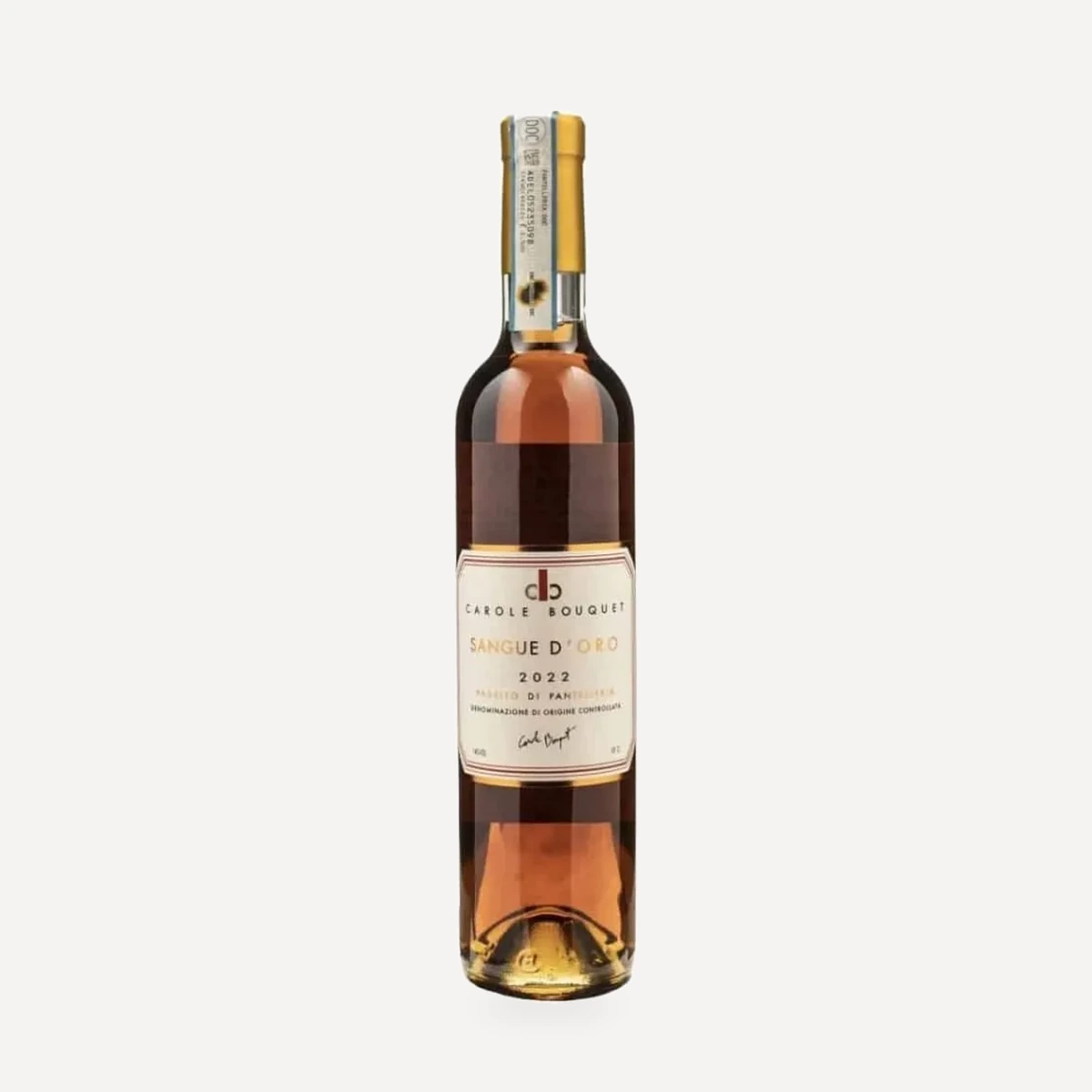
Sangue D’Oro grew from actress Carole Bouquet’s attachment to Pantelleria and to the island’s thousand-year tradition of passito production. Bouquet is identified as the project’s founder.
Sangue D’Oro and Pasqua Wines
The project now brings together Bouquet’s original vision and Pasqua Wines’ winemaking approach. Pasqua Wines acts as custodian of Pantelleria’s traditional passito practice, with particular emphasis on recognizing the correct harvest moment and drying the grapes naturally. The collaboration is conceived as cultural as well as commercial: its purpose is to give greater visibility and opportunity to Pantelleria, its wine knowledge and the community maintaining its traditional agricultural gestures.
Recognition of Pantelleria’s viticultural tradition
On 27 November 2014, UNESCO inscribed the traditional agricultural practice of the alberello-trained vine of Pantelleria on the Representative List of the Intangible Cultural Heritage of Humanity. It was presented as the first UNESCO recognition granted to an agricultural practice, acknowledging the system’s historical, cultural and identity value. Sangue D’Oro preserves this form of cultivation in its own vineyards, where bush-trained vines occupy dry-stone terraces at the foot of Montagna Grande.
Terroir
The estate lies in contrada Serraglia on Pantelleria, Sicily, at the foot of Montagna Grande. Its vineyards stand at approximately 250 metres above sea level on the island’s characteristic volcanic terrain.
A detailed vineyard description gives the soil composition as approximately 70% volcanic stone and 30% clay and limonite. Vines occupy several levels of terracing, with dry-stone walls enclosing the terraces and helping to protect the vineyard from the wind. Wind is a defining feature of the site, blowing on Pantelleria for approximately 321 days per year.
The wider agricultural landscape is rugged and frequently steep. Sirocco and Greco Levante winds can blow often and violently. Alberello vines are therefore planted in broad basins below ground level, sheltering plants and fruit while helping to balance root development with the above-ground portion of the vine. The low growth close to the soil also keeps the plants accessible for manual work.
Vinificazione
Viticulture follows Pantelleria’s traditional alberello pantesco system. Each vine is kept low and trained inside a broad basin below ground level. This protects the plant and its fruit from the island’s frequent, forceful Sirocco and Greco Levante winds, balances the development of the roots and aerial growth, and allows workers to reach the vine throughout its vegetative and productive cycle.
The vineyards are divided across dry-stone terraces, often on severe slopes. These structures belong to Pantelleria’s wider culture of working local stone, also expressed in the island’s dammusi and giardini panteschi. Machinery cannot replace manual labor in this landscape: vineyard work depends on the farmer’s hands and judgment. Annual labor requirements per unit of vineyard are described as at least three times those of a conventional mainland vineyard, hence the characterization as heroic viticulture.
Harvesting is manual and includes bunch selection. For passito production, the crop is gathered in three separate passes: the first in mid-August, the second at the end of August and the third in September. Fruit from the first two passes is laid out for natural drying in the sun and wind.
Passito production is organized around three harvests and two distinct dried-grape components. Grapes picked in mid-August are destined to dry for 30–40 days and become uva passa. A second lot, gathered at the end of August, dries for 10–15 days and becomes uva passolata. A third harvest takes place in September to supply fresh grapes for the still base wine.
The first two lots dry naturally in the sun and wind. Water evaporates from the berries, sugars and acidity become more concentrated, and the skins turn golden. Once the uva passolata is ready, it is crushed and destemmed together with the fresh third-harvest grapes. The combined fruit macerates on its skins for approximately 48–72 hours and produces a must with a potential alcoholic strength of 17–18°. Fermentation continues until the sugars in this must have been converted to alcohol, after which the wine is separated from its lees.
The longer-dried uva passa is prepared separately by hand: every berry is detached individually from the stalk once it reaches the intended degree of drying and the wine made from the passolata and fresh fruit is ready. The dried berries are then added gradually to that wine.
This infusion maceration lasts approximately three months. Wine penetrates the dried berries, dissolving their sugars and extracting aromatic substances. The proportion is 40 kg of dried grapes for each hectolitre of still wine. Dilution during the infusion lowers the alcoholic strength to 14%, while the dissolved residual sugar increases the wine’s density and aromatic concentration. At the end of the infusion, the grapes are pressed. The resulting wine is held in stainless-steel tanks and then bottled.
Filosofia
Sangue D’Oro presents itself first as a cultural undertaking and then as an entrepreneurial one. Its declared purpose is to restore visibility and opportunity to Pantelleria, its winemaking knowledge and a community that combines inherited agricultural gestures with contemporary determination.
The project treats passito production as a form of practiced knowledge rather than a purely technological exercise. Its central technical principle is the ability to recognize the correct moment for harvesting and natural grape drying. Pasqua Wines assumes the role of custodian of this practice, seeking to communicate its importance while preserving and strengthening Pantelleria’s identity.
Dedication, physical effort and respect are treated as unavoidable conditions of work on the island. This position responds to the progressive abandonment of agriculture and contraction of cultivated land on Pantelleria. The preservation of alberello cultivation, dry-stone terraces and labor-intensive drying practices is therefore both a production choice and a form of cultural stewardship.
Vini