Storia
Ancient wine landscape
Serra Ferdinandea lies near Monte Kronio at Sciacca, where residues interpreted as approximately 6,000-year-old wine were found, and near the rock-cut Phoenician-Greek wine installation known as the palmento della Risinata at Sambuca di Sicilia. The latter is dated to around the sixth or seventh century BC and may have supplied ancient Selinunte. These archaeological remains place the estate within an area of exceptionally deep Mediterranean viticultural history.
July–November 1831: the island behind the name
The estate looks south-south-west toward the stretch of the Strait of Sicily where a submarine eruption created a temporary island in 1831. Fish deaths caused by volcanic heat and gases preceded its appearance. The island emerged in July above the submarine volcano Empedocle and continued growing until it measured approximately 4 km across, with its cone reaching about 80 m above sea level.
International law then allowed a state to claim a newly formed island by arriving first. British and French flags were planted, and the island received the names Graham Island and Île Julia. King Ferdinando di Borbone rejected the foreign claims to land he considered part of Sicily and renamed it Isola Ferdinandea. The competing claims produced a diplomatic dispute involving Britain, France and the Kingdom of the Two Sicilies.
The dispute ended without a victor when the friable island collapsed back beneath the sea in November 1831. It apparently attempted to re-emerge twice during subsequent decades but never exceeded the dimensions of a reef. Its surviving submarine structure is Graham Shoal, whose summit is about 6 m below sea level and whose several calderas record repeated eruptions.
The name Serra Ferdinandea joins two elements of the landscape. Serre is the local term for the estate’s rocky ridges, while Ferdinandea evokes the temporary island visible on the maritime horizon. The name therefore connects the physical form of the land with the founders’ idea of an international, aspirational undertaking uniting Sicily and France.
The Oddo–Planeta partnership
The project arose from complementary ambitions. The French Oddo family wanted to add its first Italian estate to an international wine portfolio, while the Sicilian Planeta family wanted to place Sicilian viticulture in direct dialogue with leading international wine regions. Oddo chose Sicily and Planeta as its local partner; Planeta chose a French partner with an international network.
Planeta’s knowledge of Sicily guided a rapid survey of possible locations. The partners selected a 100 ha property between Sciacca and Sambuca di Sicilia, close to the Strait of Sicily, Monte Kronio and the palmento della Risinata. Its rolling terrain becomes almost mountainous, alternating woodland, Mediterranean scrub, clearings, slopes and exposed limestone ridges.
The enterprise was structured as an equal partnership in which the families would share agricultural, oenological and distribution experience. Lorraine Oddo and Alessio Planeta were appointed to lead the Sicilian project, supported by Bordeaux oenologist Florent Dumeau. Alessio Planeta brought three decades of work in Sicily, while Dumeau already worked with both Planeta and the French family’s estates.
The founding plan paired Sicilian varieties Grillo and Nero d’Avola with French varieties Sauvignon Blanc and Syrah. Ten hectares formed the initial planted nucleus, with a further 30 ha planned over the following two years. The wider property comprised 100 ha, including a planned total of 40 ha of vineyard and 60 ha of woodland and Mediterranean scrub. Investment was estimated at approximately €3 million, and production at maturity was projected at 200,000 bottles per year.
2019–2021: first vintage and market launch
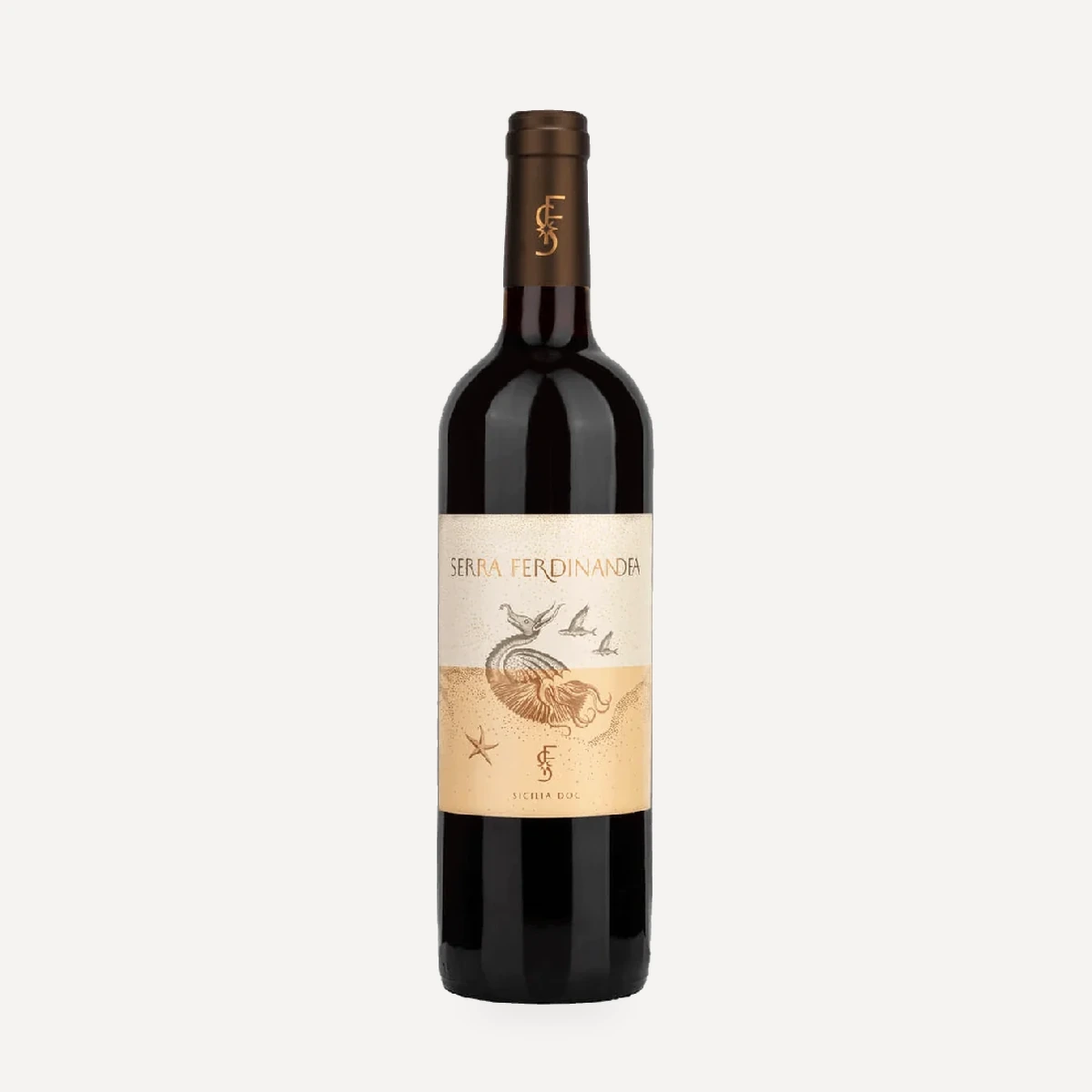
The wines introduced with the project originated in the 2019 harvest. The red wine identifies 2019 as its first vintage. Serra Ferdinandea was publicly launched on 27 January 2021, with the first white scheduled for release in March 2021 and the rosé and red offered en primeur. Distribution was assigned to Bordeaux négociant DIVA, an unusual route to market for a Sicilian producer. A dedicated winery was part of the launch plan; later technical information identifies Serra Ferdinandea’s winery at Menfi.
Terroir
Setting and relief
The estate occupies the western edge of the Monti Sicani between Sciacca and Sambuca di Sicilia in the province of Agrigento. It is surrounded by Mediterranean scrub and woodland and overlooks the sea toward Pantelleria and the former Isola Ferdinandea. The principal estate setting is described at 400–450 m above sea level, while current technical descriptions place the named vineyard used for the 2024 wines at 411 m.
The predominantly hilly landscape becomes almost mountainous in places. Meadows, slopes, clearings and exposed rocky crests alternate across the property. These crests are locally called serre, one of the two geographical references contained in the estate’s name.
Geological formation
The soils developed through the breakdown and alteration of limestone that still emerges at the estate’s margins as low, stony reliefs supporting distinctive vegetation. The parent material consists of ancient marine deposits from the Jurassic and, especially, the Cretaceous, approximately 200–65 million years old. These periods had tropical climates and coral-reef formation.
The rocks emerged much later, during the Pliocene approximately 7 million years ago, through folding caused by the meeting of the African and European tectonic plates. This geological process also shaped much of Sicily and the Monti Sicani.
Soil horizons
Natural forces and long-term human activity, particularly extensive sheep grazing, shaped the soils over millennia. The site’s cooler conditions relative to the coast slowed the decomposition of organic matter derived from vegetation and grazing animals. Beneath the surface lies a dark, fertile mollic horizon rich in stable humus. It is approximately 5–30 cm thick and remains relatively light and workable even during summer drought.
Deeper horizons are calcareous and contain stones together with balanced proportions of sand, silt and clay. They are generally beige, shifting toward red in some places and dark brown where water retention is greater. Current vineyard descriptions likewise identify a dark, organically rich surface layer over deep limestone mixed with stones, sand, silt and clay. Soil colour varies with organic-matter content, and the profile offers resilience during summer drought.
Biological condition
Before vineyard establishment, these lands had remained largely untouched by the plough for centuries. Microbial communities and soil organisms within the rooting zone were therefore undisturbed. Vineyard planting was undertaken with the intention of disturbing this biological structure as little as possible.
Vinificazione
Serra Ferdinandea has applied the SOStain® protocol since the project’s creation. The Sicilian sustainability model establishes ten fundamental requirements covering vineyard management, biodiversity protection, measurable energy-use indicators and the use of local materials. Sustainability also guides production, landscape management, work organization, energy procurement and water-resource management.
The property is managed according to biodynamic principles, an approach chosen in response to the largely undisturbed condition of land previously shaped mainly by natural forces and extensive pastoralism. The stated priorities are maximum respect for the site and minimum intervention.
Cover crops combine fava beans, vetch and spontaneous flora. They are used to increase soil organic matter and nitrogen while supporting the vitality of soil microfauna. Biodynamic preparations and herbal teas are used throughout vineyard management. Recorded plant-protection measures include minimal quantities of sulphur and copper, beneficial insects, mating disruption and natural strengthening agents such as zeolite, kaolin and plant extracts.
Planting was conducted with minimal disturbance to soil microbial life and other organisms in the rooting zone. Grapes are harvested by hand in small crates. Depending on the intended cellar route, they are cooled overnight before whole-bunch or berry selection by hand on a sorting table.
Serra Ferdinandea’s grapes are vinified at its winery in Menfi. Across the range, harvesting is manual and different varieties are picked separately according to ripeness. Fruit is transported in small crates, rested overnight in a temperature-controlled cold room and manually selected before processing.
Fermentations are started with indigenous yeasts propagated through a spontaneous pied de cuve. Several days or weeks before the main harvest, selected grapes from the same vineyard are picked, manually crushed and allowed to begin fermenting naturally. This active fermenting mass is then used to initiate the main must, with the aim of preserving the integrity and origin of the fruit.
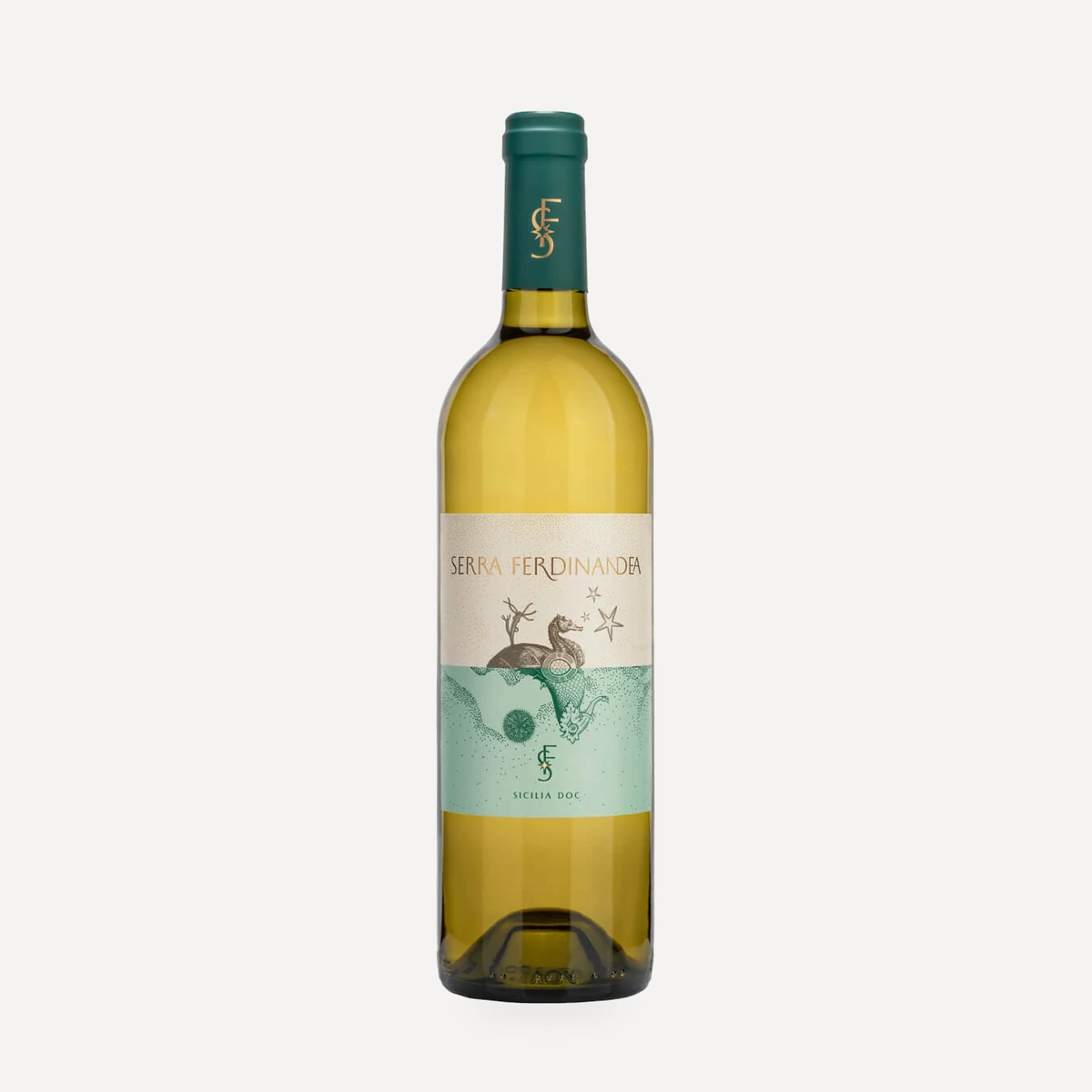
White grapes are cooled overnight to about 10°C, selected manually and gently pressed as whole berries. Free-run juice undergoes static cold settling in stainless steel. Grillo ferments principally in steel, with approximately 10–12% of the must receiving an infusion of manually destemmed whole berries. The berries remain in the clear must throughout fermentation to add skin-contact aromatic complexity while limiting excessive phenolic impact. Sauvignon Blanc ferments equally in 5 hl tonneaux and 25 hl oak casks, followed by 10 months in used oak.
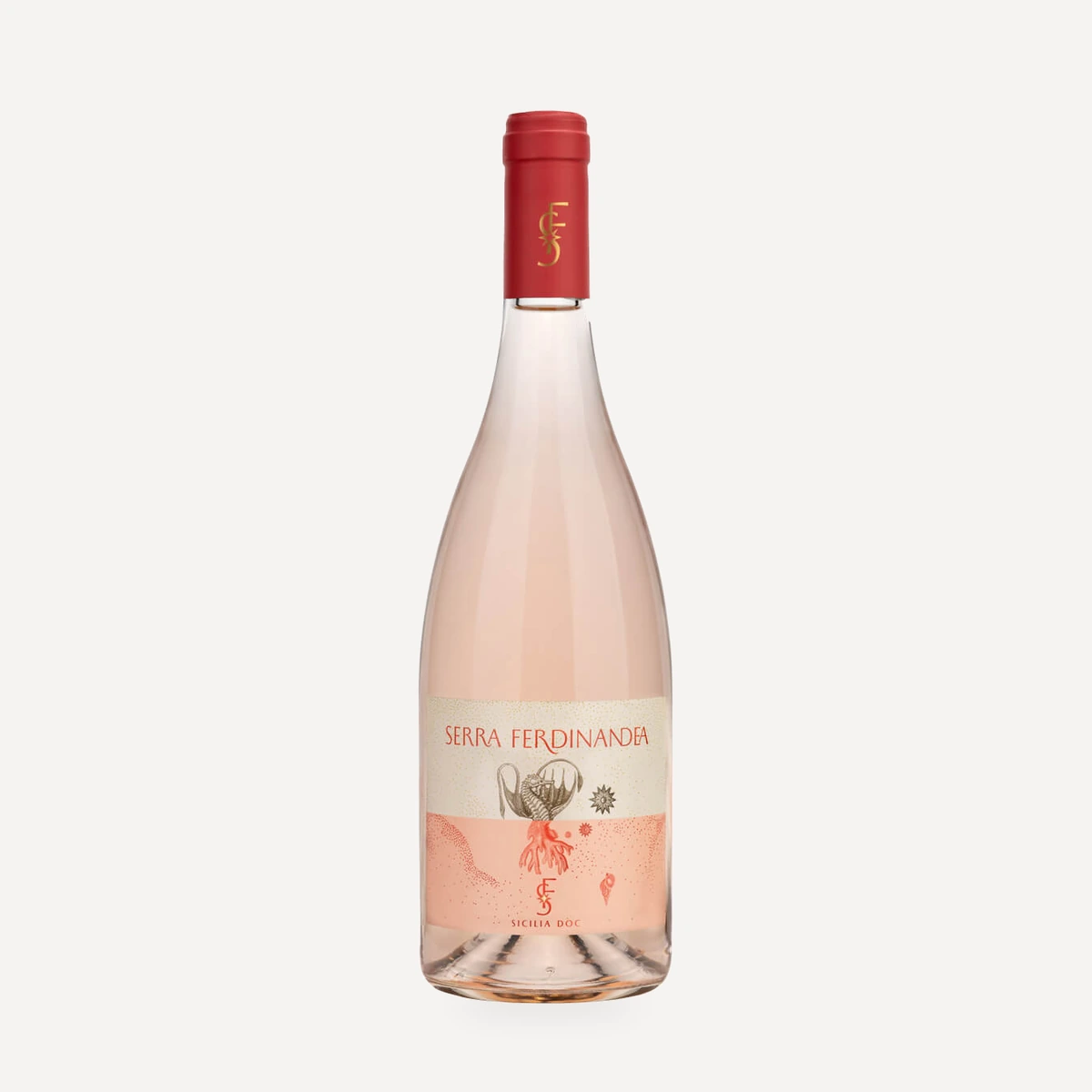
Rosé fruit is hand-picked in 14 kg crates and cooled overnight to 6–8°C. Selected whole bunches enter a soft press using an especially gentle, non-rotating cycle. Following static cold settling, fermentation takes place in stainless steel with indigenous pied-de-cuve yeasts. The wine remains in steel after fermentation, with weekly stirring of the fine lees during its first months.
For red production, Syrah and Nero d’Avola are cooled overnight at 12–13°C, selected manually and transferred by conveyor to their vessels. Fermentation is divided between concrete vats and stainless-steel tanks, with 2–3 weeks of skin maceration. A portion of Syrah is fermented separately in steel with 20% whole, undestemmed clusters. Maturation continues for 12 months in used 35 hl casks and 5 hl tonneaux, of which 10% are new, followed by another 6 months in concrete before bottling.
Filosofia
Serra Ferdinandea is conceived as a meeting of Sicily and France. The project pairs the Planeta family’s knowledge of Sicilian viticulture with the Oddo family’s French and international perspective, combining local and French grape varieties, agricultural experience, oenology and distribution.
Its declared ambition is to create an emphatically Sicilian enterprise with a clear French imprint. The partnership is based on equal participation, complementary expertise, friendship and a shared pursuit of quality, with the property itself treated as the foundation of the project.
Environmental stewardship is framed as both an instinctive response to the landscape and an ethical obligation. Agricultural, productive, pastoral, organizational, energy and water decisions are directed toward rigorous sustainability. Biodynamic management extends this position through minimal intervention and respect for soils that had remained largely unploughed and biologically undisturbed for centuries.
In the cellar, spontaneous vineyard-derived starters, gentle fruit handling and the selective use of steel, concrete and oak are intended to retain fruit integrity and make the wines faithful to their place of origin. The estate’s guiding idea is to make the land productive while preserving the balance between farming and nature.
Vini
Serra Ferdinandea Bianco
Serra Ferdinandea Rosato