Questo vino
Vineyard and terroir
Plumbago comes from old Nero d’Avola vineyards around Lago Arancio. The fruit is grown in the Ulmo Vecchio and Vruca vineyards within the Dispensa and Ulmo holdings, in the districts of Menfi and Sambuca di Sicilia (AG). Ulmo lies at 195 m above sea level and Dispensa at 75 m.
Ulmo’s moderately deep, medium-textured soils contain abundant pebbles at depth, moderate limestone and darker patches rich in vegetation. At Dispensa, the moderately deep soils tend toward chalk, have almost no structure and contain an average proportion of lime. Planting density is 4,545 vines/ha at Ulmo and 5,050 vines/ha at Dispensa; respective yields are 80 and 70 quintals/ha. The vines are espalier-trained and spur-pruned on cordons.
Cultivation follows organic agriculture and the SOStain® protocol. Cover crops of beans, vetch and spontaneous plants build organic matter and nitrogen while supporting soil microfauna. Vine health is managed with minimal quantities of sulphur and copper. Beneficial insects, mating disruption, zeolite, kaolin and plant extracts are used to deter pests. The 2023 wine is certified organic and SOStain®.
Grapes
100% Nero d’Avola.
Vinification
Harvest takes place from 5 to 10 September. Grapes from Ulmo Vecchio and Vruca are picked by hand, placed in backpacks and taken immediately to the Ulmo winery. After pressing and destemming, the must enters stainless-steel tanks for an eight-day alcoholic fermentation.
Temperature progresses from approximately 14–15 °C in the initial phase to 18–21 °C during the second phase and 24–25 °C as fermentation approaches completion. The cap is worked two or three times per day with short pump-overs of 12–18 minutes, adjusted to the stage of fermentation to protect the skins and develop complexity.
Once alcoholic fermentation has finished, the tanks are topped with wine from the same vineyards. Skin contact continues for 10–12 days at approximately 21–23 °C. Malolactic fermentation is completed entirely in stainless steel before the wine is racked and separated from its lees.
Ageing
The wine matures for 10 months in French Allier oak barrels and casks in their third and fourth use. Bottling of the 2023 wine is scheduled for December 2025.
Technical data
The 2023 wine has 13.50% alcohol, total acidity of 6.55 g/L and a pH of 3.32. It is bottled in a 0.75 L Centopercento Sicilia bottle made from recycled and remanufactured Sicilian glass. The bottle weighs 410 g and is sealed with a DIAM closure.
Tasting profile
Deep, saturated violet-purple in colour. Ripe plum and wild blackberry dominate the nose. The general profile also develops incense, jasmine and black-truffle nuances, while the 2023 description highlights Modica chocolate and citrus marmalade. The varied tannin texture moves between soft, sweet, seductive sensations reminiscent of Sachertorte and the firmer, more direct austerity of a bar of Modica chocolate. Rounded tannins and measured oak frame a soft, fruit-driven expression of Nero d’Avola.
Serving and pairing
Suitable for drinking on release or ageing for up to 10 years. Pair with grilled meat, whose smoky flavours echo the wine; its natural sweetness also suits sauces. Other suggested dishes include mixed boiled meats and quinto quarto offal preparations.
Vintage notes
In Menfi, maritime breezes kept disease pressure manageable during the 2023 growing season. Heat at the end of July accelerated the crop after a significantly delayed start, compressing the harvest. Production was approximately 15% lower, but grape quality improved. The reduced red-wine crop produced rich, concentrated fruit, with Nero d’Avola particularly distinguished.
Label / history
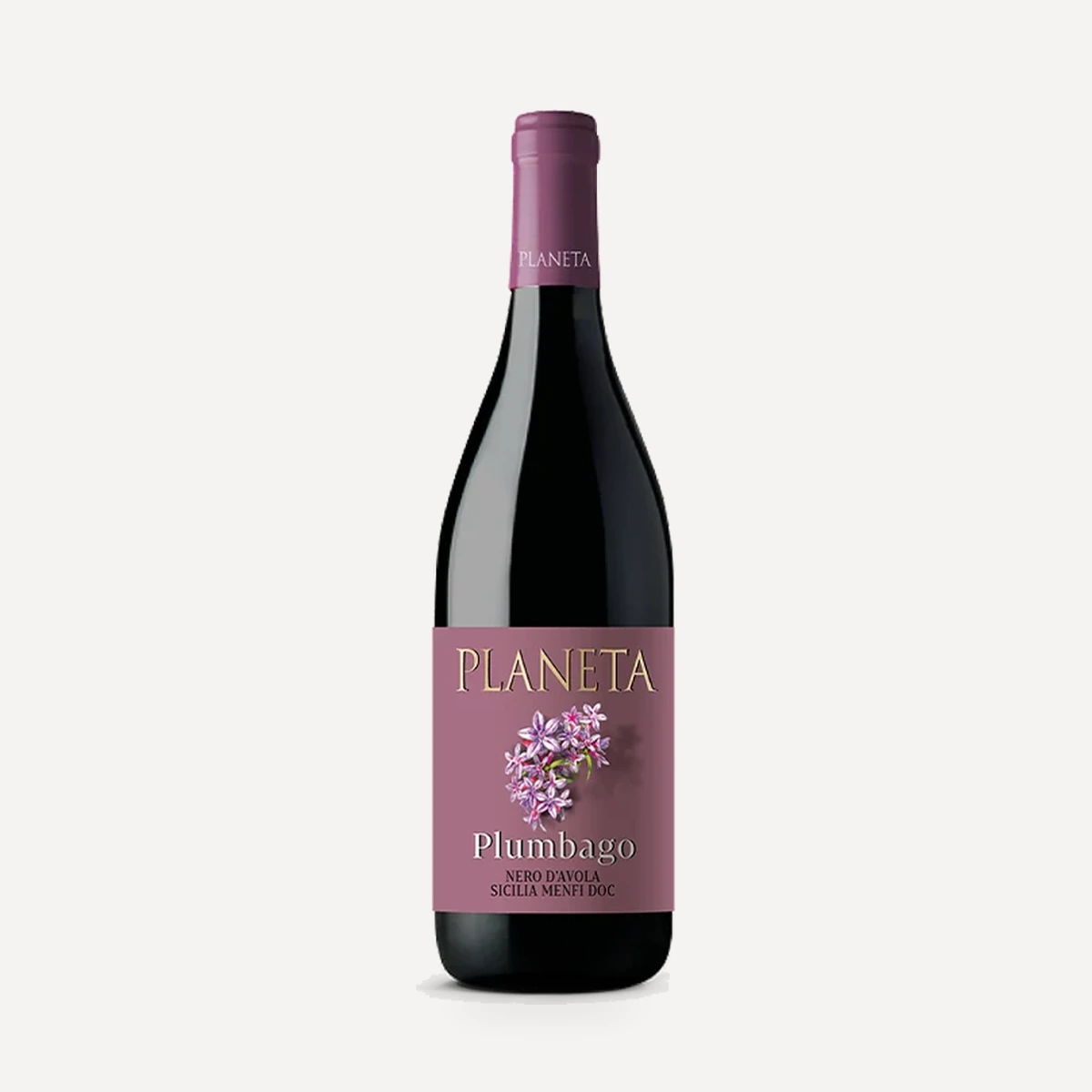
First produced in 2008, Plumbago takes its name from the violet-coloured wildflower growing in the woods around the Ulmo baglio and vineyards.