Storia
Medieval origins
Villa Pillo originated as a traditional Tuscan agricultural estate during the medieval period. Its early existence is recorded in historical documents preserved over successive centuries. The property stands in an area crossed by trading and pilgrimage routes since Etruscan times, including the network that developed into the Via Francigena.
The Incontri estate and its historic buildings
Marchese Incontri, identified as the original owner, commissioned the Palladian villa and its park during the eighteenth century. The estate's historic wine cellars date from 1700.
A separate panoramic building was erected in the late nineteenth century. It initially served as a granary and was subsequently used for approximately 40 years as a vinsantaia for the maturation of traditional Tuscan sweet wine.
Earlier vineyards
The oldest specifically dated vineyard planting is a Trebbiano and Malvasia vineyard established in 1968 for Vin Santo del Chianti.
Purchase and renewal by John and Kathe Dyson
In 1989, the 500-hectare estate was purchased by the American couple John and Kathe Dyson. Their restoration program encompassed the Palladian villa, its park, old farmhouses and the wider property. They also renewed the wine operation, refurbished and modernized the winery, planted new olive groves and began a broad vineyard-replanting project.
The Dysons combined established Tuscan methods with advanced Californian techniques. Their vineyard program envisioned approximately 50 hectares, of which 40 hectares were completely replanted. Sangiovese remained central, while French varieties—including Syrah, Merlot and Cabernet Franc—were introduced or expanded in response to the estate's soils and sites.
Vineyard development from the 1990s
Syrah was planted in 1991 in the Palazzaccio, Sanguigno and Peretola vineyards. Merlot vineyards associated with Sant’Adele, Meliana and San Michele were planted between 1991 and 1995. Cabernet Franc plantings used for Vivaldaia date from 1991 and 1997. Sangiovese for Cypresses was planted in 1997, while a Sauvignon Blanc vineyard followed in 2005.
The redevelopment placed vineyards on sites selected for their soil characteristics and aspect. Newly available clones and rootstocks were chosen with quality as the objective, while planting densities and trellising systems were designed to restrict yields. The program was accompanied by a quality-driven approach in both vineyard and cellar.
Hospitality development
The former late-nineteenth-century granary and vinsantaia was renovated to extend Villa Pillo's hospitality program. It became the setting for a restaurant and expanded tasting experiences, complementing visits to the eighteenth-century cellars.
Terroir
Villa Pillo occupies 500 hectares at Gambassi Terme in the Province of Florence, in the heart of the Chianti area and close to San Gimignano. It lies approximately equidistant from Florence, Pisa and Siena. The estate landscape comprises rolling Tuscan hills, woodland, restored historic farmhouses, cereal fields, olive groves and vineyards.
The 40 hectares of replanted vineyards occupy sites selected for their soils and aspects. Merlot is associated particularly with the estate's clay soils. The Syrah vineyards Palazzaccio, Sanguigno and Peretola lie east of the Via Volterrana, an ancient route that crosses the property. Hot summers bring Merlot to ripeness first among the estate's red varieties, generally in early September, while Sauvignon Blanc can mature by the end of August.
Villa Pillo's vineyard development retained Sangiovese while incorporating French varieties judged suited to the property's soils. The estate is also crossed by Stage 8 of the Via Francigena, whose route passes through its hills and vineyards between Rio Pietroso in the north and the Via Volterrana near Pieve di Santa Maria Assunta a Chianni in the south.
Vinificazione
Villa Pillo's vineyard renewal is based on selected grapevine clones and rootstocks chosen to maximize quality. Planting densities and dedicated trellising systems are intended to produce low yields, while the vineyards occupy sites selected for their soil characteristics and aspect.
Merlot, Syrah and Sangiovese are trained vertically. Foliage catchwires support the season's growth and improve the clusters' exposure to sunlight and air circulation. Winter spur pruning is followed by spring selection of fruit-bearing shoots to regulate both production and quality. Surplus shoots and leaves are removed manually where required.
Harvesting is performed by hand, with fruit selected carefully at maturity. Merlot is normally the first red variety harvested, in early September after the hot August growing period, while Sauvignon Blanc can be picked at the end of August. Grapes for the traditional Vin Santo are selected for soundness before drying.
No organic, biodynamic, regenerative or sustainability certification is identified for the estate.
Villa Pillo's historic cellars date from 1700. Following the Dysons' purchase in 1989, the winery was refurbished and modernized as part of a broader program that combined traditional Tuscan practice with Californian technology.
The cellar works with hand-picked fruit selected at maturity. Where several varieties enter a blend, they may be fermented separately before assembly. The equipment and methods represented across the range include static tanks, dry-ice protection, small French oak barrels, 225-litre barriques, 700-litre tonneaux and traditional caratelli. Oak programs vary by wine and include both new and previously used French cooperage.
Traditional Vin Santo production remains part of the cellar's work. Selected Trebbiano and Malvasia clusters are dried for five months, pressed, and the limited volume of must is rested for 24 hours before transfer to partially filled caratelli. Maturation lasts four years in the vinsantaia, where seasonal changes in temperature contribute to development.
Filosofia
Villa Pillo defines its approach as a union of tradition and innovation: wine is made with passion, supported by technology, and understood as beginning in the vineyard before developing in the cellar.
Since 1989, the estate's renewal has joined traditional Tuscan methods to sophisticated Californian techniques. In the vineyard, this is expressed through site selection, improved clones and rootstocks, carefully designed planting densities, low yields and detailed canopy work. In the cellar, it is expressed through modernization without abandoning historic spaces or traditional processes such as long maturation in caratelli.
The guiding objective is quality across both vineyard and winery, with the character of the estate pursued through Sangiovese as well as French varieties adapted to its soils.
Vini
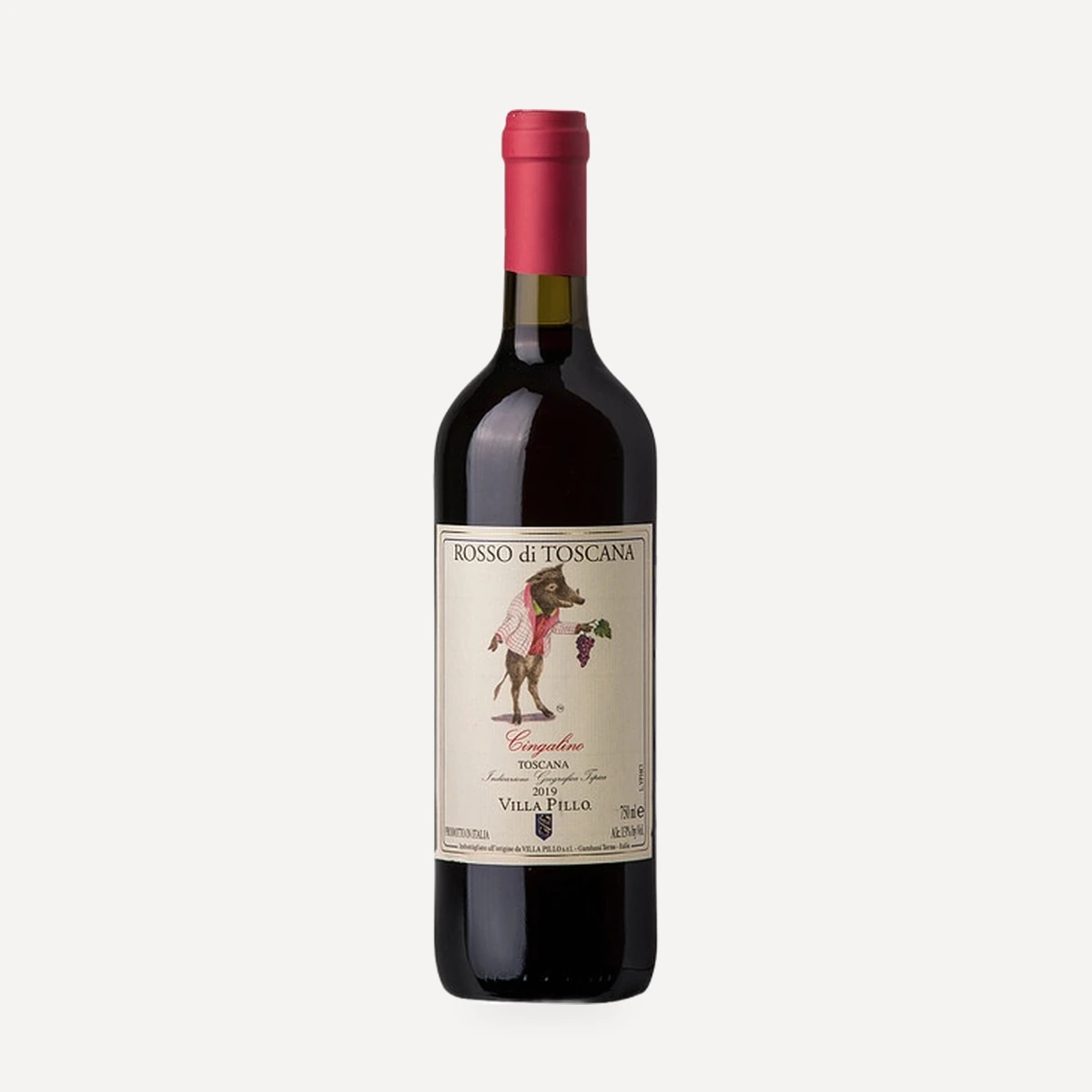
Cingalino