Storia
2012: a film, a harvest and a nickname
Ziobaffa began during the production of Bella Vita, a surf film directed by Californian filmmaker Jason Baffa and shot entirely on 35 mm along the Italian coast. The film followed surfer, artist and environmentalist Chris Del Moro to his family’s homeland, exploring the meeting of traditional Italian craft and contemporary surf culture.
On 16 September 2012, the production came to Poggio al Casone in Tuscany. The film crew and friends helped harvest the grapes, joined the traditional harvest lunch and recorded the occasion on film. During the time spent between the coast and the vineyard, local surfers nicknamed Jason Baffa “Zio Baffa”—“Uncle Baffa,” conceived as the offbeat, fun-loving uncle found in many families.
The friendship continued after filming. Piergiorgio Castellani, a fifth-generation member of a Tuscan wine family, transformed the nickname into an organic Italian wine project with both Tuscan and Californian influences. Jason Baffa worked with Castellani on the bottle designs, while Chris Del Moro drew the first labels by hand.
The grapes harvested at Poggio al Casone in September became the first Ziobaffa wine, Toscana 2012. Its inaugural edition was released in magnums sealed with red wax and individually signed by Piergiorgio Castellani.
2014: Bella Vita reaches the festival circuit
Bella Vita screened at the Santa Barbara International Film Festival in 2014. Its harvest sequence and themes of Italian food, craft, family and outdoor life remained the foundation of the Ziobaffa identity.
2017: California and Japan
At the end of August 2017, Ziobaffa travelled to California, Jason Baffa’s home territory, for the first “Zio does Cali” trip. The journey connected wine, surfing and local makers, including potter Skoby Joe, and featured the first cases of Ziobaffa Prosecco carried in the group’s van.
In October 2017, members of the Italian and Californian community travelled to Japan. Japanese surfers Yuma Takanuki and Kenta Ishikawa participated in the trip, which combined surf sessions, Japanese traditions and shared bottles under the “Zio does Japan” banner.
2019: the family reunion and Brazil
At the end of September 2019, surfers, photographers, filmmakers, cooks and friends from America, Japan and Italy gathered in Tuscany for a week of cooking and communal meals. The programme included tagliatelle with mushrooms, wild-boar stew with olives and dinner between the vineyard rows. Cozy and Jo of Salt & Silver cooked the ambassadors’ dinner, while Paolo and Filippo Parisi supplied eggs and meat.
At the end of 2019, the project travelled to Brazil. The programme brought together surfer Andrew Serrano, Casa Surf and Chef Eudes of Taioba Gastronomia. Ciro Bicudo of Organik World Lab drew the artwork for the tour shirt.
2020: films made from home and a return to harvest
When travel and large gatherings stopped in 2020, the community continued through film. “We are what we eat” was produced from home, followed by the “Keep the World Open” collection. Participants who had shared the 2019 table contributed photography, art, surfing and filmmaking from different parts of the world. Contributors included artist Nilo, filmmaker Jason Baffa, entrepreneur Isabela, surfer Andrew Serrano and photographers Todd Glaser and Gabriela Haydée.
As travel restrictions began to ease, the group returned to the Tuscan vineyard for the 2020 harvest. Josh Hall joined the work among the rows, linking the period of isolation with the documentary series that followed.
2021–2022: the Med Diet Collective
During 2021 and 2022, Ziobaffa produced the Med Diet Collective, a documentary series treating the Mediterranean diet as a way of life rather than a prescriptive diet. The series followed the people who grow ingredients, make food, cook it and bring it to the table.
Filming began on small local roads in July 2021, using an old Fiat 500 to visit producers. The subjects included the Martelli family, pasta makers since 1926, and Luca working in their yellow uniform. Later instalments documented pizza in August 2021, late-season tomatoes in October and freshly pressed olive oil in December. Bread followed in January 2022. Paolo Parisi appeared with the eggs from his hens, Filippo Parisi led the meat story, and Chef Eudes returned for the fish and octopus episode in October 2022. Cerise Zelenetz illustrated the series’ Mediterranean food pyramid.
In October 2022, the Zio Bici Tour travelled by bicycle from Poggio al Casone in Crespina to Bolgheri, finishing along the cypress-lined avenue. The ride was organised with Z-Adventure of Florence and Podere Arduino’s Bolgheri Green.
2023: Vermentino joins the range
Vermentino entered the Ziobaffa family with the 2023 harvest. Grown in Tuscany, it joined Pinot Grigio and Toscana Rosso. Toscana Rosso continued to come from the family vineyards where the original Bella Vita harvest had been filmed.
2026: a new visual identity
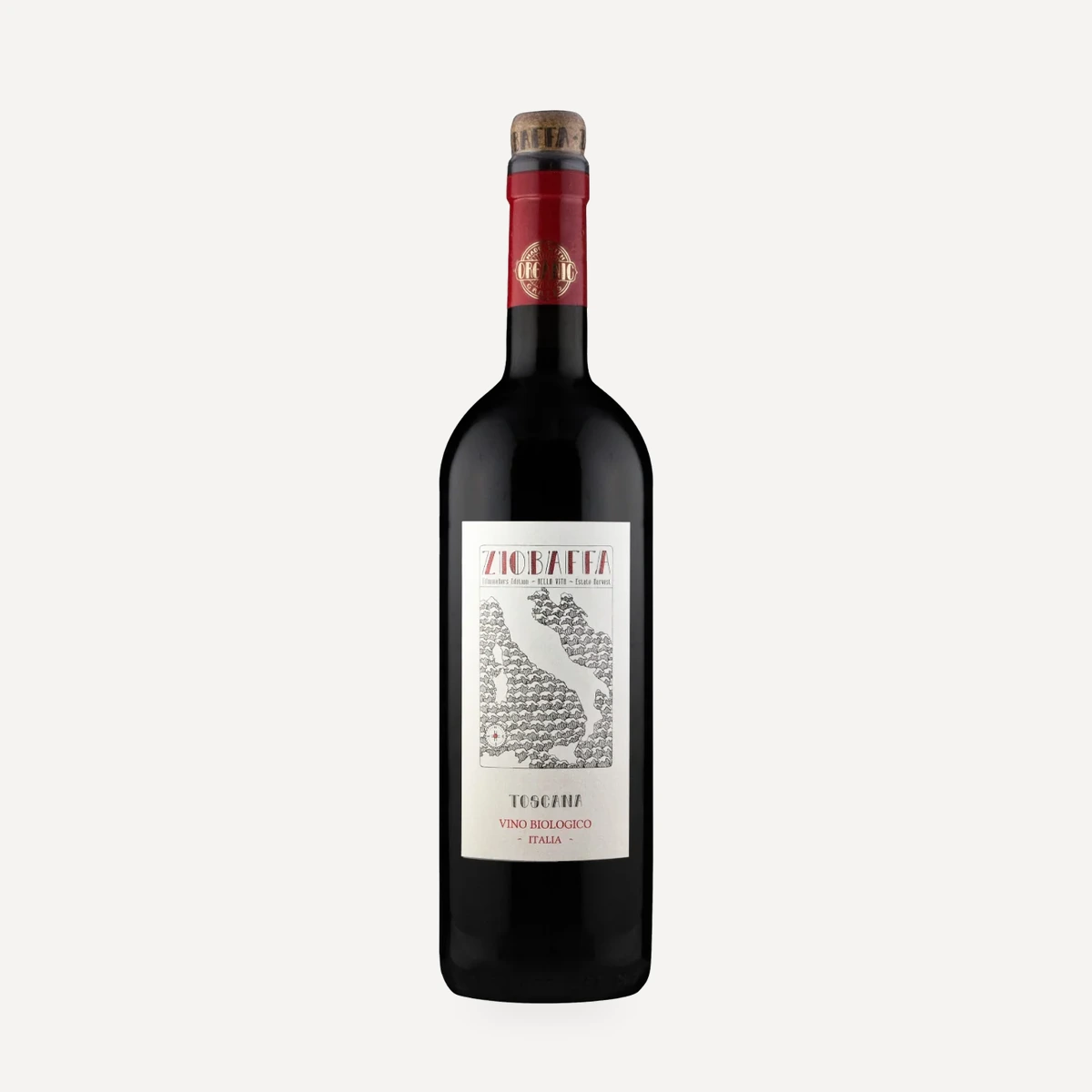
In spring 2026, Ziobaffa completed a graphic redesign. The new presentation introduced a wordmark with a woodblock-like grain, redrawn waves and a textured Materica paper. The change concerned the visual identity rather than the established wines. The label continued an artistic tradition begun with Chris Del Moro’s hand-drawn design of Italy formed from waves, a compass-like seal and striped lettering.
Terroir
Ziobaffa draws its range from three Italian regions and four distinct growing contexts.
Tuscan hills
Toscana Rosso comes from Tuscan hills with warm Mediterranean days and cool nights. The soils combine sandy clay with abundant limestone, providing drainage and mineral complexity. The vines are 15–25 years old and are trained to spurred cordon. The blend is based on Sangiovese with smaller proportions of Syrah and Merlot that can vary slightly with the vintage.
Tuscan coast
Vermentino grows along the Tuscan coast, where warm days are moderated by maritime breezes and cooler nights. The soils are sandy-clay and calcareous, with marine fossils associated with the wine’s saline and mineral character. The vines are 12–20 years old and trained to cordon spur.
Western Sicily
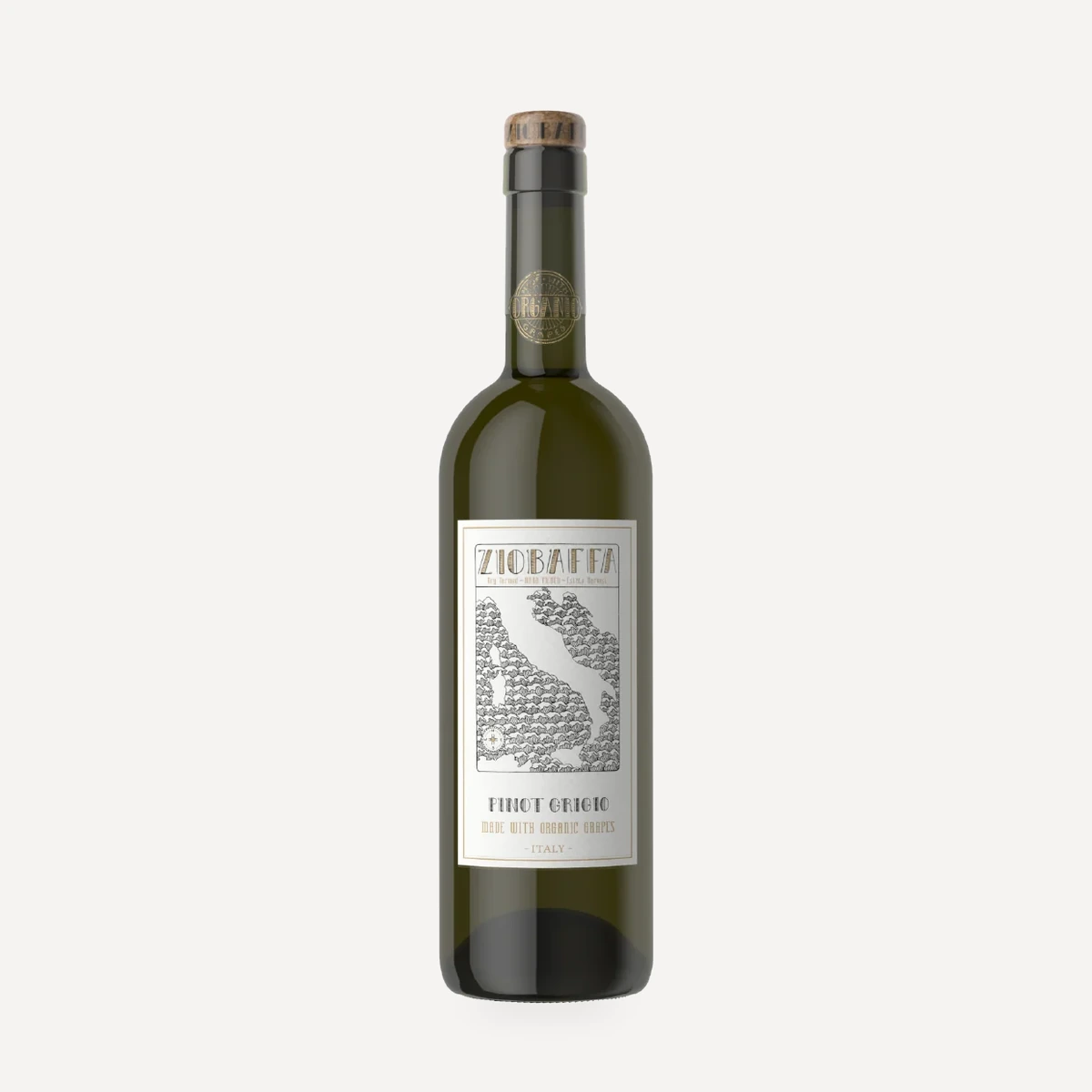
Pinot Grigio comes from the sunny hills of western Sicily. Sea breezes influence the vineyards, while the clay-and-limestone soils offer good drainage and moderate fertility. The vines are 10–15 years old and trained to Guyot.
Veneto and the Prosecco DOC area
Glera is grown within the Prosecco DOC area of Veneto. The vineyards stand on alluvial soils composed of clay, sand and gravel. The vines are trained using Guyot and Sylvoz systems.
Vinificazione
All four Ziobaffa wines are EU-certified organic under control-body code IT-BIO-014. Synthetic pesticides, herbicides and fertilisers are excluded. An independent control body inspects the farming and cellar operations at least annually, and vineyards must follow organic rules for three years before they can use organic status.
Soil fertility is maintained through plant growth between the rows, including cover crops, and through compost. The vegetation supports wildflowers and insects rather than leaving bare ground. Vine protection is limited to natural-origin materials allowed by organic regulations. The wider approach emphasises soil health, local biodiversity and low-impact vineyard management.
The Tuscan vineyards are dry farmed without irrigation. Toscana bunches are picked by hand in September, selecting them at the vine. Prosecco grapes are harvested in September, early in the morning or before sunset, and transported quickly from vineyard to press. Pinot Grigio is picked with care before gentle pressing.
Ziobaffa’s still wines are principally produced in stainless steel, using temperature control to preserve fruit and freshness. Toscana grapes are destemmed and fermented in steel; skin maceration supplies colour and structure. The red sees no oak, remaining for several months in stainless steel before further integration in bottle.
The white-wine processes favour gentle handling and cool fermentation. Pinot Grigio is gently pressed and fermented at low temperature in stainless steel without oak, followed by a short period on fine lees for texture and aromatic depth. Vermentino ferments at 14–18 °C for 10–15 days and remains on its lees for several weeks after fermentation.
For Prosecco, the September harvest is moved from vine to press as quickly as possible. The grapes are destemmed, cold crushed and fermented in steel tanks. A second fermentation by the Martinotti method creates the bubbles while preserving a fresh profile.
The winery works under Equalitas Sustainable Winery certification. Earlier production principles retained on the domain include minimal intervention during vinification and ageing, native wild-yeast fermentation, minimal filtration and fining, restricted sulphur-dioxide additions and the exclusion of additives intended to modify aroma, colour, flavour or texture. The wines are presented as non-GMO, and the range is described as vegan.
Filosofia
Ziobaffa was conceived around five connected ideas: surfing, travel, organic food, family and wine. Its identity joins Tuscan family winemaking with Californian surf culture and treats wine as a means of bringing people together rather than as a ceremonial object.
The stated product goal is to combine organic farming, environmental responsibility and accessible pricing. In the vineyard, that means excluding synthetic pesticides, herbicides and fertilisers, maintaining living ground between the rows and submitting both farm and cellar to independent organic inspection. In production, the emphasis is on restrained intervention, freshness and the avoidance of substances used to engineer aroma, colour, flavour or texture.
Sustainability is framed as an ongoing task encompassing environmental, social and economic considerations. Castellani’s Equalitas certification evaluates the environment, the people doing the work and the economic durability of the winery. Packaging decisions follow the same approach through lighter glass, renewable cork and FSC-certified paper. Ziobaffa presents these measures as a continuing process and intends to keep seeking improvements in growing, production and packaging.
Vini
Ziobaffa Terre Siciliane IGT Pinot Grigio