About this wine
Vineyard and terroir
The 1.0582-hectare vineyard is located at Corona, a hamlet of Mariano del Friuli in the province of Gorizia. It occupies part of cadastral parcel 1388 on land-registry sheets 4 and 5. Planted in 1991, it has a calcareous mineral base rich in iron sesquioxides and poor in organic matter and other nutrients. The resulting slow vegetative growth helps restrict production.
The vines face south, with rows oriented northwest–south. They are planted at 2.70 × 0.80 m, or 4,630 vines per hectare, and trained to unilateral Guyot with four to five buds per cane. Light summer trimming improves the balance between leaves and clusters. No fertiliser is used. Rootstock is SO4 Kl. 31 Op., with Friuli Venezia Giulia clonal selection.
Grapes
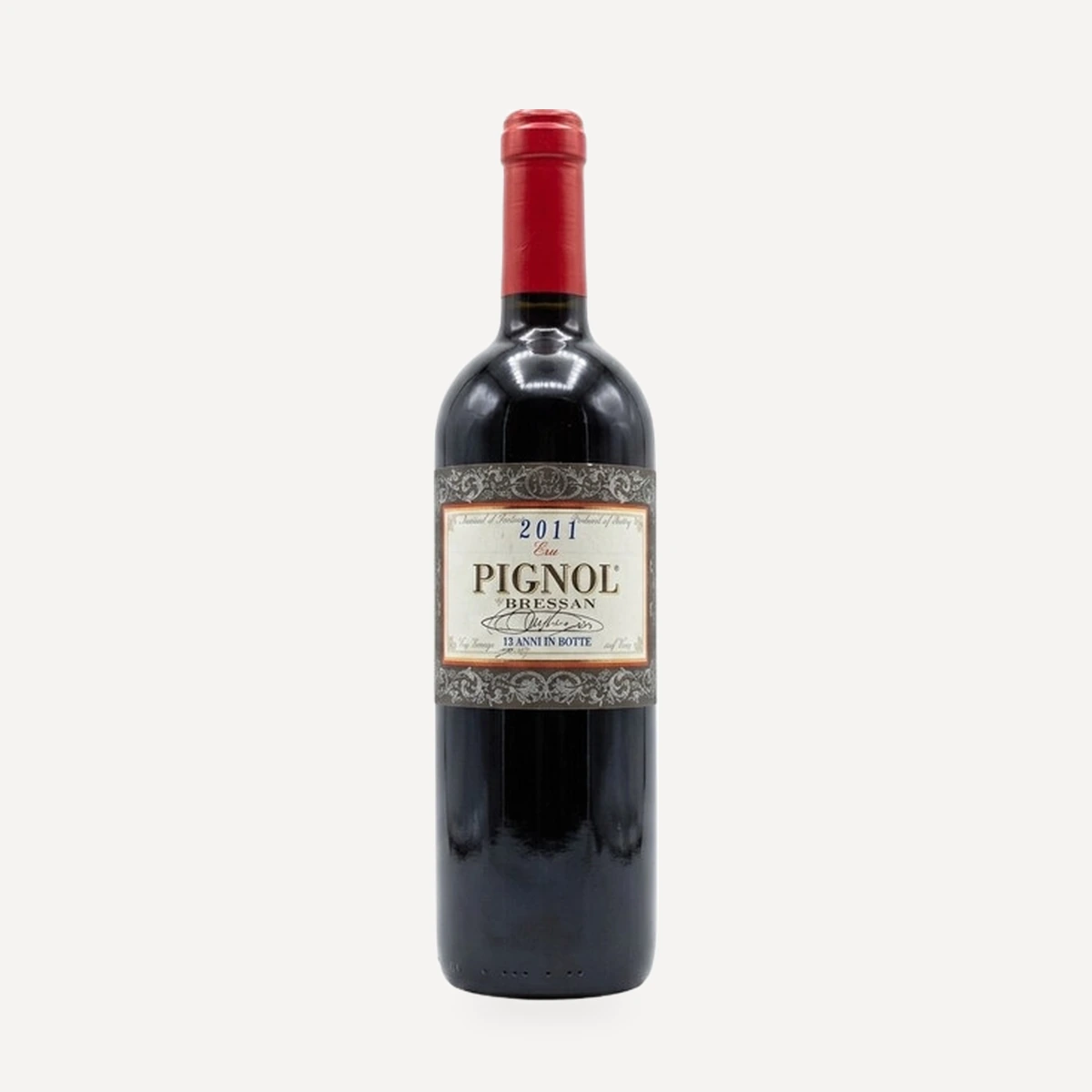
100% Pignolo, classified as Venezia Giulia IGT. Yield is 3,500 kg per hectare and 0.5–0.8 kg per vine.
Vinification
The grapes are picked exclusively by hand at physiological maturity, with timing guided by the ripening curve. They are destemmed and gently pressed. Primary fermentation proceeds on the skins for 20–40 days, depending on the vintage, at a controlled 24–29°C with refrigeration. After racking, a secondary fermentation continues for another 40 days. The wine is subsequently held in AISI 316 stainless-steel tanks.
Ageing
Depending on the intended maturation, the wine spends 10, 12, 15 or 20 years in 2,000-litre oak casks. It is bottled at the end of spring, packed in groups of 500 bottles inside large chests and aged for a further 15 months in a temperature-controlled warehouse. Long maceration and elevated fixed acidity give it the structure for prolonged development.
Tasting profile
Vivacious ruby red, with good alcohol and acidity, a harmonious profile, elegant body and delicate, supple tannins. Initially reserved and vinous on the nose, it gradually opens into an inviting fruit-led bouquet. Its character is restrained and slow to reveal itself.
Label / history
Pignolo is presented as one of Friuli Venezia Giulia’s historically esteemed indigenous grapes. References reach back to the late seventeenth century, including Abbot Gio Batta Michieli’s Bacco in Friuli. G. Poggi later described a rustic, highly sensitive vine of limited vigour that nevertheless produces a distinctive wine with strong alcohol, acidity, characteristic fragrance and notable resistance to ageing. Poggi also recorded Professor Dalmasso’s assessment of a 1930 Pignolo as a singular, luxurious style of wine.