About this wine
Vineyard and terroir
San Petrolo is made from selected White Malvasia and Tuscan Trebbiano grown in the estate’s remaining rows from the 1960s and other old vineyards. The bunches are placed in perforated crates and left in a dry, well-ventilated room until February–March following harvest, or nearly until Easter. Once the desired degree of withering is reached, the fruit is carefully sorted for soundness.
Grapes
The latest published technical sheet, for 2008, gives 20% White Malvasia and 80% Tuscan Trebbiano in its variety field. Other passages provide conflicting proportions, detailed in notes.
Vinification
The selected bunches enter a pneumatic press whole and are pressed gently. The resulting must rests for approximately two days so that solids can settle. It is then transferred to 50 L caratelli, filled to roughly 70%, in the well-aerated vinsantaia. Large natural temperature variations in this room accompany fermentation.
The wine is bottled without filtration. After about nine years, only the barrels judged to have developed best are assembled into the final blend.
Ageing
Maturation lasts approximately nine years in small 50 L caratelli; the main wine page identifies them as new. Bottling and further maturation in bottle complete the process, although no bottle-ageing duration is given.
Technical data
For the 2008 vintage: 13.69% alcohol by volume, total acidity 11.47 g/L, volatile acidity 2.22 g/L, pH 3.60, residual sugar 409.50 g/L and dry extract 533 g/L. Production comprised 150 bottles of 0.375 L and 287 bottles of 0.250 L. The broader wine-page figure is approximately 600 half-bottles.
Tasting profile
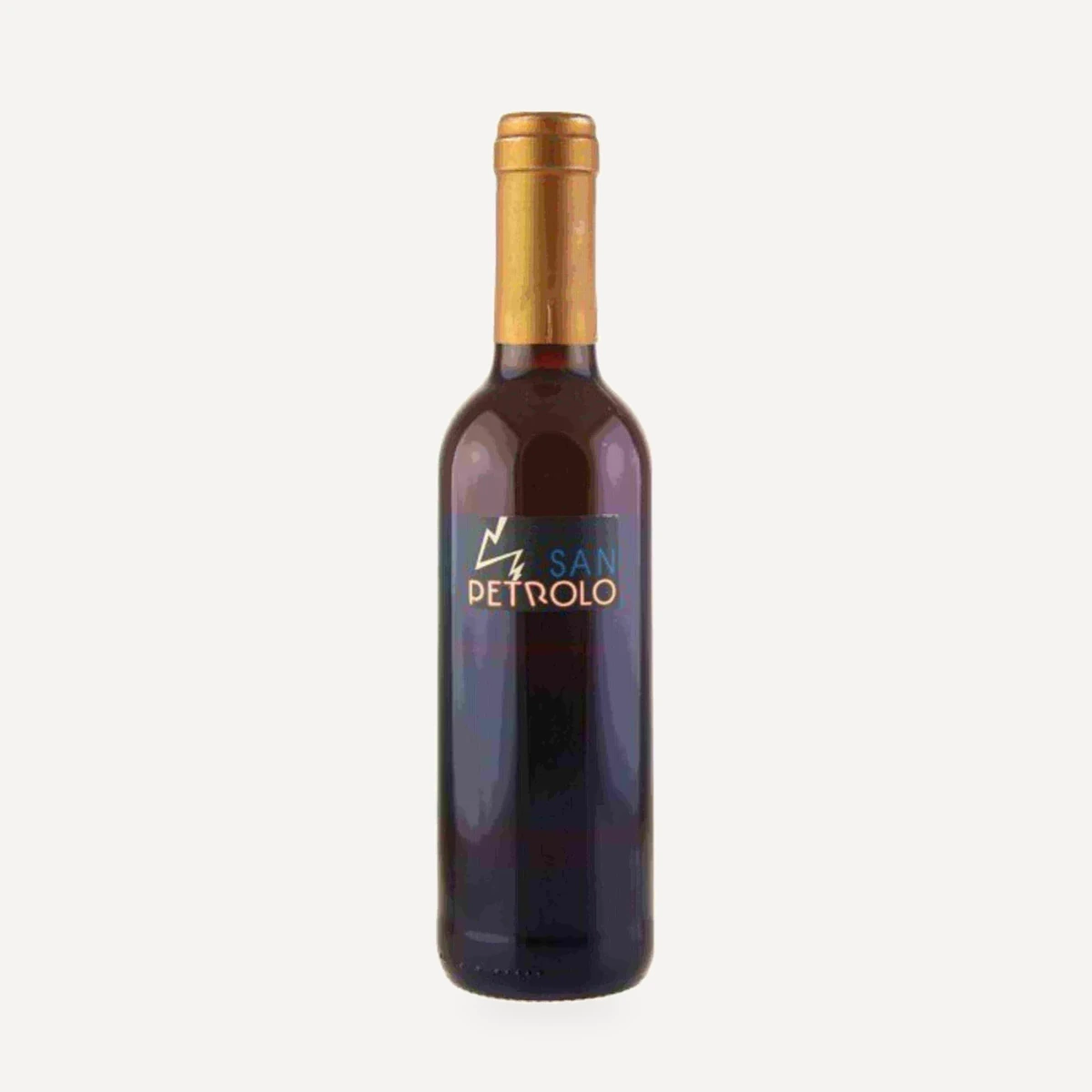
The 2008 is dark brown with deep amber highlights. Its texture is intensely sweet, viscous and glass-coating, with pronounced concentration and richness. The aromatic profile evokes dried fig, maple syrup, chestnut honey and bitter chocolate.
Vintage notes
The selected PDF also contains technical sheets for 2007 and 2006, but the current card uses the latest published vintage, 2008. The 2008 wine has lower residual sugar than the general stylistic statement of more than 450 g/L printed in the same sheet, while still retaining the dense, highly concentrated character associated with San Petrolo.
Label / history
Petrolo had produced Vinsanto del Chianti since the 1950s. From the 2001 vintage it adopted the name San Petrolo and the IGT Toscana Passito classification because the wine’s analytical profile—unfiltered, relatively low in alcohol and exceptionally high in sugar—did not fit the limits of the former denomination. San Petrolo is entirely produced and bottled at the estate.