Storia
Earlier land use
Amoenus works with agricultural land in Abruzzo overlooking the Adriatic. The fields were laid out and cultivated by earlier generations before being abandoned. The surviving plantings preserve evidence of those earlier agricultural decisions: the small mixed vineyard contains white and red grapes, including old Montepulciano material and a handful of Moscatello Bianco vines, while the olive grove retains a multi-variety composition conceived more than a century ago.
Foundation and recovery
Giada and Gaetano founded Amoenus after deciding to pursue agriculture consciously. Their project was conceived as an agricultural and artisan enterprise dedicated to bringing abandoned land back into production, reassessing its potential under climatic conditions that have changed since it was first planted. The farm developed a plant-based range rooted in foods associated with the Mediterranean diet, including wine, extra-virgin olive oil, legumes, gluten-free cereals and their derivatives.
Recovery of the small vineyard included an ampelographic examination of its red half. This work distinguished old Montepulciano clones alongside Sangiovese. The white portion yielded Trebbiano, Malvasia and rare Moscatello Bianco vines. Amoenus used the mixed composition rather than restructuring it around a single variety: the red grapes were fermented together, following the complementary logic built into the original planting, while the small quantity of Moscatello was used to prepare an aromatic fermentation starter for the white grapes.
Diversification and research
In 2022 Amoenus established its first micro-planting of saffron to create a saffron-infused olive-oil condiment. After initial artisanal trials, food technologist Ancuta Nartea of the Università Politecnica delle Marche developed a method for extracting safranal from the farm's stigmas. The process uses green techniques and university equipment including ultrasound, while fragments of the red stigmas remain visible in the finished condiment.
The enterprise has continued to frame its development around organic cultivation techniques, rehabilitation of existing perennial plants, low environmental impact, plant-based food and measures intended to reduce food and packaging waste.
Terroir
Amoenus farms in Abruzzo on land overlooking the Adriatic. These are inherited agricultural landscapes shaped by previous generations and later abandoned. Their recovery is approached in light of climatic conditions that have changed since the original plantings.
Rainfall and dry periods have become less predictable. Across the farm, species and sowing dates are consequently selected to make use of available rain or periods of drought. Mature perennial plants are especially valued: their accumulated resilience is considered an advantage in coping with climatic change.
The surviving vineyard is a small, historically mixed planting. Its composition—Trebbiano, Malvasia and a few Moscatello Bianco vines on the white side, with old Montepulciano clones and Sangiovese on the red side—forms the principal documented expression of its inherited site character.
Vinificazione
Amoenus follows organic cultivation techniques and treats sustainability as a farm-wide working principle. Its practices include crop rotation, green manure, false sowing and conservation of existing biodiversity. The aim is to work symbiotically with a complex ecosystem, minimize interference and encourage plants' own immune response to pathogens.
Mature plants are retained and valued for their greater resilience and reduced vulnerability to climatic change. Where old perennial plants are available, the farm studies how best to support them rather than automatically replacing them. For annual cereal and legume crops, species are selected for present climatic conditions and sowing is staggered across different periods of the year to respond to increasingly unpredictable rain and drought.
Maximum yield is not the objective. None of the farm's plots is managed for record production; the stated priority is nutritious food with a low environmental impact. In the vineyard, this broader recovery philosophy is reflected in the retention of old Montepulciano material, the mixed planting and the few surviving Moscatello Bianco vines.
The cellar works with the mixed composition inherited in its small vineyard. Fermentation starters are prepared from estate fruit: the few Moscatello Bianco vines supply an aromatic pied de cuve for the white grapes, while Montepulciano and Sangiovese are combined in a pied de cuve to initiate spontaneous fermentation of the red grapes.
The current white and red vinifications both use seven days of skin maceration. The red must receives continual manual punch-downs during maceration. The skin-contact white is racked dry after maceration. Both wines undergo neutral maturation in stainless steel, preserving the grapes' varietal expression without an oak contribution.
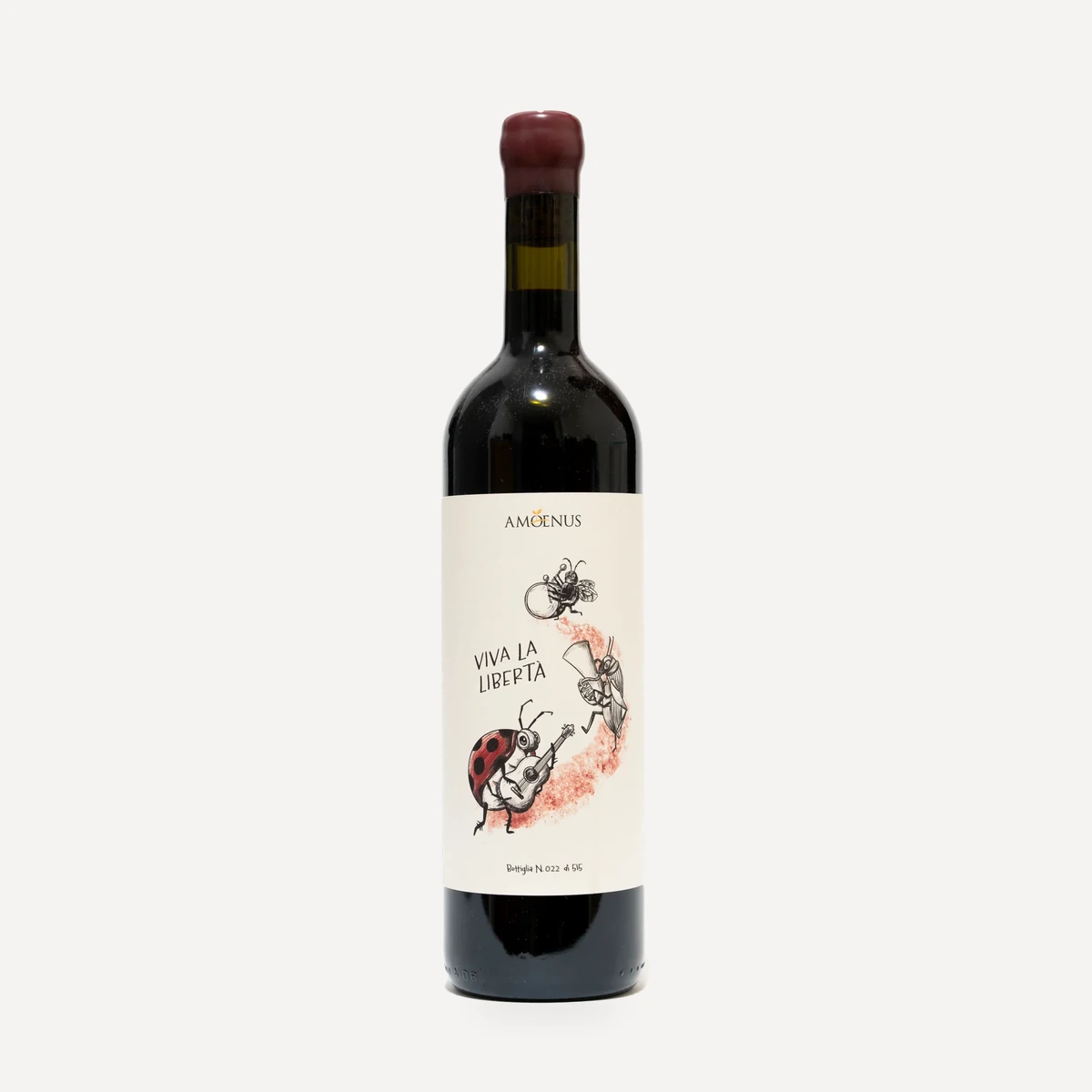
The documented red production comprised 515 individually numbered bottles, illustrating the small scale of the vineyard and vinification.
Filosofia
Amoenus presents agriculture as a necessity and as a means of giving expression to natural beauty. Its central project is the recovery of land shaped by earlier generations and subsequently abandoned, with farming decisions reassessed for present climatic conditions rather than simply reproducing past practice.
The farm aims to work in symbiosis with the existing ecosystem, limiting interference, conserving biodiversity and supporting plants' natural defenses. Longevity and maturity are treated as agricultural assets: established plants are valued for the resilience acquired over time, while the goal for every plot is quality and nutritional value rather than record yield.
Its broader food philosophy is plant-based and inclusive. Amoenus works with naturally gluten-free ingredients suitable for different diets and ages, seeking to bring people together around healthy, flavorful food. It regards Italy's traditional plant foods as a resource to be rediscovered and places wine within a larger agricultural range that includes olive oil, legumes, cereals, pasta, herbal infusions and saffron.
Environmental responsibility extends beyond cultivation. The business participates in Too Good To Go's “Look, Smell, Taste, Don't Waste” initiative, marks products as potentially good beyond their minimum durability date and develops larger formats to reduce packaging per unit of food. Its stated priority is sustainability rather than volume.
Vini