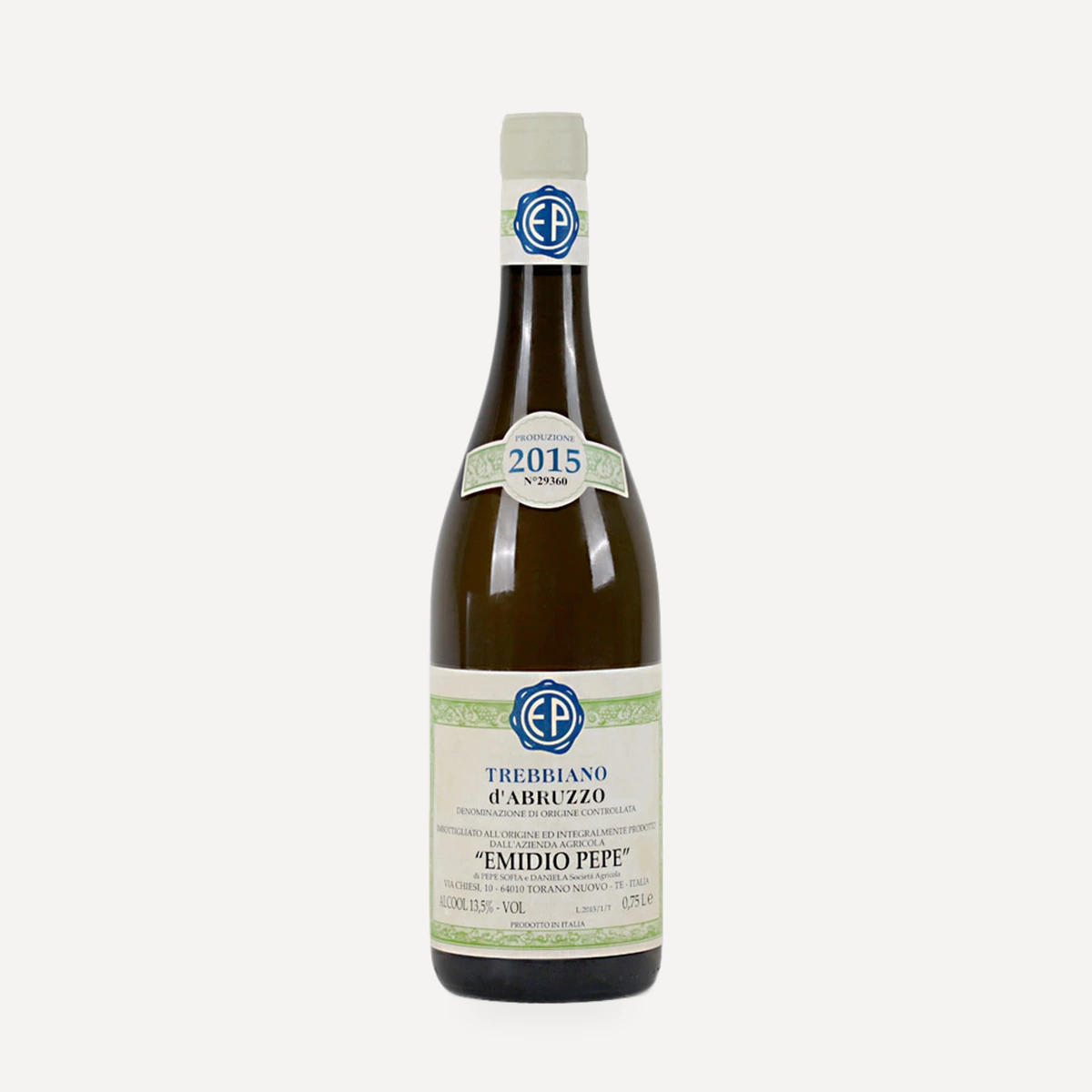
Questo vino
Vineyard and terroir
Trebbiano parcels documented around Casa Pepe and Torano Nuovo are Morganti Nord (0.75 ha, 2016), Vacchì (0.41 ha, 2008), Pozza (0.41 ha, 2008), Mianinitt (0.21 ha, 1974), Mozzadoro (0.21 ha, 1974), Menghetta (2.1 ha, 2012), Morganti Sud (0.75 ha, 2016) and Donatella (0.78 ha, 1988). The estate lies between the Adriatic Sea and Gran Sasso, with clay-limestone soils, broad solar exposure, diurnal temperature variation and persistent winds. Biodynamic preparations and cover crops are used without chemical products.
Grapes
100% Trebbiano d’Abruzzo, an ancient indigenous Abruzzo clone distinct from other members of the Trebbiano family.
Vinification
Selected grapes are harvested entirely by hand. Batches of roughly 350 kg are crushed by foot in a large wooden vat for 40–45 minutes, gently extracting material, aromas and flavour without breaking the stems. Only the juice moves into small concrete tanks for spontaneous fermentation lasting 30–35 days. No selected yeasts or enzymes are added.
Ageing
The wine remains in concrete until the second spring after harvest, when it is bottled directly and begins extended bottle development. Old-vine Trebbiano is bottled early to retain richness and vitality; malolactic fermentation may consequently occur in bottle, and the resulting carbon dioxide can assist preservation. Selezione Vecchie Vigne bottles rest in the cellar for at least four years before release. At least half of total estate production is retained, with vintages released when mature.
Technical data
The 2024 declaration gives 301 kJ / 72 kcal, 0.2 g carbohydrate and 0.2 g sugar per 100 ml. Ingredients are organically grown grapes, sulphites and sulphur dioxide; bottling occurs under protective atmosphere.
Tasting profile
In youth the wine is elegant and austere, with pronounced minerality, vivid acidity and aromatic balance. Bottle age brings greater complexity, volume and depth.
Vintage notes
The 2024 white-grape harvest began early, on 17 August. Fruit health was impeccable and fermentation was energetic yet relatively cool. In 2022, Trebbiano was harvested from 5 September after late-July rain restored water for final ripening. The 2021 wine retained tension and a saline impression despite extreme drought. The long, steady 2020 ripening season preserved acidity and moderated potential alcohol. The 2019 whites combined naturally high acidity with satisfactory phenolic maturity. Older observations include intense acidity and longevity in cool 2004, difficulty under the heat of 2003, and particularly elegant, age-worthy wines in cool 2002.