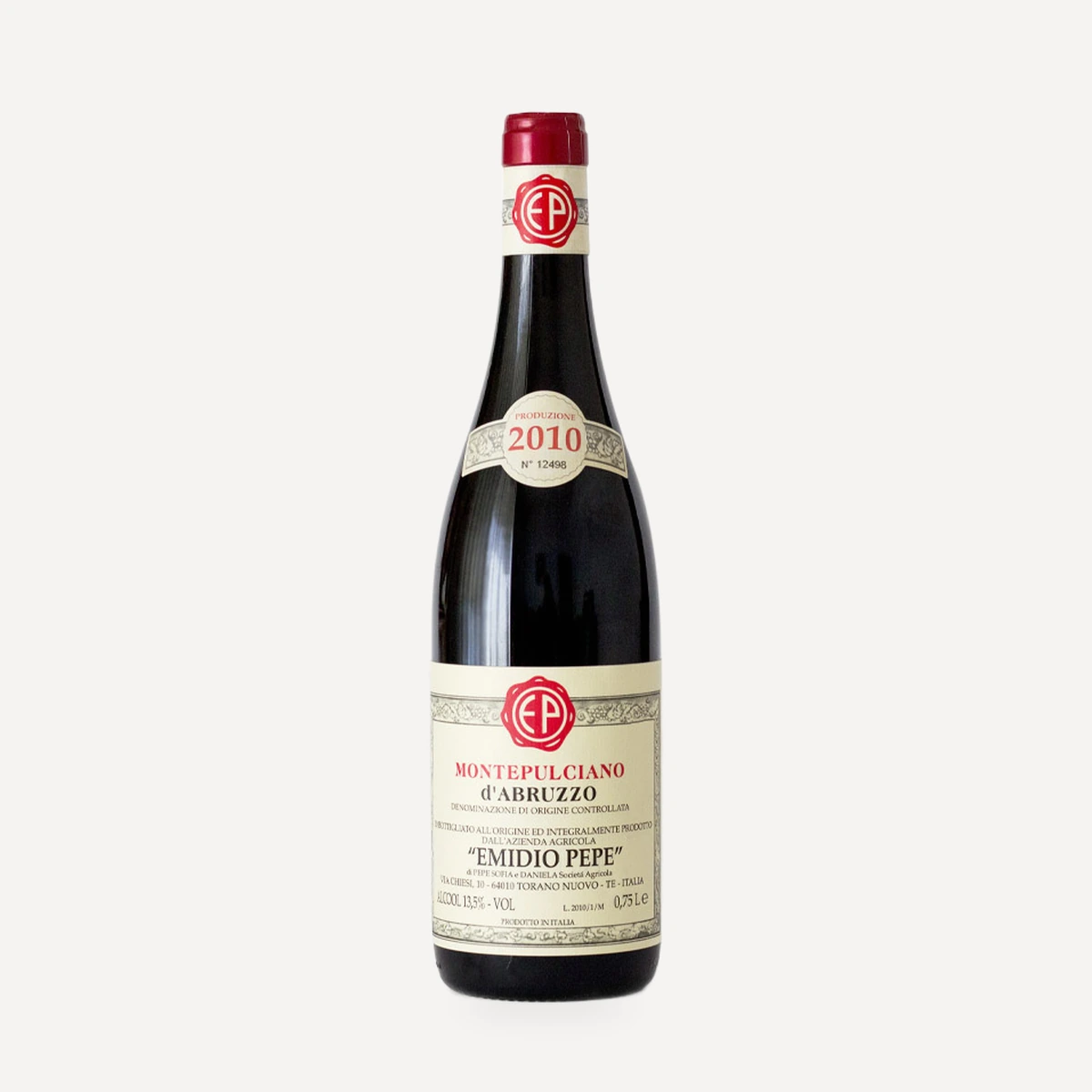
Questo vino
Vineyard and terroir
Documented Montepulciano parcels include Branella (2.6 ha, planted 1971), Casa Pepe (1.28 ha, 1974), Mianò (0.45 ha, 2006), Torretta (1.98 ha, 2004) and Daniela (1.98 ha, 2004). Casa Pepe and Branella, the two oldest parcels, have been mapped and vinified separately since 2020. Their blue-grey Calabrian marls form a mosaic of compact calcareous clays, limestone-sand veins, pebbles and occasional softer sands. One parcel gives more luminous fruit and fine-grained tannins; the neighbouring site shows darker, broader tones and lingering saline depth.
The traditional Pergola Abruzzese provides shade that slows Montepulciano ripening and helps retain elegant tannins. The Torano Nuovo climate combines Adriatic influence with cool currents from Gran Sasso; diurnal temperature variation and steady winds assist gradual ripening. Farming uses biodynamic preparations and cover crops without chemical products.
Grapes
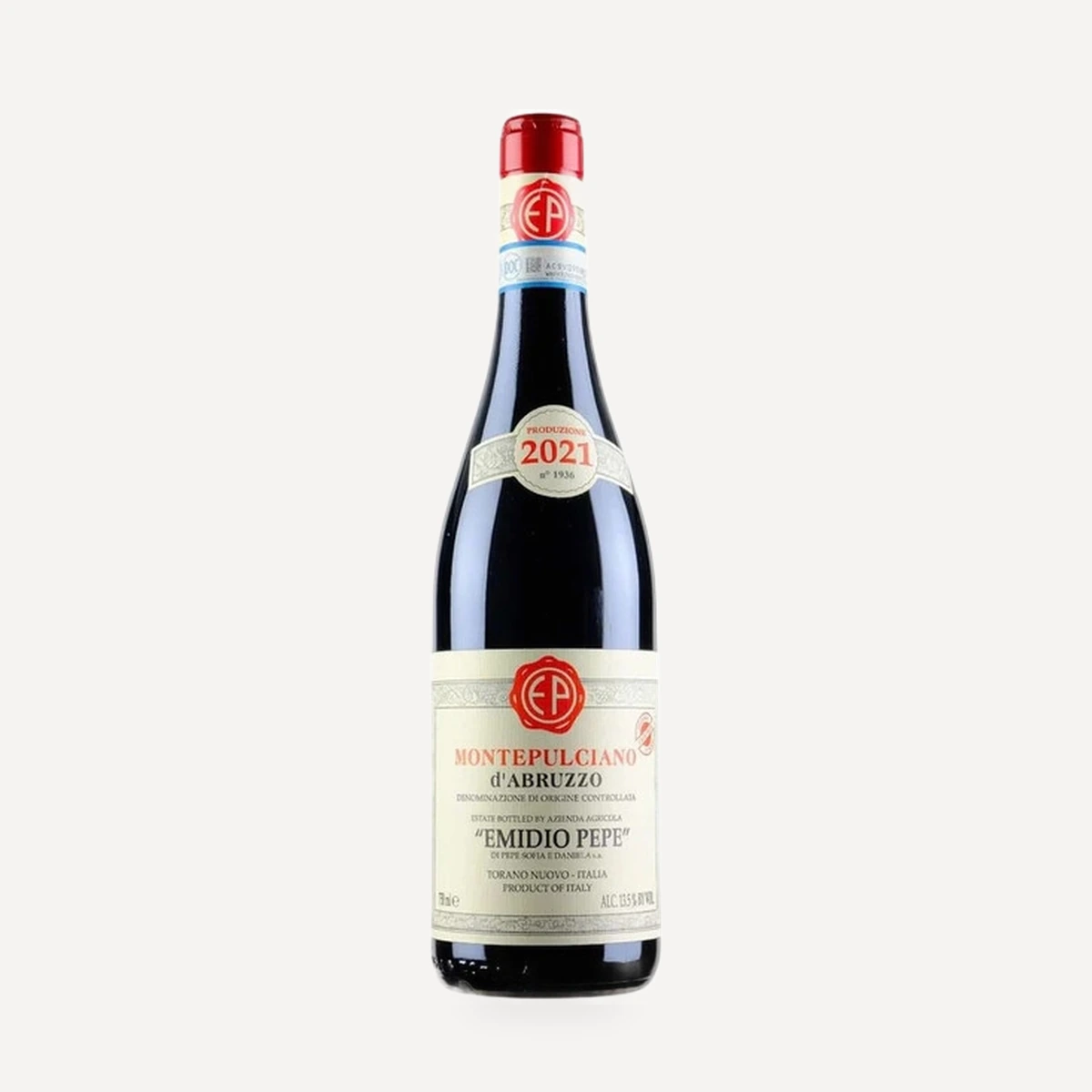
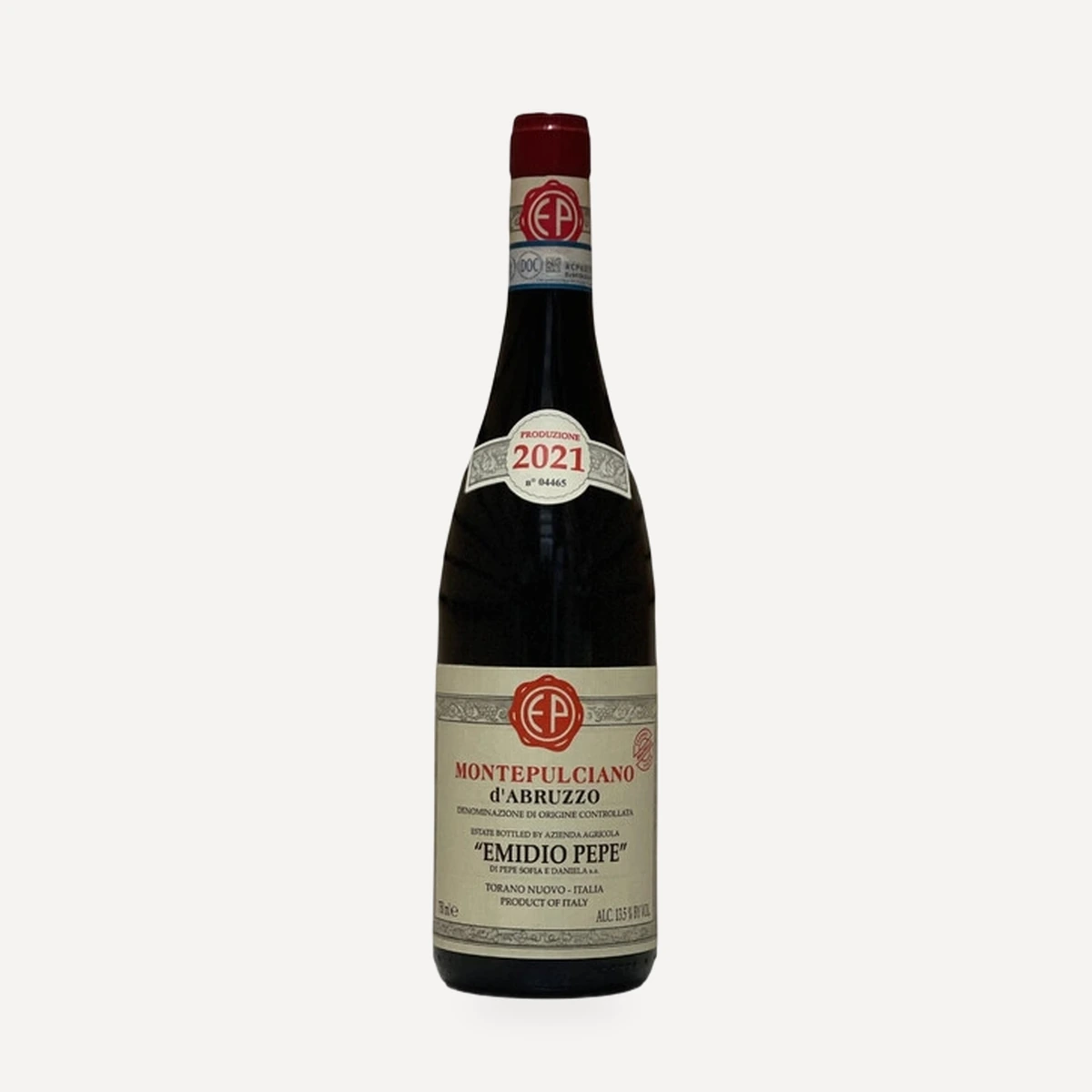
100% Montepulciano d’Abruzzo.
Vinification
Fruit is picked and selected entirely by hand. The grapes are manually destemmed over a net set above a wooden vat. Intact berries fall through while unbroken stems remain behind, avoiding bitter stem tannins and preserving indigenous yeasts on the skins. Fermentation is spontaneous, with neither selected yeasts nor enzymes. Concrete provides a neutral, temperature-moderating environment.
Ageing
The wine ages in bottle without filtration. At least half of the estate’s production is retained in a cellar holding more than 350,000 bottles, and small quantities of older vintages are released when mature. Old-vine lots go directly into the ageing cellar and carry the Selezione Vecchie Vigne stamp; younger-vine wines reach the Italian market after roughly two to three years.
Before release, qualifying old bottles are reopened and decanted by hand to remove sediment and assess condition. Each bottle is topped with wine from another bottle of the same vintage, recorked and marked with the decanting year.
Technical data
The 2024 declaration gives 300 kJ / 71 kcal, 2.2 g carbohydrate, 0.4 g sugar and 0.1 g salt per 100 ml. Ingredients are organically grown grapes, sulphites and sulphur dioxide; bottling occurs under protective atmosphere.
Tasting profile
The variety combines immediate appeal with substantial ageing capacity. Pergola-grown fruit develops elegant skin tannins. The 2003 wine illustrates the mature style: vibrant acidity integrated with bold tannins, while Casa Pepe and Branella show contrasting luminous, fine-grained and darker, saline expressions.
Vintage notes
The inaugural vintage was 1964. In 2024, rain between the white- and red-grape harvests gave Montepulciano additional time to complete phenolic ripening; harvesting concluded on 3 October. The healthy fruit fermented energetically at relatively cool temperatures, extending maceration by two days. The 2022 harvest began on 22 September and introduced an old manual-destemming arrangement with gravity unloading to preserve berry integrity. The 2020 vintage achieved complete ripening and exceptional skin quality. Hail reduced the 2019 Montepulciano crop by about 40%, while careful selection reduced quantities again in 2018. The estate retained 80% of the balanced 2015 production for ageing. Among mature vintages, 1985 is considered one of its finest expressions, while 1983 demonstrates the variety’s longevity through deep colour and concentrated tannins.