Storia
Four generations of winegrowers
I Campi grew from the winegrowing heritage of the Prà family. Flavio Prà represents its fourth generation. After completing his studies, the Veronese oenologist began an extended period of study and practical work devoted to viticulture and high-quality winemaking. Alongside his own project, he developed experience through collaborations with important wineries in Veneto and elsewhere in Italy.
Flavio Prà’s project
After 15 years of work and experience, Flavio decided to create a project in which he could test new viticultural and oenological strategies with the objective of achieving the highest possible quality. His family supported the initiative and adopted his emphasis on carefully matching grape varieties to suitable sites and preserving their pure expression.
The search for the most appropriate terroir for every wine inspired the name I Campi. The project was conceived from the ground up: each wine begins with the soil, the site’s pedoclimatic position and its capacity to ripen a particular grape variety. The selection of high-hill vineyards became central to the estate’s development.
High-altitude expansion
Flavio subsequently planted a new vineyard at more than 500 m in Val d’Illasi. The site is enclosed by woods, with strong day–night temperature variation and substantial biodiversity. The family waited for the young vines to develop, convinced that the location could yield grapes suited to wines of complexity and longevity.
The present generation
The winery and production centre stand at Località Allodola in Cellore d’Illasi. The Prà family’s winegrowing heritage now spans four generations. Flavio intends to transmit it to his children, and Gloria already works alongside him as the first step in that generational continuity.
Terroir
The Lessini foothills
The principal sites are closely connected to the Monti Lessini, the mountain system overlooking the Veronese and Vicentine plains. Its proximity shapes both the geology and climate of the hill and foothill vineyards. Erosion, runoff and the redistribution of geological material have created varied soils, while the mountains exert a decisive climatic influence.
The broader geological landscape extends from Lake Garda and the Val d’Adige to the ancient submarine volcanic formations of the Berici and Euganean hills. During the Eocene, approximately 50–60 million years ago, part of the Lessini foothill zone was a coral reef rich in fish and other marine species. The fossil record is represented by the Pesciara di Bolca, near the upper ridges of the Alpone valley, where the Cerato brothers conducted excavations that yielded fossils now held by museums around the world.
Valleys, airflow and altitude
The Tramigna and Progno di Illasi valleys form two deep north–south corridors descending from the Monti Lessini toward the Po plain. Their orientation and pronounced elevation changes—especially in the Illasi valley—generate persistent air currents. The winery’s high-hill strategy uses these ventilated conditions to preserve grape quality and freshness.
The selected vineyard holdings average approximately 300 m above sea level. A newer Val d’Illasi vineyard lies above 500 m and is surrounded by woods. Its biodiversity and strong day–night temperature variation influence grape aromas, producing fruit described before harvest as crisp, finely fruity and peppery.
Some Val d’Illasi slopes reach gradients of 30–35%, with retaining terraces in places. The Illasi vineyards are generally well exposed, windy and rich in stony skeletal material. Pebbles deposited over millennia by the Progno created the stony ground associated with Campo Ciotoli.
Monteforte d’Alpone and volcanic Soave soils
The Campo Vulcano site lies on a hill at Monteforte d’Alpone, within the historic Soave Classico zone, and predominantly faces south to southwest. Significant temperature variation, fresh winds from the Monti Lessini and volcanic soils characterize the site. Its grapes develop sugar and acidity levels described as above the Soave average. Dark flint-like mineral tones are associated with these soils.
Other Soave vineyards combine volcanic and calcareous material. Their elevations range from approximately 170 to 300 m, with east, southeast, south and southwest exposures depending on the site.
Lake Garda and the Vicenza hills
Campo Argilla is located on the southern, Brescian side of Lake Garda. Its clay soil and lake currents define the site; the currents bring freshness, while the vineyard occupies a well-exposed, ventilated position at 50–100 m.
Campo delle Pietre lies in the Vicenza hills. Its stony, southeast-facing vineyard is planted at approximately 150 m in the technical documentation, while the general vineyard description places it at 200 m. The site is exposed and ventilated.
Marl and fossil soils
Campo Marna Cinquecento is associated with the Progno di Cellore and the marl of Tregnago. Its fossil marl combines clay and limestone: the clay component contributes structure and savoury character, while limestone is linked to freshness and elegance. The vineyard reaches the estate’s highest elevations and occupies very steep terrain.
Vinificazione
The vineyard programme is based on internal zoning: soil, elevation, exposure, local climate and ripening potential are assessed before matching a site with a grape variety. High-hill vineyards form the core of this strategy, both for grape quality and for retaining freshness.
Vineyard management is framed as a correct and sustainable collaboration with nature. The newer Val d’Illasi vineyard is surrounded by woodland, and biodiversity and strong day–night temperature changes are treated as integral parts of its performance. Steep sites can reach gradients of 30–35%, with retaining terraces where required.
Training systems vary by site. Guyot and Pergoletta Veronese are used in the Soave and Val d’Illasi vineyards, while Campo Argilla and Campo delle Pietre are Guyot-trained. The Durella vineyard uses pergola training. Recorded planting densities range from 2,500 to 8,000 vines/ha, while row spacing varies from 3 × 1 m to 0.65 × 2 m. Site-specific yields range from 5,000 to 12,000 kg/ha; the more restricted Val d’Illasi sources are recorded at 0.6–1.2 kg per vine.
Harvest generally takes place in September and October. The Lessini Durello vineyard is explicitly harvested by hand in September. Grapes in the new high-altitude vineyard are tasted before harvest to evaluate their aromatic development, including crisp fruit and fine peppery notes.
The winery and production centre stand at Località Allodola in Cellore d’Illasi, in the Illasi valley and beneath the Monti Lessini. The building is constructed principally from stone and wood and is surrounded by vineyards. Cellar technology is directed toward three objectives: wine quality, preservation of authenticity and sustainability. Flavio Prà approaches oenology as a rigorous discipline integrated with practical experience and personal intuition.
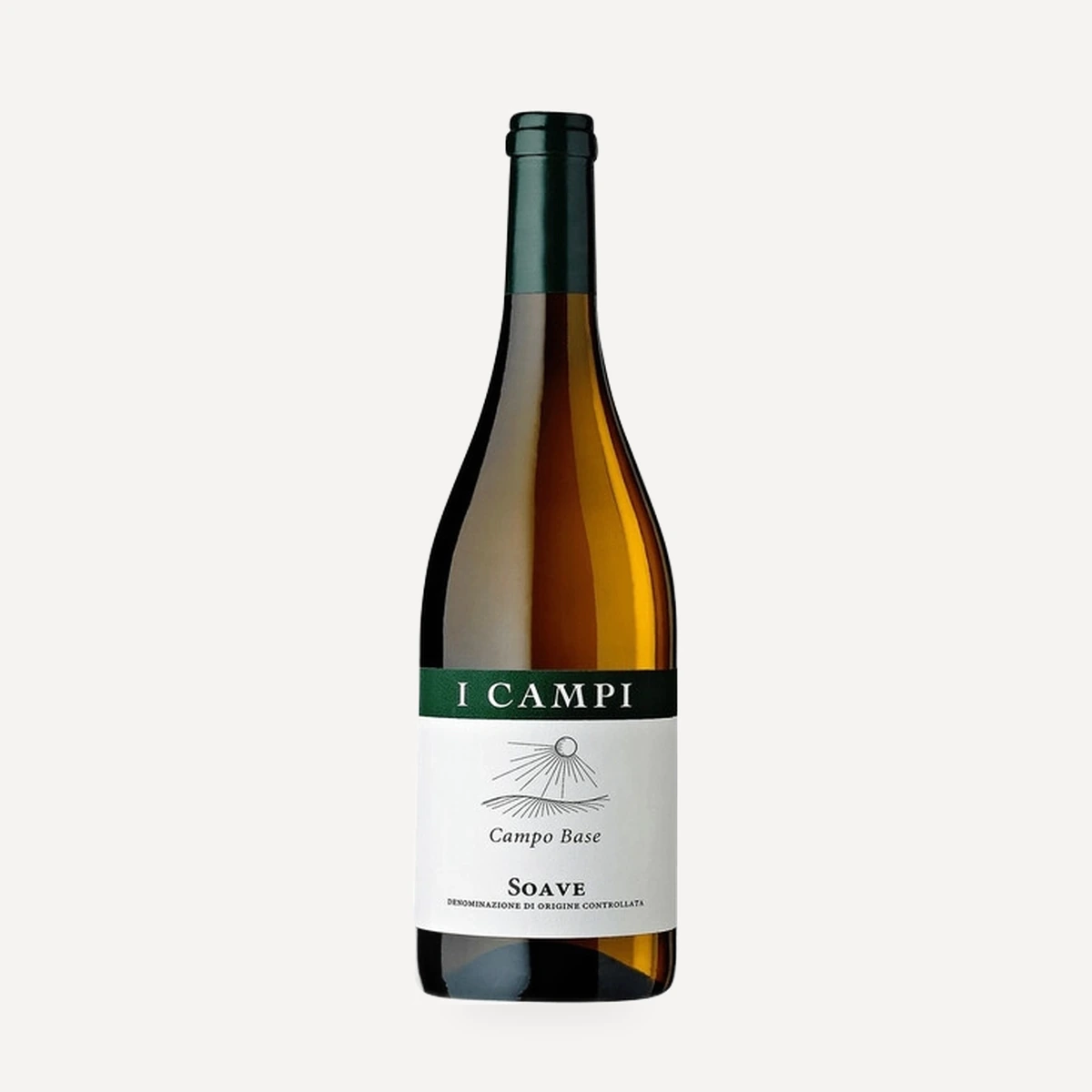
White-wine production generally begins with destemming and crushing, followed by fermentation without maceration. Clarification is natural or static-natural. Fermentation takes place in stainless steel, normally for 15–20 days. The principal Soave and Lugana fermentations are conducted at approximately 18°C, while Pinot Grigio is fermented at 14–16°C. Yeasts are selected in the cellar. Malolactic fermentation is partial for the Soave and Lugana wines and avoided for Pinot Grigio. Lees maturation generally lasts six months; bâtonnage is used for Campo Vulcano, Campo Base and Campo Argilla. Bottling is normally in March, followed by one to six months of bottle maturation depending on the cuvée.
Red-wine production uses destemmed and crushed fruit, with maceration lasting 10–15 days. Fermentation takes place in stainless steel and wood at 23–25°C, using yeasts selected in the cellar. Fermentation lasts approximately 8–15 days, depending on the selection. Malolactic fermentation is completed, in wood for the longer-aged reds. Natural or static-natural clarification is used.
Wood maturation ranges from one year in barrique for the Ripasso selection to 18 months for Campi Lunghi, two years for Campo Prognare and three years in new barriques for Campo Marna Cinquecento. Bottle maturation ranges from one to two years for the longer-aged reds. Some bottlings are scheduled for Easter week; Campi Lunghi is bottled during Easter week three years after harvest.
The Lessini Durello Brut is produced by the Martinotti method. The Riserva uses the traditional method, spending 36 months on its lees before further bottle refinement. The estate also employs the traditional Ripasso technique and light grape drying for selected Valpolicella-based wines.
Filosofia
Flavio Prà’s central principle is that every wine requires its own land. Quality begins in the field, through careful and sustainable vineyard management and by placing the appropriate vine in the appropriate soil.
The project therefore starts with pedoclimatic location and the actual ripening potential of each site rather than with a predetermined cellar style. Internal zoning, high-hill vineyard selection and the pure expression of grape varieties are its governing ideas. History and local tradition remain reference points, while new viticultural and oenological strategies may be tested when they serve quality.
Flavio describes analysis and instinct as complementary. Terroir and grapes are the two starting variables; technology is used to protect quality, authenticity and sustainability. Oenology is treated as rigorous rather than formulaic, and the intended result is a faithful expression of soil and site.
Family continuity is equally important. The project grew from four generations of winegrowing, became a collective family decision and is intended to pass to Flavio’s children.
Vini