Storia
Marco's early path
Marco “Barba” grew up in Madonna di Lonigo, in the province of Vicenza. After completing compulsory education, he initially worked as a carpenter. His developing interest in biodynamic agriculture and Rudolf Steiner's anthroposophy subsequently took him to Switzerland's Jura canton, where he worked with livestock and in the cultivation of vegetables and fruit.
Return to Veneto in 2015
Marco returned to Veneto in 2015 and joined his friend Stefano Menti at the Menti family winery, which Stefano managed with his father. The experience gave Marco practical exposure to winemaking. In his free time, he began vinifying grapes from several vineyards that he was already managing for elderly widows in his home area. The number of individual lots increased from year to year.
Development of the project
During the following years, friends whom Marco had met while working at Menti helped him improve the agronomic side of his production. Marco and Stefano's initial idea developed into a collective project carried forward by the close-knit team known as the Barbaboyz.
Launch of Marco Barba in 2018
In 2018, Marco and the Barbaboyz launched the Marco Barba brand. Their shared interests in biodynamic viticulture and respect for nature shaped a project devoted to direct, genuine wines made from what they describe as clean, authentic grapes. The group assumed responsibility for small, formerly abandoned vineyard plots belonging to elderly widows around Lonigo and Gambellara.
The project remains based at the Menti Giovanni winery in Gambellara, where the wines are made and bottled. The Barbaboyz also contribute to the production of Giovanni Menti wines. Annual Marco Barba output is approximately 40,000 bottles across semi-sparkling white, still white and red wine, alongside grappa.
Terroir
The project works with small vineyard plots in two contrasting areas of Veneto. Around Lonigo, the vineyards lie on white sedimentary terrain. Around Gambellara, the soils are dark and volcanic. These two soil environments supply the grapes used across the Marco Barba range.
Vinificazione
The vineyards are farmed exclusively according to biodynamic principles. The approach emphasizes respect for nature, minimal intervention and work kept in harmony with the needs of each vineyard. The Barbaboyz care for multiple small plots, including formerly abandoned vineyards belonging to elderly widows around Lonigo and Gambellara.
The plantings collectively provide mixed local white varieties, mixed local and international red varieties, and aromatic grapes. No certification body or formal certification status is identified.
Marco Barba wines are made and bottled at the Menti Giovanni winery, Via Dottor Bruzzo 24 in Gambellara. Production varies across the range but is consistently based on indigenous-yeast fermentation and bottling without filtration.
Concrete vats are used for fermentation of the still white and red wines. The still white remains for at least six months in the same concrete vessels used for fermentation, while the red matures for at least six months in steel tanks. Both are bottled unfiltered with a small addition of sulfur dioxide.
The semi-sparkling white is produced through indigenous fermentation and receives no added sulfur dioxide. Its second fermentation is initiated in the bottle with must from dried grapes, and the wine is neither filtered nor disgorged.
Annual production is approximately 40,000 Marco Barba bottles across semi-sparkling white, still white and red wine, together with grappa. The grappa is distilled from the pomace of aromatic grapes normally used in the semi-sparkling white base wine, using a traditional continuous steam system.
Filosofia
Marco Barba defines itself as a group of friends united by biodynamic viticulture and respect for nature. What began casually became a collective attempt to make direct, genuine wines from grapes the team regards as clean and authentic.
In the vineyard, this philosophy is expressed through exclusively biodynamic cultivation, minimal intervention and work intended to remain in harmony with the vines. In the cellar, indigenous fermentations, unfiltered bottling and restrained or absent sulfur additions extend that low-intervention approach.
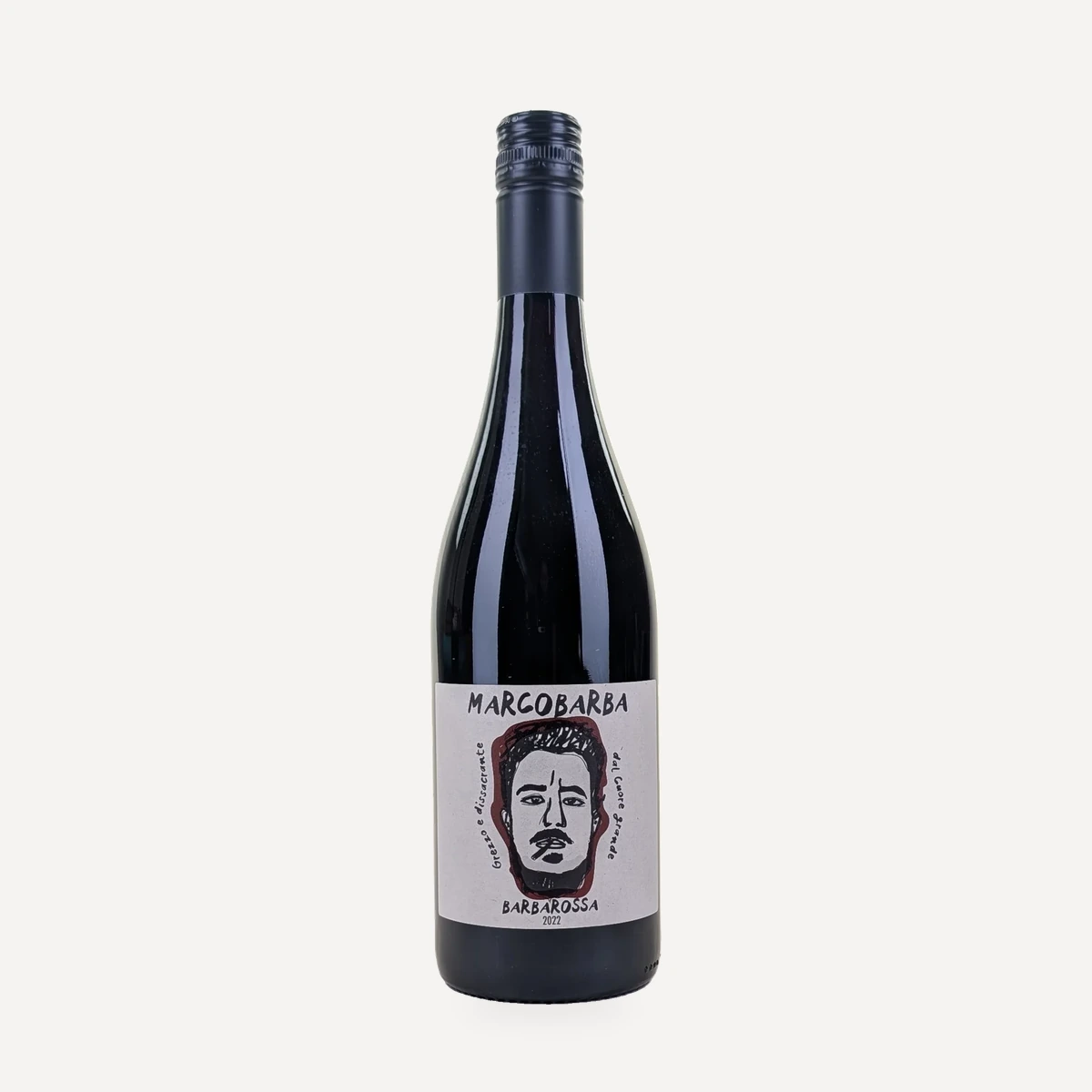
The project presents simplicity as a guiding idea: grapes and terroir are treated as the essential ingredients. Its self-image is deliberately informal and irreverent; the wines are portrayed as rough-edged and unconventional like Marco himself, but made with generosity and heart.
Vini