Storia
The Carmignano setting
Carmignano's viticultural reputation was established by the 13th century. In the 16th century, Catherine de’ Medici brought Cabernet to the Carmignano hills after becoming Queen of France, creating the basis for Cabernet's longstanding place in the local blend. In 1716, Grand Duke Cosimo III de’ Medici gave the wine-growing area legal protection, formalising a tradition that had already developed over several centuries.
Mauro Vannucci and the beginnings of Piaggia
Mauro Vannucci established Piaggia after purchasing vineyard land in the Carmignano DOC zone at Piaggia in the mid-1970s. The property lay near his home in the Poggetto area. Its exposure and permeable, dry, clay-rich ground convinced him that the site could produce high-quality Carmignano.
Mauro began producing wine in 1988. He planted or worked with Sangiovese, Cabernet Sauvignon, Cabernet Franc and Merlot, varieties that would define the estate’s production. The first bottled Piaggia Carmignano Riserva DOCG followed in 1991. Some of the early bottles were initially shared with family friends and clients rather than released through an established commercial network.
Expansion and a new interpretation of Carmignano
At the beginning of the 1990s, Piaggia acquired approximately 15 additional hectares in a natural basin a few hundred metres from the centre of Carmignano. The site overlooks Florence and substantially enlarged the estate’s vineyard base.
During the same decade Mauro pursued techniques then regarded as unconventional in the area, particularly the use of new oak barriques. The decision attracted criticism, but the resulting wines gradually secured listings in prominent restaurants and increasing attention from specialist guides. The estate’s first cited guide recognition concerned the 1994 vintage, which received two glasses from Gambero Rosso.
In 1995, Giacomo Tachis tasted Piaggia during a session at Villa di Artimino and responded enthusiastically to the wine. Alberto Antonini was hired as enologist in 1996, while Federico Curtaz worked as agronomist. In 1997 Piaggia received Gambero Rosso’s Tre Bicchieri, marking a further step in the estate’s national recognition.
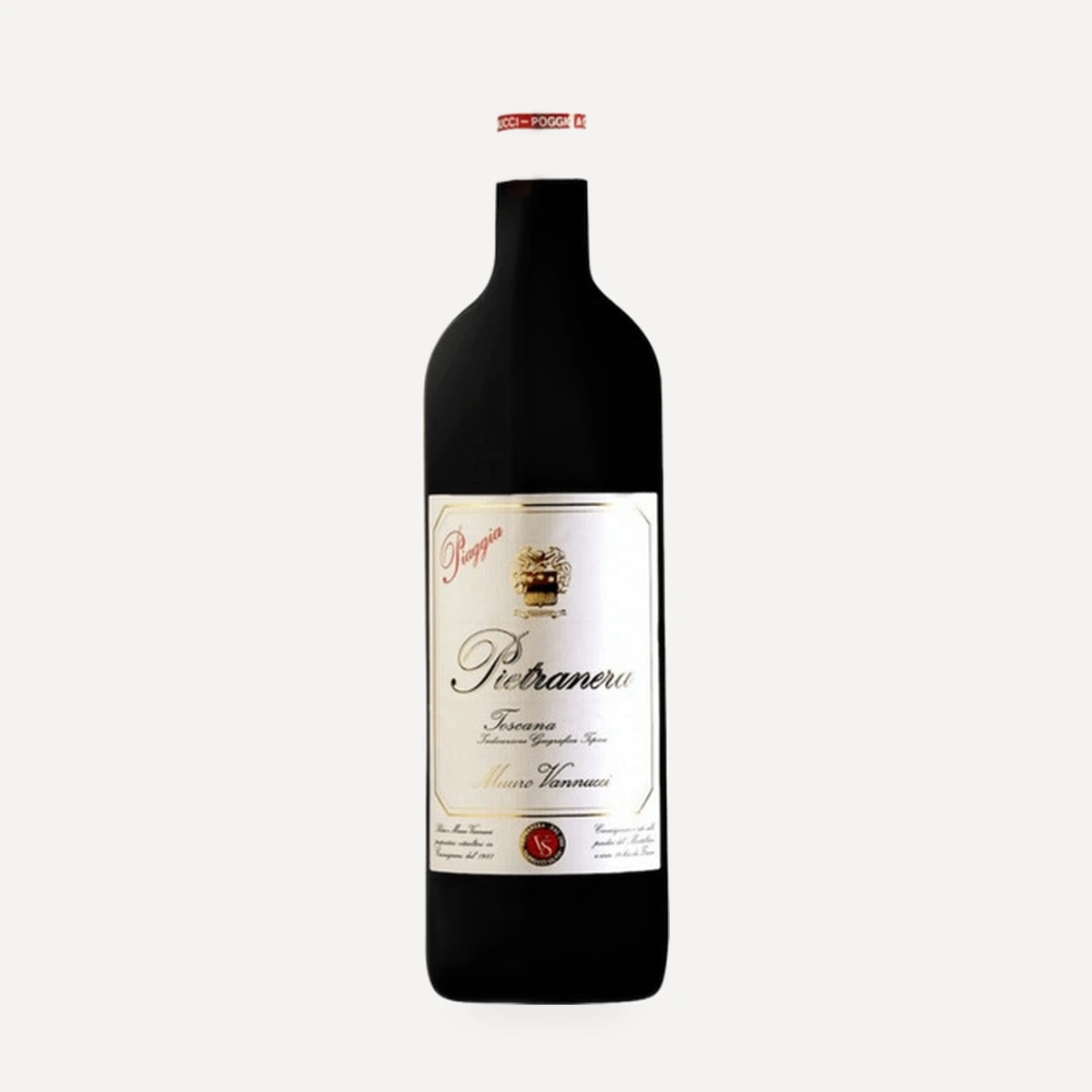
The expanding vineyard holdings enabled the creation of distinct wines linked to individual sites. Il Sasso developed from the vineyard at S. Cristina a Mezzana. Poggio de’ Colli emerged after years of separate vinifications and tastings of old French-origin Cabernet Franc clones growing on the estate. Piaggia Riserva remained the principal expression of an old vineyard at Piaggia, while Pietranera and the steep Viti dell’Erta site broadened the range.
Cellar development and generational transition
The cellar was enlarged as vineyard holdings and production developed. A later cellar was built partly into the hillside, using the surrounding ground to maintain the stable temperature required for maturation.
Mauro brought his daughter Silvia Vannucci into the project as the estate evolved. Silvia subsequently assumed ownership, representing the second generation of the Vannucci family at Piaggia. The present estate extends over approximately 25 hectares, around 15 hectares of which are planted with vines in the communes of Poggio a Caiano and Carmignano.
Terroir
Piaggia is based in the commune of Poggio a Caiano, in the province of Prato, approximately 14 km west of Florence. Its vineyards lie within the Carmignano DOCG area, partly in Poggio a Caiano and partly in the commune of Carmignano.
The Carmignano production zone covers approximately 40 km² on the eastern side of the Montalbano hills, between Florence, Prato and Pistoia. The Apennines exert a marked climatic influence, producing pronounced temperature differences, particularly during summer. The area’s well-drained ground contains limestone and microelements, conditions associated with rapid but balanced vegetative development.
Piaggia’s current technical profiles place its principal sites at approximately 250 m above sea level, with south-western exposure. Their soils are medium-textured, combining clay with galestro. The original Piaggia property was selected for its favourable exposure and permeable, dry, clay-rich soil.
The land acquired near Carmignano in the early 1990s forms a natural basin a few hundred metres from the village. It has an open view towards Florence. Individual sites add further variation: the Piaggia vineyard is an old planting near Poggetto; Il Sasso lies at S. Cristina a Mezzana; and Viti dell’Erta occupies a particularly steep section of vineyard.
Vinificazione
The principal vineyards are Guyot trained at a planting density of 6,250 vines/ha. Current vineyard profiles give site- or selection-specific yields ranging from 5,000 to 8,000 kg of grapes per hectare: 5,000 kg/ha for Poggio de’ Colli, 6,000 kg/ha for Il Sasso, 6,500 kg/ha for Piaggia Riserva and 8,000 kg/ha for Pietranera.
Harvesting and selection are manual. Piaggia Riserva undergoes careful hand selection, while Poggio de’ Colli is selected from the best vineyard plots. Viti dell’Erta is likewise based on a manual selection from its steep vineyard section.
Water used for vineyard irrigation has historically been collected in a cistern. Mauro Vannucci’s approach also included accepting harvest risk in pursuit of ripeness: during one difficult season he left grapes on the vines for about a month beyond the customary mid-September harvest, benefiting from favourable October weather.
The winery is built partly into the hillside so that the surrounding ground helps provide a constant, suitable temperature for maturation. Cellar work has historically placed strong emphasis on hygiene and detailed control.
Red grapes are hand harvested and manually selected. For Piaggia Riserva, the varieties are vinified separately in small vessels to optimise extraction from the skins. Fermentation is conducted without selected yeasts. Skin contact varies by variety from at least 18 days to as long as 25–28 days, with punching down and pumping over.
Il Sasso and Pietranera are also vinified in small containers with natural yeasts. Their maceration lasts at least 18–20 days, accompanied by punching down and brief pumping over. Poggio de’ Colli follows a distinct Cabernet Franc protocol: selected grapes are fermented with their native yeasts in open wooden vats, manually punched down, and kept in contact with the skins for approximately two weeks.
After alcoholic fermentation, the red wines are transferred to French oak. Piaggia Riserva moves to French oak barriques; the other red selections use small French wooden vessels or barriques. Malolactic fermentation takes place in wood. Current maturation periods range from at least 10 months for Pietranera, through approximately 12 months for Il Sasso, to at least 18 months for Piaggia Riserva. During maturation, periodic rackings clarify the wine and prepare it for bottling.
The red wines covered by these protocols are bottled without filtration or clarification, preserving their organoleptic components. The cellar’s early development was notable for Mauro Vannucci’s decision to use new, small oak barriques at a time when the practice drew criticism locally.
Filosofia
Piaggia’s stated objective is to express individual vineyards and the wider Carmignano territory through a modern reading of local tradition. The estate treats the old Piaggia vineyard and Il Sasso as distinct sites whose characteristics should remain recognisable, while Poggio de’ Colli joins old French-origin Cabernet Franc material with a Tuscan growing environment.
The production philosophy emphasises close attention in both vineyard and cellar. Manual selection, small-lot vinification, natural yeasts, extended skin contact and bottling without fining or filtration are intended to retain the character of the grapes and place.
Authenticity and attachment to the land recur throughout the range. Pietranera is conceived as an accessible expression of Tuscan tradition and the estate’s terroir, while Viti dell’Erta revisits the historic Carmignano Vin Ruspo tradition. Across the range, Piaggia seeks to combine inherited regional practices with contemporary interpretation rather than treating tradition and innovation as opposing principles.
Vini
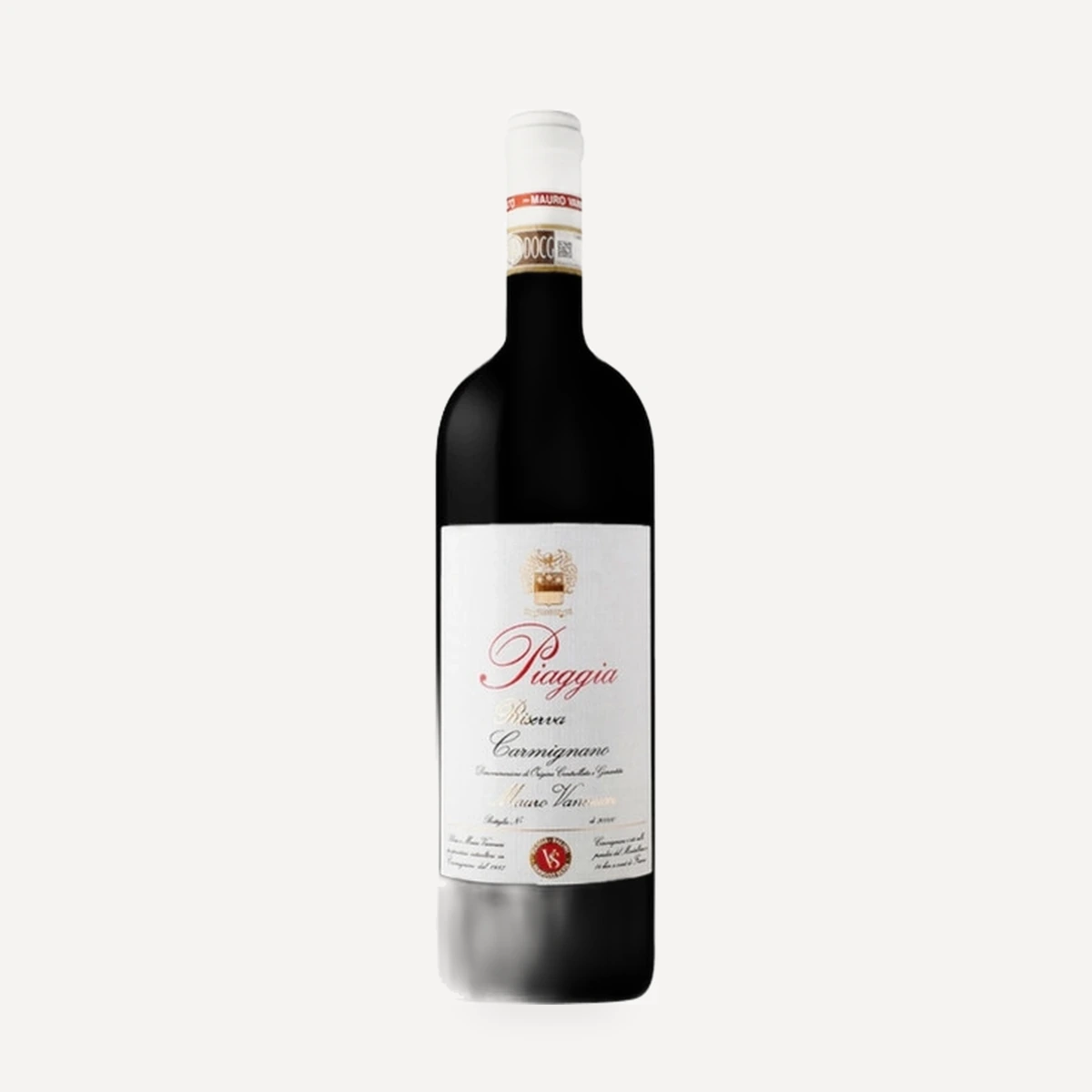
Piaggia Carmignano Riserva DOCG
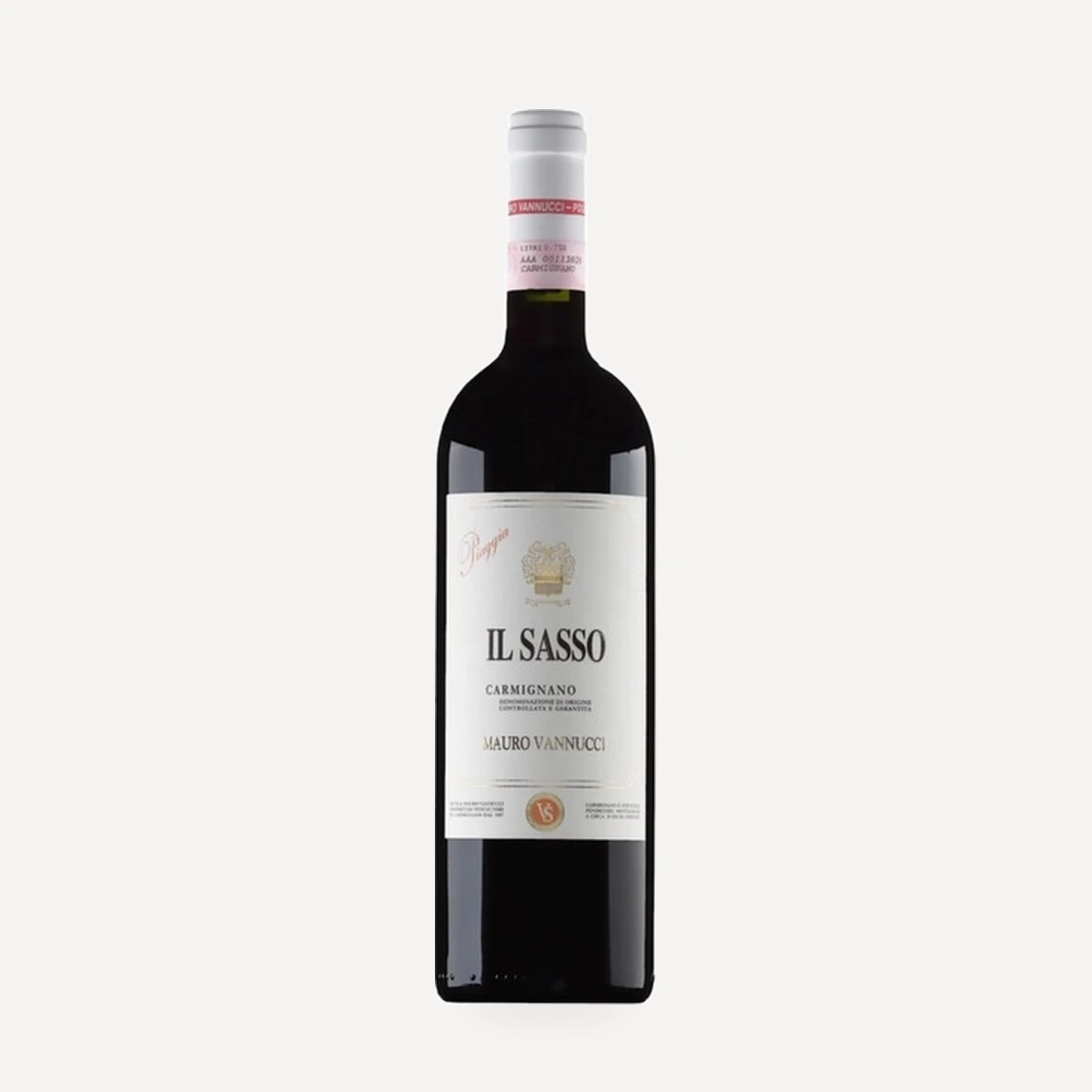
Il Sasso Carmignano DOCG