Storia
Carmignano before Fattoria Ambra
Carmignano had acquired a reputation for fine wine by the 13th century. Cabernet, historically called Uva Francesca, has been cultivated in the area since around 1700, when the Medici family introduced it. In 1716, Cosimo III de’ Medici, Grand Duke of Tuscany, issued a decree regulating the production area. The boundaries established by that decree remain those of the modern appellation, now one of Italy’s smallest DOCG zones.
Family ownership from 1870
The Romei Rigoli family has owned the 35-hectare estate since 1870. Fattoria Ambra lies near the Ombrone river and the Villa Medicea of Poggio a Caiano. Its name comes from Ambra, a poem written by Lorenzo il Magnifico in the 15th century.
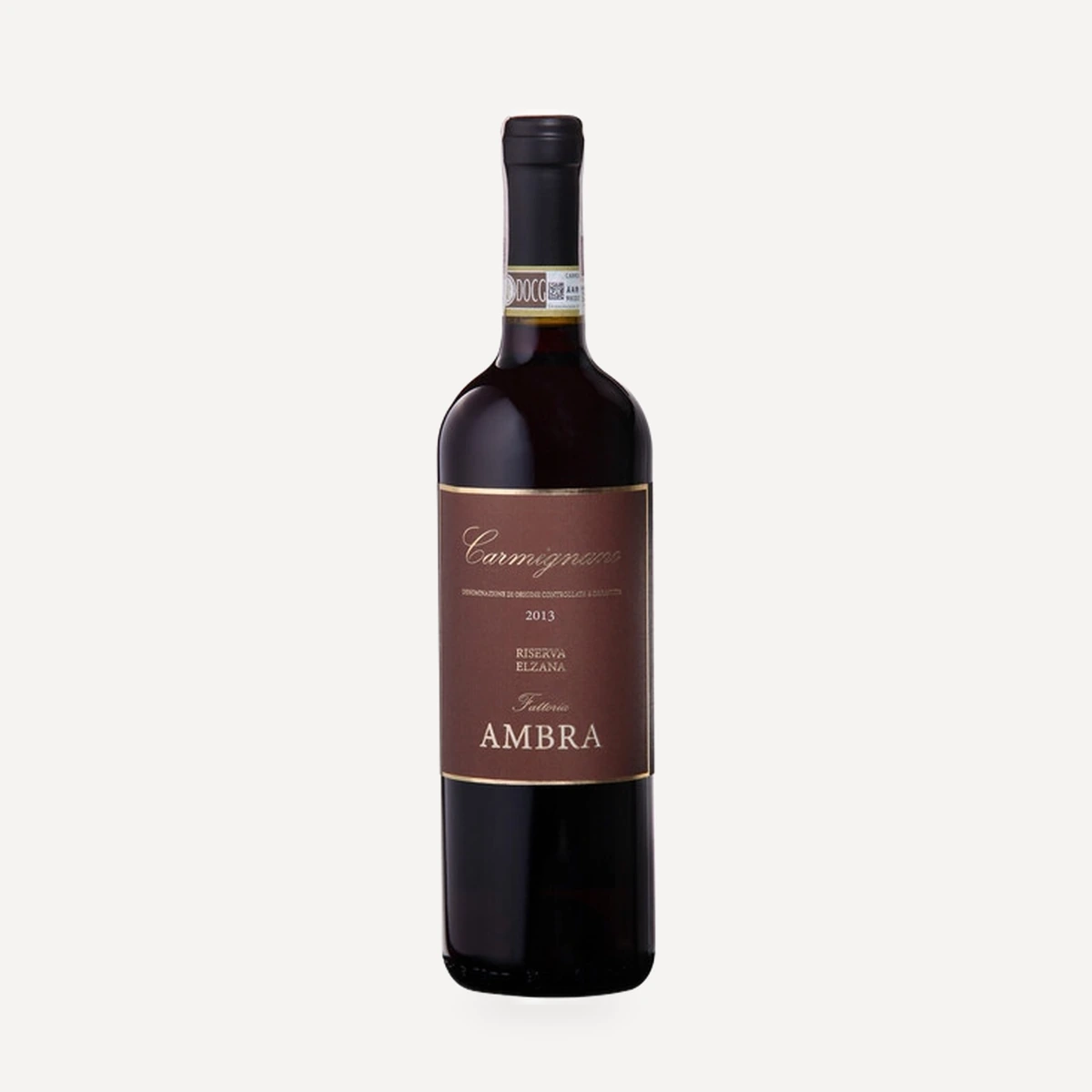
The family gradually developed vineyards in four principal Carmignano crus: Elzana, Montalbiolo, Santa Cristina in Pilli and Montefortini–Podere Lombarda. The latter stands near the Etruscan tombs of Montefortini and Boschetti.
Development of the four crus
The oldest dated planting is at Montalbiolo, where Sangiovese and Canaiolo Nero were planted in 1972. Elzana was planted entirely with Sangiovese in 1975. Planting at Santa Cristina in Pilli began in 1975 and continued in 1991, 1999, 2001, 2010 and 2013, creating a mix of older and younger vineyard blocks. Montefortini–Podere Lombarda was planted in 1999, 2008 and 2015.
The estate organized its Carmignano production around the four sites. Each cru supplies a separately bottled Carmignano DOCG, including two riservas. Younger vines and second selections serve the younger-drinking Barco Reale and the traditional rosato known as Vin Ruspo, while the older Santa Cristina vines are reserved for Carmignano DOCG Santa Cristina in Pilli. Trebbiano, Vin Santo and, later, Vermentino complement the red-wine range.
Organic certification
The wines have carried certified-organic status since the 2018 vintage. Technical specifications identify all current vineyard sources as certified organic.
Recent plantings and releases
A new vineyard was planted at Santa Cristina in Pilli in 2020; by May 2022 it was showing strong vegetative development.
During October 2022, one hectare at Montalbiolo was ploughed in preparation for a new Sangiovese vineyard. Planting was planned for November 2022 or the beginning of 2023, depending on weather conditions. The completed vineyard was presented in March 2023 as Montalbiolo Quercia Noce, named for the walnut and oak trees growing among its vines. It covers approximately one hectare and was planted at 5,000 vines per hectare on limestone and clayey-schist soil with an eastern exposure.
In 2023, Fattoria Ambra also introduced the organic Vermentino Toscana IGT L’Aldino, made from Vermentino planted at Santa Cristina in Pilli in 2013. Its name recalls a small snake encountered in the vineyards.
Terroir
Fattoria Ambra’s vineyards occupy protected hills near the Ombrone river and the Villa Medicea of Poggio a Caiano. The wider vineyard zone ranges from approximately 80 to 200–250 metres above sea level.
The Montalbano range, extending through the provinces of Prato, Pistoia and Florence, shelters the area from frost, hail and excessive summer heat. Carmignano’s harvest generally begins earlier than in neighbouring Chianti, frequently allowing the fruit to be gathered before autumn rain. This protected setting has sometimes enabled successful Carmignano harvests during difficult vintages elsewhere in Tuscany.
Conditions vary substantially among the crus. Elzana occupies a cool valley with severe winters, fresh summers and a broad day–night temperature range. Its clay and galestro soils and southern exposure produce the estate’s latest-ripening fruit. Montalbiolo is the estate’s highest established cru, at about 200 metres, with clayey schist and sandstone. Santa Cristina in Pilli is characterized by limestone alberese, while the earlier-ripening Montefortini–Podere Lombarda rests on sandstone near the Montefortini and Boschetti Etruscan tombs.
Vinificazione
The estate farms 24 ha of certified-organic vineyards, and its wines have been certified organic since the 2018 vintage. The certification body and the date on which vineyard conversion began are not identified.
Sangiovese occupies 16 ha. Canaiolo Nero accounts for 1 ha, Cabernet Sauvignon and Cabernet Franc together for 2.5 ha, and Trebbiano for 2 ha. The remaining 2.5 ha contain Foglia Tonda, Pugnitello, Vermentino, Merlot, Colorino, Ciliegiolo and San Colombano.
Planting densities reflect vineyard age: older blocks generally contain 3,300 vines/ha, while newer blocks reach 5,000 vines/ha. Guyot is used throughout the estate, with cordon-spur training also present in some older-and-newer mixed sources. Stated average yields range from 35 hl/ha in the principal riserva and Santa Cristina parcels to 40 hl/ha in Montefortini and the younger-vine red sources; white-grape sources are given as 40–50 hl/ha.
Fruit allocation is based partly on vine age and selection. Younger vines and second selections are directed to Barco Reale, while older Santa Cristina vines supply its Carmignano DOCG. Rosato fruit is picked approximately 15 days before the grapes intended for Carmignano DOCG and vinified separately. For Vin Santo, clusters undergo a further careful selection before drying.
Seasonal reports illustrate the vineyard response to contrasting years. In 2022, low autumn and winter rainfall and mild weather were followed by late budding, no frost and beneficial late-April rain. Flowering was already underway by 22 May. Despite subsequent heat and prolonged drought, most plots remained healthy, especially older vines; mid-August rain benefited ripening, and the estate reported good technical and phenolic maturity. In spring 2023, cool, rainy weather produced vigorous growth and replenished soil-water reserves. Downy mildew developed under the frequent rain, but damage remained limited, and harvest was expected to begin later than in preceding vintages.
Red-wine production uses temperature-controlled skin maceration followed by malolactic fermentation. Depending on the source and intended style, maceration lasts 10–15, 15–20 or 20–25 days. Extraction includes délestage and pumping over.
The estate uses glazed concrete, steel and oak. In October 2022, newly fermented whites and rosato were racked into steel, while reds were moved to glazed concrete for malolactic fermentation. Younger red production can mature for seven months in glazed concrete, with 20% of the volume spending the same period in 3.5- or 5-hl tonneaux.
The principal Carmignano wines mature for one year in wood, divided equally between 3.5- and 5-hl French-oak tonneaux and 25-hl Slavonian-oak casks. Riserva maturation extends to two years: the first in French-oak tonneaux and the second in 25-hl Slavonian casks, followed by one year in bottle.
White wines ferment under temperature control: Trebbiano at 16°C and Vermentino at 17°C, followed by maturation in steel. Rosato grapes are picked around 15 days earlier than fruit destined for Carmignano DOCG, pressed immediately after harvest and fermented separately at 16°C before steel maturation.
Vin Santo clusters are carefully selected and hung to dry until late December or January. After pressing, the must is transferred to 50–100-litre Slavonian-oak caratelli, where fermentation occurs. Maturation continues in small oak barrels for six years.
Filosofia
Fattoria Ambra defines itself as a family-run estate in which everyone lends a hand. Responsibilities overlap across viticulture, cellar work, marketing, tastings and events rather than being isolated in narrowly separated departments.
Its vineyard organization gives individual Carmignano crus separate identities, while fruit selection and vine age determine how grapes are directed through the range. The combination of long-established parcels, continued replanting, certified-organic farming and the parallel use of concrete, steel, French tonneaux and large Slavonian casks reflects an approach that retains established local practices while applying controlled cellar techniques.
Vini