Storia
Ancient roots
The farmstead may date to the 10th century, after the Barbarian invasions drove inhabitants of the Etruscan city of Roselle to seek protection in territories controlled by the wealthy Abbey of Sant’Antimo. The first vines on San Polino’s fertile slopes were probably planted during this period.
In 1581, San Polino was recorded among the properties of Santa Maria della Croce, the hospital of Montalcino. Its register described a farmstead comprising a house, cultivated fields, woodland, a vineyard and six olive trees. Those six trees still grow in front of the farmhouse and supply olives for San Polino extra-virgin olive oil.
The farmhouse remains almost unchanged inside and out. Remnants of old furnaces survive at the forest edge, together with a historic fountain once used for washing clothes and drawing irrigation water.
1989–1990: rediscovery and purchase
Katia Nussbaum first visited San Polino in September 1989, travelling down its dirt road with her young son Daniel. She found an abandoned farmhouse surrounded by uncultivated, scrub-covered fields, brambles and the scent of helichrysum, with an open view across the hills toward Monte Amiata. That evening she returned with Luigi “Gigi” Fabbro, and the couple decided to make the property their home.
Luigi and Katia purchased San Polino in 1990. The estate had been abandoned for many years: the farmhouse lacked electricity and running water, while the land was overgrown but had escaped industrial agriculture. Brambles and olive trees covered the property, which remained enclosed by undisturbed forest. The couple restored the farmhouse as their family home, began working the land and established the foundations of the winery.
Luigi brought experience from biodiversity-mapping and sustainability work in the Brazilian Amazon, including the study of Indigenous permaculture systems that renewed soil fertility through composting and close ecological integration. Because San Polino’s soils had never received herbicides or pesticides, the family’s objective was to protect an existing ecosystem rather than repair a degraded one.
1994: organic certification
In 1994, San Polino became the first farm in Montalcino to obtain organic certification. Ecological protection, natural composting and the interdependence of vines, other plants, animals and microorganisms had informed its agricultural approach from the outset. The estate subsequently developed regenerative methods that were later taken up by other wineries.
1998–2001: the first vines and Brunello
The family’s first agricultural work was carried out slowly and by hand, initially producing olive oil with their young children alongside them. In 1998 they planted the first 300 Sangiovese vines. The inaugural Brunello di Montalcino vintage followed in 2001. That debut received international recognition and multiple trophies, establishing San Polino among recognised Montalcino producers.
The work developed through local knowledge and collaboration. Luigi and Katia learned from Montalcino traditions and their neighbours. Their sons Daniel and Giulio grew up among the vines. Alberto “Avni” Gjilaska initially arrived to help temporarily in the vineyard but remained, becoming central to the estate’s development. His brothers Mariano and Altin subsequently joined him and have contributed for more than two decades. The Fabbro and Gjilaska families have now lived and worked together for approximately three decades, raising children, planting vines and shaping the property as a shared undertaking.
2018–2022: vitiforestry
In 2018, San Polino began incorporating principles of testucchio vitiforestry inspired by Etruscan and Roman agricultural traditions. Fruit trees were planted around vineyard boundaries. In 2022, rows of Tuscan field maple (Acer campestre) began to be interspersed among the vines, intended to encourage fungal networks, provide shade and improve resilience under a changing climate.
San Polino today
San Polino remains a small, independent and family-run estate. Its 9.5 ha of Sangiovese include 5 ha registered for Brunello di Montalcino and are set among olive groves, hedgerows and extensive forest. Work continues by hand with minimal intervention in both vineyard and cellar. A 1952 Massey Ferguson tractor formerly owned by Luigi’s father remains in service.
The farmhouse is still the centre of family and winery life: the family lives upstairs, while the cantina occupies the lower floor. Luigi is gradually transferring responsibility to his sons while continuing to oversee winemaking. Daniel, Giulio and Shani Fabbro are active in the business, and the next generation is progressively taking over its management.
The emblem
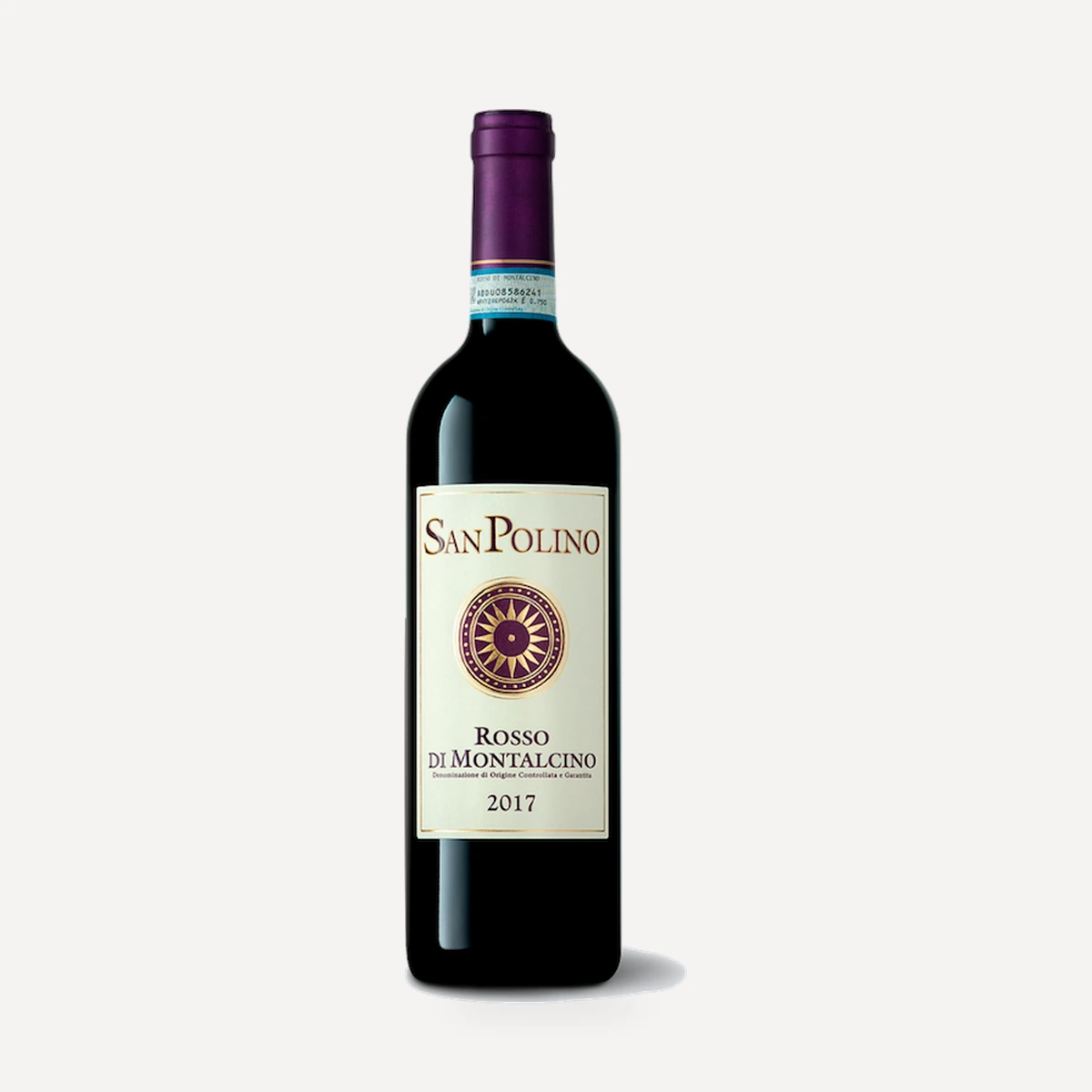
The San Polino emblem reproduces an Etruscan solar symbol from a large oval bronze belt buckle dated to approximately 800 BC, an ornament that would have covered the lower abdomen of a noblewoman or priestess. Its image depicts the sun—associated with the Etruscan goddess Catha—being carried eastward across the ocean in a chariot drawn by a water bird, probably an ibis, before rising again at dawn. San Polino selected the design for its beauty, local antiquity and the continuing importance of solar energy to winegrowing.
Terroir
Two vineyard environments
San Polino farms 9.5 ha of Sangiovese divided between two principal sites with distinct elevations, exposures and soils. The historic vineyards surrounding the farmhouse lie in south-eastern Montalcino at approximately 450 m. The second site is north-east of Montalcino at approximately 300 m.
The elevated farmhouse vineyard is south-facing. Its highly heterogeneous ground combines predominantly sandy-loam and volcanic material with marl veins. The elevation provides ventilation and cooler night-time conditions during hot years.
The lower north-eastern site occupies loamy slopes at approximately 300 m. Its soils are rich in clay and marl. Abundant sun and good ventilation support even ripening and grape health.
The vineyards sit within a broader mosaic of olive groves, hedgerows, wild corridors and extensive forest. The estate treats this entire setting—including soil organisms, fungi, insects, animals and neighbouring vegetation—as part of the living terroir. The surrounding forest also functions as a carbon sink.
Vitiforestry is progressively changing the vineyard microenvironment. Fruit trees grow around vineyard edges, while Tuscan field maples are being introduced between vine rows to create natural shade, encourage mycelial connections among plants and improve resilience as temperatures rise.
Vinificazione
Organic, biodynamic and regenerative farming
San Polino’s soils had never received pesticides or herbicides when Luigi Fabbro and Katia Nussbaum purchased the property in 1990. Their objective was therefore to safeguard an intact ecosystem rather than rehabilitate damaged farmland. The estate became Montalcino’s first organically certified farm in 1994 and is now certified organic by ICEA and biodynamic by AgriBio Piemonte. It is also a member of the Italian Agroforestry Association, participates in the Porto Protocol and is recognised as a Natural Refuge.
The vineyards are managed as interconnected ecosystems rather than isolated vine monocultures. All vineyard waste is composted, nitrogen-fixing plants are sown, and synthetic treatments and synthetic pesticides are excluded. Beneficial fungi, bacteria and insects are supported as natural allies of the vines. Friendly microorganisms and predatory insects are introduced to compete with or consume pathogens, and microbial preparations capable of controlling mould are used when disease pressure rises.
Native wildflowers and grasses that attract insects are planted throughout the vineyards, and bees are kept on the property. Hedgerows and uncultivated corridors provide habitat and routes for wildlife. Fields remain unfenced during most of the year so that animal movement is not unnecessarily obstructed.
Vitiforestry and climate adaptation
The estate began a testucchio vitiforestry programme in 2018, drawing on Etruscan and Roman precedents for combining trees and vines. Fruit trees were first established along vineyard boundaries. Beginning in 2022, rows of Tuscan field maple (Acer campestre) were planted within the vineyards. The programme investigates whether trees can expand soil biodiversity and mycelial networks, provide natural shade and help vines withstand rising temperatures.
San Polino collaborates with geologists, botanists, entomologists, ornithologists, yeast specialists and other researchers. Its field trials are based on observation, experimentation and adaptation as ecological conditions change.
Canopy, water and harvest work
The vineyards are not irrigated. During the growing season, clusters are separated by hand so that they hang freely without touching or crowding one another. Shoots and leaves are positioned vine by vine, leaving a light protective canopy over the grapes to reduce exposure to ultraviolet radiation and potential hail.
Harvest is carried out manually with secateurs and boxes. Picking decisions are made plot by plot and according to ripeness, grape character and immediate weather conditions. In the difficult 2024 season, extensive handwork, microbial mould control and selective, intermittent harvesting kept the crop healthy despite heat, rain and hail risk. Each harvested lot was separately identified by date, precise vineyard origin and fermentation history.
Cellar setting and intervention
The cantina occupies the ground floor of the historic farmhouse, beneath the family residence. Cellar work follows the same minimal-intervention principle as the vineyards. Harvested parcels are kept separate, labelled with their picking date, precise vineyard section and fermentation history, and monitored individually. Fermentation temperatures are checked twice daily, detailed records are maintained, and completed lots are sampled for laboratory analysis.
Fermentation and maceration
Fermentations begin spontaneously with native yeasts and the grapes’ natural microbiome. The principal fermenters are 35 hl tronconic wooden vats; the Rosso protocol is also described with large Slavonian-oak vats. Stainless steel has additionally been used for part of certain fermentations.
A three-day cold pre-fermentation maceration is used, historically specified at 12°C. Subsequent skin contact varies by selection: approximately 18–25 days for Rosso di Montalcino, around 30 days for Brunello di Montalcino and Helichrysum, and approximately 42 days for the current Riserva protocol. Older vintages document longer post-fermentation macerations of up to 60 days.
Maturation
Brunello di Montalcino matures for three years in large Slavonian-oak barrels, with an additional cellar-aged French-barrique component. Helichrysum receives approximately six months of bâtonnage in French barriques before four years in large Slavonian and French oak barrels. Riserva follows a comparable initial six months of bâtonnage in French barriques and four years in large Slavonian and French oak. Rosso di Montalcino matures for six months in wood followed by six months in stainless steel.
The estate also reduces environmental impacts beyond production through lighter bottles, shorter capsules, sustainably sourced cardboard and electricity obtained entirely from renewable sources.
Filosofia
Everything is connected
San Polino’s philosophy treats people, vines, other plants, animals, insects, microorganisms and wider natural systems as parts of one connected living network. The relationship extends beyond the farm to visitors, importers and the people who eventually share its wines.
The family sees balance, harmony, elegance and structure in wine as reflections of biological richness in the originating ecosystem. Environmental and aesthetic quality are therefore inseparable: a complex, living wine should portray a dynamic place.
Protection rather than restoration
The property encountered in 1990 was untouched by modern industrial agriculture. Its soils had never received herbicides or pesticides, and its surrounding forests remained wild. Luigi Fabbro’s work with Indigenous permaculture and biodiversity in Amazonia reinforced a principle of natural nutrient renewal through composting and ecological integration. From the beginning, the objective at San Polino was to protect these functioning systems, minimise external impacts and build a largely self-sustaining winery.
Curiosity and adaptation
The estate presents ecological farming as a continuing enquiry rather than a fixed doctrine. Collaboration with specialists, field observation and experimentation are used to improve understanding of the vineyard’s living systems. Vitiforestry exemplifies this combination of innovation and pre-industrial tradition.
The family describes its philosophy as alive and capable of changing with seasons, people, land and new knowledge. Its constant principle is that cooperation with nature can produce wines with structure, longevity, meaning and a clear relationship to terroir. Each bottle is conceived metaphorically as performance art, carrying the family’s work and relationships together with the variety, trees, climate, rain and canopy decisions of its season.
Vini
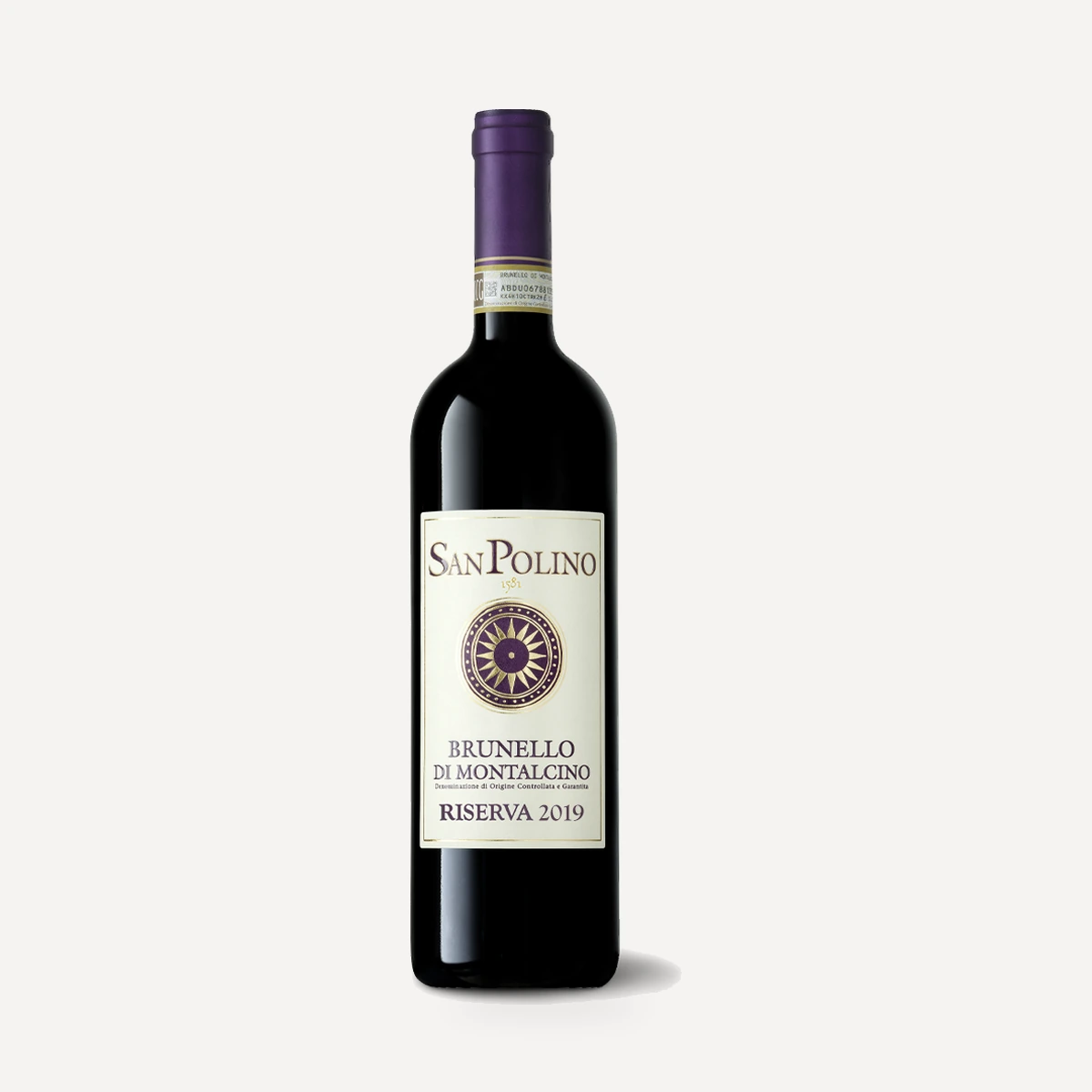
Brunello di Montalcino Riserva
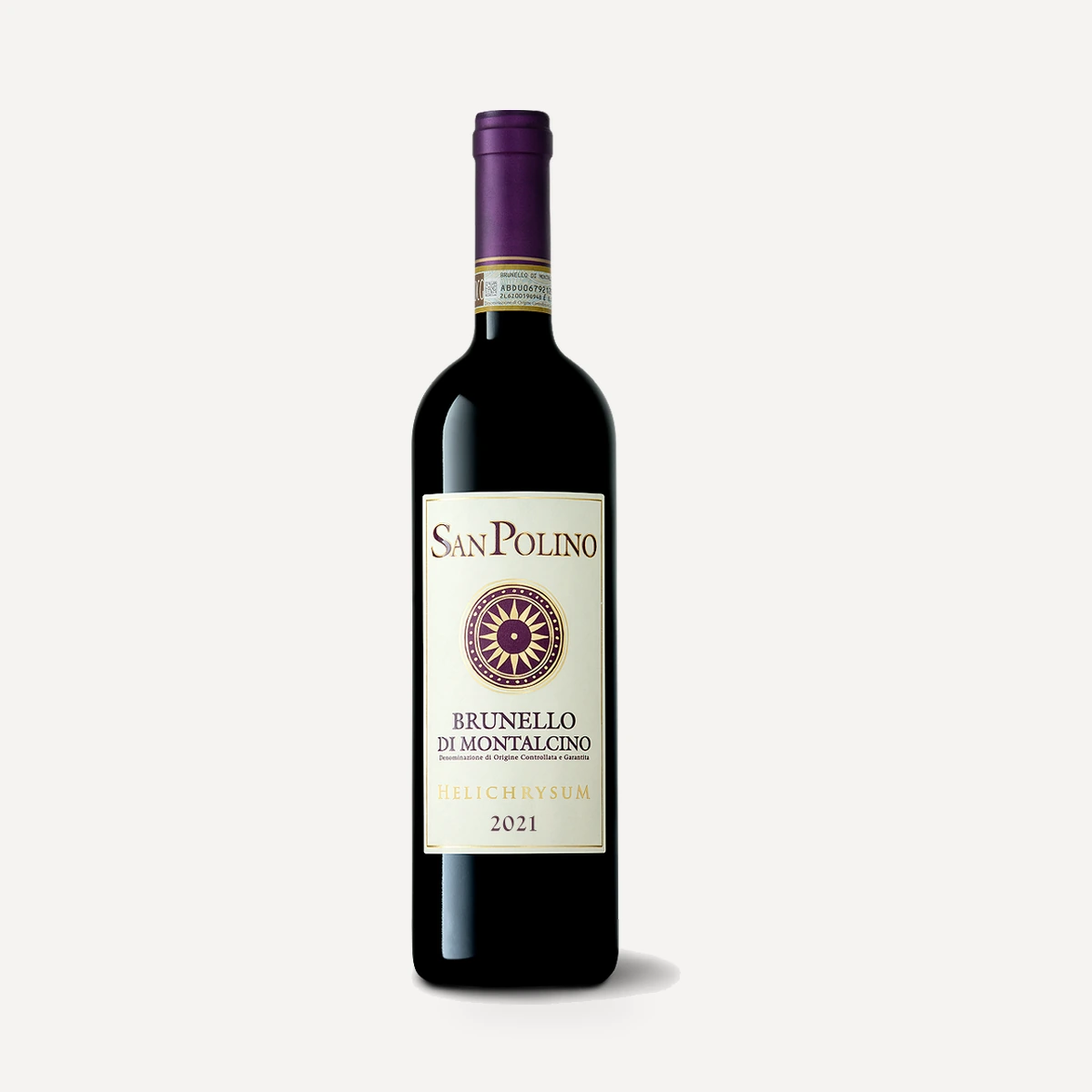
Brunello di Montalcino Helichrysum
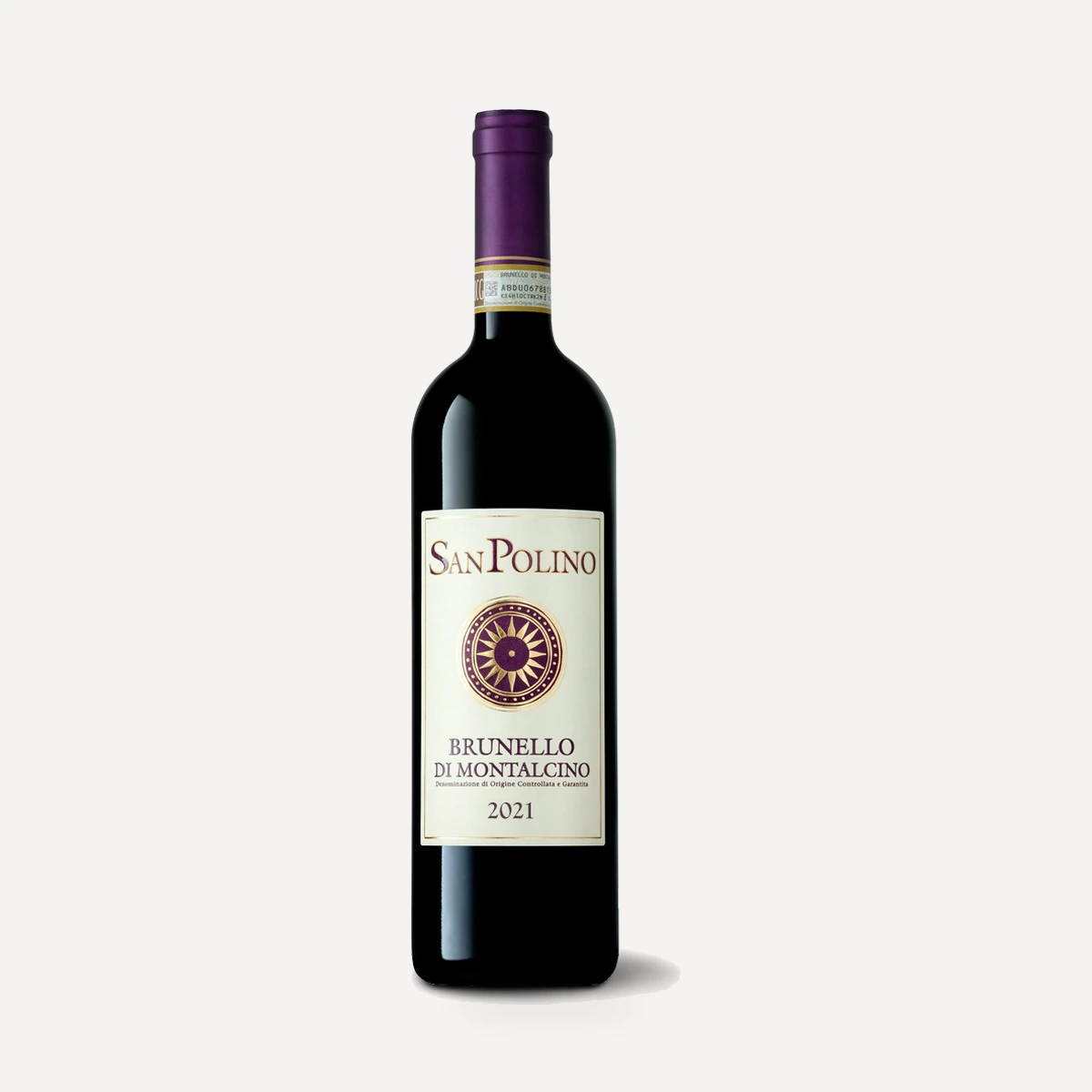
Brunello di Montalcino