Storia
Foundation in 2001
Talamonti began in 2001 as a family project in Loreto Aprutino. The estate’s materials attribute its creation to the Redmont–Di Tonno family and identify Antonella Di Tonno and her father, Alfredo Di Tonno, as co-founders. A more recent estate presentation also places Antonella and Rodrigo Redmont at the centre of the project. Their stated objective was to bring innovation and technological progress to a historic Abruzzo winegrowing area while promoting its native Montepulciano d’Abruzzo, Trebbiano d’Abruzzo and Pecorino grapes.
Vineyard development and experimentation
The estate developed 45 hectares of grape production around the winery in the Tavo Valley. In 2004 it planted Pecorino experimentally, using small-scale vinifications to investigate the variety’s genetic characteristics, adaptation to the site and potential contribution to higher quality.
Quality control and vertical integration
In 2007 Talamonti began an ISO 9001 quality-certification programme focused on production standards and customer satisfaction. An estate-hosted certificate issued in 2017 covered vinification, bottling and distribution of DOC, IGT and table wines, together with bag-in-box packaging.
In 2008 the estate acquired its own bottling and labelling equipment. This brought packaging in-house and expanded direct control over the production chain. The winery also established an internal analytical laboratory for monitoring grapes, musts and wines throughout production.
Sustainability programme
Renewable energy entered the estate’s sustainability programme in 2015. ISO 22000 food-safety certification followed in 2017, while SQNPI integrated sustainable production and a programme to reduce carbon emissions began in 2018. BRC and IFS food-safety standards were added in 2019, vegan-wine production in 2020 and the GEEIS diversity initiative in 2021.
A new photovoltaic installation began operating at Talamonti’s logistics hub in January 2022. The estate’s 2023 carbon-reduction certificate calculated an annual reduction of 68.5 tonnes of CO₂ compared with 2021, an amount equated in the certificate to the absorption of 3,425 trees. A January 2024 Agroqualità document confirmed Talamonti’s continued eligibility for the SQNPI quality regime following an October 2023 inspection.
Terroir
Talamonti stands in the Tavo Valley in the municipality of Loreto Aprutino, at the foot of Gran Sasso. The vineyards encircle the winery. The principal estate page places them at approximately 300 metres above sea level with a south-eastern exposure; another estate presentation describes an altitude range of 200–400 metres and steep, predominantly south-facing slopes.
The vineyards’ soils are described as limestone clay. The wider landscape bears evidence of glacial and periglacial processes developed over millions of years, including glacial cirques, moraines, rock glaciers, roches moutonnées, kettle holes and patterned ground. Studies of the kettle-hole soils identified sequences of buried soil containing wind-blown volcanic ash, while the Italian estate description characterizes the ground as volcanically stratified.
Loreto Aprutino lies between major geographic influences: the Apennines to the west, the Maiella to the south, the Sibillini massif to the north and the Adriatic Sea to the east. Gran Sasso and the Maiella ridges shelter the estate from severe weather and help form its microclimate. The wider area also has extensive woodland and national parks.
The Apennines and the Adriatic, both only a few kilometres away, strongly influence the climate. Mean annual temperature is approximately 15°C, with stated extremes of 35°C in summer and −2°C in winter. Estimated annual precipitation is 700 mm. The Adriatic generally moderates winter temperatures, although cold Balkan air currents can abruptly lower them and bring snow, making winters more severe than at comparable latitudes.
Vinificazione
The vineyard programme centres on matching each variety with its exposure, training system and desired yield. Work is adapted to the characteristics of the site and the identity of each grape rather than applying a single formula across the estate.
Pecorino was introduced experimentally in 2004. Separate micro-vinifications were used to investigate its genetic traits, habitat, site compatibility and qualitative potential. Guyot and overhead-trellis systems are both documented across the vineyards.
Talamonti has participated in Italy’s SQNPI integrated-production system since 2018. Estate materials describe all its wines as certified sustainable under the national integrated crop-management quality system. Agroqualità confirmed continued compliance for 2024 after an October 2023 inspection.
The broader sustainability programme includes renewable energy since 2015, carbon-emissions reduction since 2018 and vegan wines since 2020. Solar and wind power are identified as the estate’s energy sources. The January 2022 photovoltaic installation at the logistics hub contributed to a calculated reduction of 68.5 tonnes of CO₂ per year compared with 2021. Talamonti’s stated longer-term objective is a carbon-neutral estate, supported by greater energy efficiency, waste reduction and conservation.
The vinification area contains temperature-controlled stainless-steel tanks in multiple capacities—25, 50, 100, 150 and 180 hl—allowing grapes from different vineyard parcels to be fermented separately and their individual characteristics preserved. Micro-vinification also formed part of the estate’s work on the adaptation of Pecorino.
The barrel cellar contains dozens of oak vessels selected for diversity of geographical origin, grain, seasoning and toast. Following a research project conducted with the University of Teramo’s oenology faculty on the development of Montepulciano d’Abruzzo in different oak types, Talamonti chose 300-litre and 3,400-litre formats. The documented wood sources are France, Austria, the United States and Hungary or, more broadly, Eastern Europe.
Talamonti performs analytical monitoring in its own laboratory, following the condition of grapes, musts and wines through the production chain. Bottling and labelling have been handled with estate-owned equipment since 2008, extending direct control into packaging. Estate-hosted quality and food-safety certificates also cover vinification, bottling and distribution of DOC, IGT and table wine, as well as bag-in-box packaging for IGT and table wine.
Filosofia
Talamonti’s guiding idea is that high-quality wine begins with high-quality grapes. The vine is treated as the centre of the process, with human work synchronized to the site and the identity of each variety. The estate seeks the most effective relationship among grape variety, exposure, training system and yield so that the site remains legible in the finished wine.
In the cellar, this becomes a step-by-step interpretation of the raw material and of the chemical and microbiological changes that transform must into wine. Research, detailed observation and technical control are intended to support—not erase—the character of the place. Research and development results are to be verified and shared internally and with the broader Abruzzo wine community.
Family stewardship is linked explicitly to sustainable development. Antonella Di Tonno frames the family model around respect for nature, humility, the dignity of work and balanced relationships among land, production, employees, suppliers and customers. The estate’s ethical framework emphasizes legality, moral integrity, respect, safety, health, environmental responsibility, transparency, truth and fair competition.
Sustainability is presented as an operating principle rather than an abstract aspiration. The stated direction combines certified integrated production, renewable energy, emissions reduction, conservation, lower waste and a long-term goal of creating a carbon-neutral estate. The team-development philosophy similarly focuses on training young staff into a cohesive future leadership group.
Vini
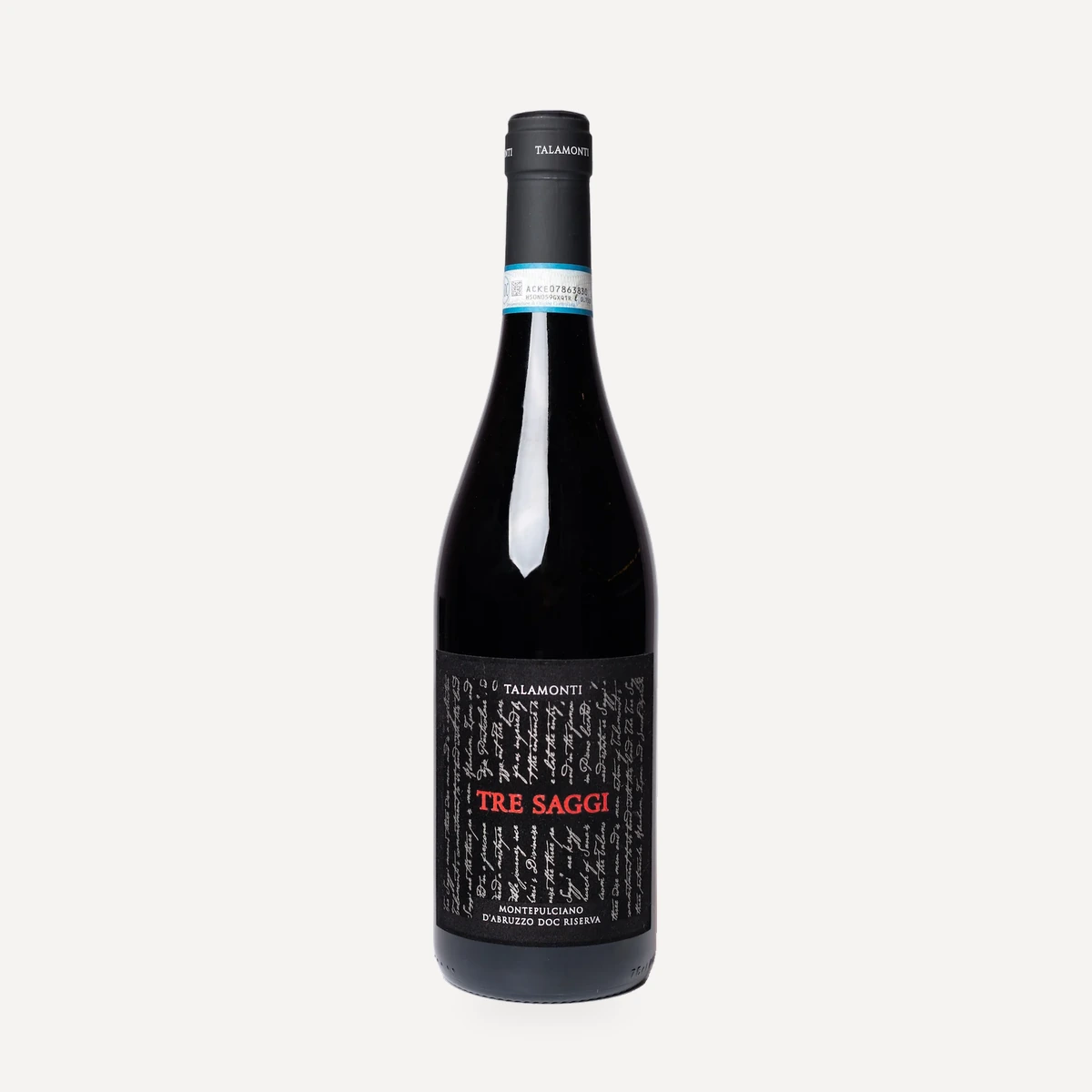
Tre Saggi Montepulciano d’Abruzzo Riserva DOC