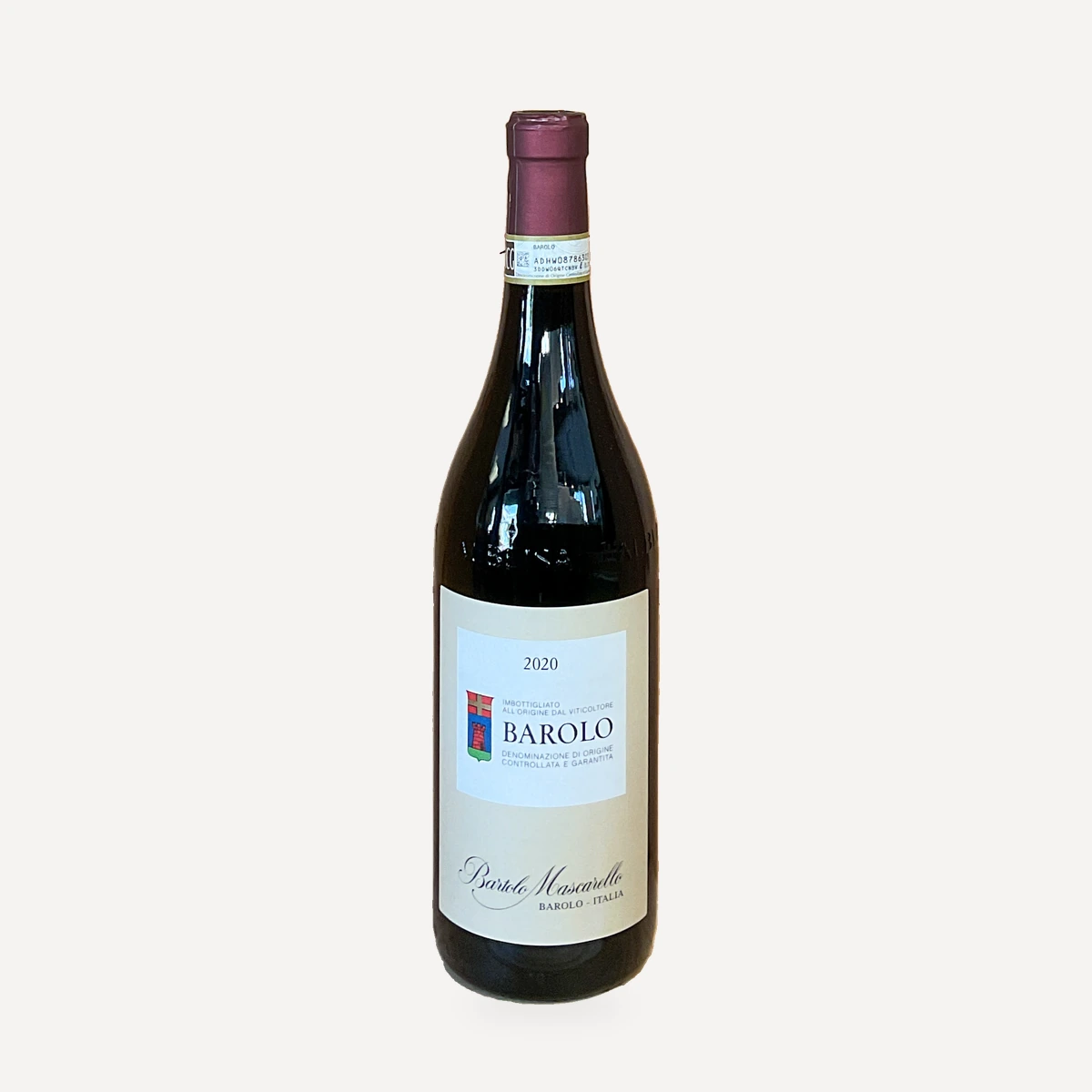
About this wine
A Barolo made entirely from Nebbiolo and conceived as a traditional multi-vineyard blend rather than a series of single-site wines. Its sources span Cannubi, Rué, San Lorenzo and Monrobiolo di Bussia in Barolo, together with Rocche dell’Annunziata in La Morra. Their proportions are determined by each harvest rather than by a fixed recipe.
Vineyard and terroir
The vineyards encompass several clay-based soil profiles: clay with sand, tufa and limestone at Monrobiolo della Bussola, Rué and Cannubi; sand with a substantial clay component at San Lorenzo; and clay interlaced with sand at Rocche dell’Annunziata. Vineyard work and harvesting are performed by hand, and the fruit is cleaned in the vineyard. Artificial fertilizers, herbicides and pesticides are not used.
Vinification
Fruit from the different parcels is co-fermented in concrete tanks. Fermentation and maceration generally extend for a combined 30–50 days, depending on the vintage. Pump-overs may be followed by submerged-cap maceration, but this decision responds to the condition of each harvest: the technique was used in 2021, omitted from 2022 through 2024 and resumed in 2025. The wine is subsequently pressed in a traditional basket press.
Ageing
Maturation lasts about 30 months in large, neutral botti with capacities of 2,500–5,000 litres; the estate uses large untoasted Slavonian oak casks rather than barriques. Bottling normally occurs in the third year after harvest, followed by approximately one further year in bottle before release. Average production is about 1,400 cases.
Tasting profile
The multi-site blend is intended to combine the vineyards’ differing attributes into aroma, complexity, balance and completeness. Its character is classically structured and aromatic, with finesse and the capacity for prolonged development in bottle.
History
Giulio Mascarello established the family cellar in 1919. Bartolo Mascarello later became an uncompromising advocate of blended, traditionally matured Barolo, rejecting both single-cru bottlings and small barriques. His daughter Maria Teresa, who assumed responsibility for the estate after his death in 2005, continues to produce one blended Barolo using concrete fermentation, long vintage-dependent maceration and large traditional casks. Bartolo’s opposition to barriques also inspired his celebrated hand-drawn “No Barrique, No Berlusconi” labels.