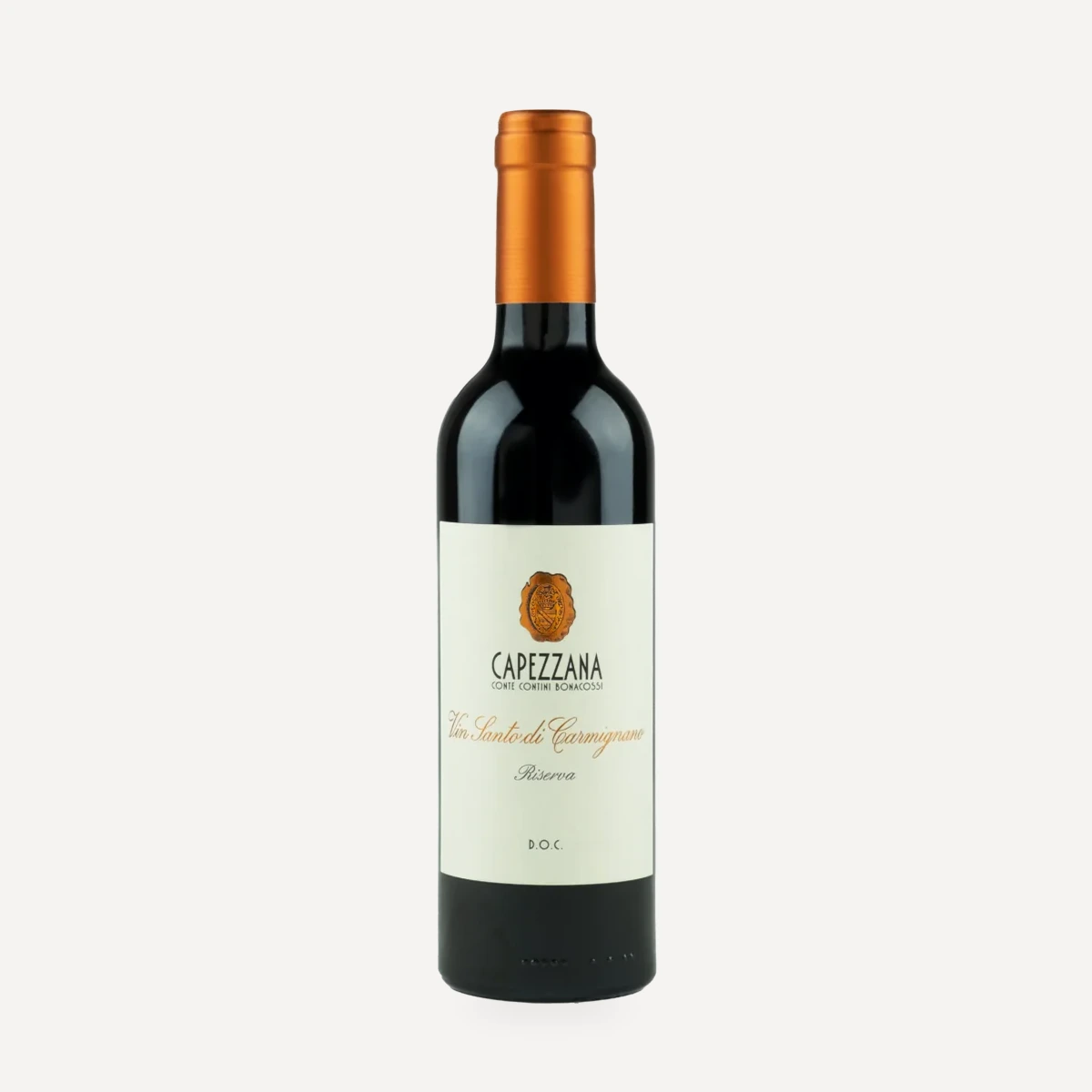
About this wine
Vineyard and terroir
The grapes come from the ripest vines registered for Carmignano production. The 2016 wine originated in Carmignano (PO), from east-facing sites at 100–150 m above sea level on clay-schist soils. Harvest ran from mid-September into early October.
Grapes
Trebbiano and San Colombano.
Vinification
Selected grapes dry naturally on mats from harvest until the following February. The concentrated must is transferred to traditional small caratelli made from chestnut and cherry wood. These barrels are kept beneath the roof, where falling winter temperatures affect alcoholic fermentation. Drying and selection result in an exceptionally low yield: roughly one-quarter to one-fifth of the grapes’ initial weight.
Ageing
The 2016 technical specification gives seven years in small barrels, with chestnut, cherry and oak represented, followed by at least three months in bottle. The broader production description sets a minimum of five years in caratelli. Once bottled, the wine can continue ageing without a defined limit, developing further richness and fragrance.
Technical data
The 2016 wine contains 14% alcohol and 280 g/L residual sugar. Its technical sheet records 5,774 bottles, all in 0.375 L format. The 2017 entry records 6,097 bottles of the same size.
Tasting profile
The current description presents an intense golden-yellow colour; the 2016 sheet characterizes it as amber. The bouquet is complex and fruit-led, combining dried and candied apricot, candied orange peel and yellow-flower nuances. The palate is sweet, soft and opulent, with complexity and a persistent candied-fruit finish.
Serving and pairing
Serve at 16–18°C. Pair with biscuits and traditional Tuscan desserts, blue cheeses or liver pâté. It may also be enjoyed by itself as a contemplative wine.
Vintage notes
The current product entry identifies the 2017 vintage and 6,097 bottles of 0.375 L. The selected technical sheet covers 2016 and records 5,774 bottles. A separate figure of 5,256 numbered bottles appears in the product-page content without an explicit vintage.
Label / history
Capezzana gives 1925 as the first production year, while the 2016 technical sheet describes Vin Santo as having always been produced at the estate.