History
The underground origins
The cellars beneath the Canelli hill originated as small storage spaces in the eighteenth century. During the nineteenth and twentieth centuries they were enlarged and reshaped as wine production developed. The resulting network, cut by hand into calcareous tufa, eventually became known as the Underground Cathedrals.
Canelli was an important meeting point for Piedmontese grape growers and winemakers during the second half of the nineteenth century. The town was also the birthplace of Italy’s first sparkling wine refermented in bottle from Moscato, helping it develop into an internationally connected wine-production centre.
1892: Piero Coppo establishes the winery
Piero Coppo founded Coppo in Canelli in 1892. He personally oversaw vineyard work, pressing, vinification and ageing, establishing direct supervision of the complete production cycle as a defining principle of the business.
The union of Coppo and Pio Pennone
Piero Coppo married Clelia Pennone, heir to the Pio Pennone cellars, a wine-producing and exporting house already active for two generations. Their marriage united the original Coppo facilities in central Canelli with the Pennone buildings between Via Giuliani and Via Alba. These buildings and the cellars beneath them remain the company’s base.
By the beginning of the twentieth century, Coppo was shipping wine throughout the world. Its production encompassed sparkling wines, Piedmontese reds led by Barbera, and Vermouth. The latter formed an important part of aperitif and cocktail culture between the nineteenth and early twentieth centuries.
The 1948 flood and Luigi Coppo
Luigi Coppo succeeded his father Piero. He led the winery through the difficult period following the 1948 flood, undertaking modern restructuring and adopting new technology.
Quality development and the 1980s
Over subsequent decades, vineyard care intensified. Crop thinning was introduced to lower yields, pesticides were eliminated, and greater attention was devoted to hygienic cellar practice. Inspired by French vignerons, Coppo began experimenting with small oak barrels for both red and white wines, pursuing greater complexity, elegance and longevity.
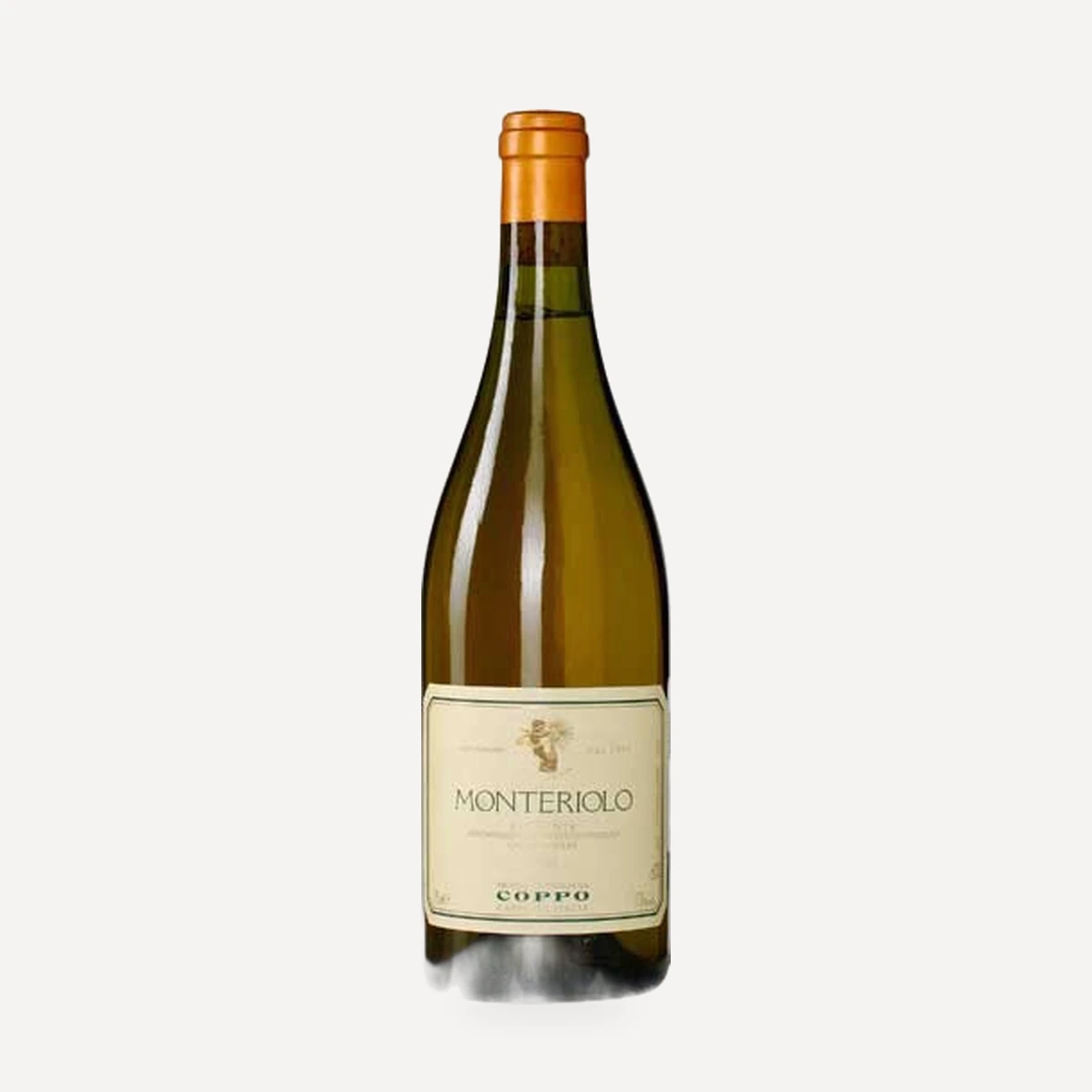
The 1980s became a decisive period in Coppo’s work with Barbera. In 1984 the winery produced the first vintage of Pomorosso, conceived to demonstrate that Barbera could produce a substantial, age-worthy red. The same year also marked the first vintages of Chardonnay Monteriolo and Riserva Coppo. Coppo has managed the property associated with Gavi La Rocca since the mid-1980s. In 1987 the winery began producing its rare Freisa Mondaccione in selected vintages.
Historic recognition
In 2012 Unioncamere entered Coppo in Italy’s national register of historic businesses, recognising more than a century of uninterrupted activity in the same sector.
In 2014 the Underground Cathedrals became part of the UNESCO World Heritage site “Vineyard Landscape of Piedmont: Langhe-Roero and Monferrato.” The same year brought recognition of the Nizza denomination. In 2017 Coppo further developed its focus on the individual character of its Barbera vineyards within Nizza.
New ownership and expansion
New owners acquired the winery from the Coppo family in 2021. The change initiated increased investment in Nebbiolo vineyards in the Langhe and acquisitions in sites intended for Barolo and Barbaresco, including Ravera in Novello, Bussia in Monforte d’Alba, Rive in La Morra and Montersino at San Rocco Seno d’Elvio.
A major recovery and expansion programme began in 2022. Walled-up passages were reopened, historic structures were restored, and production areas, offices, visitor routes and tasting spaces were enlarged and modernised. The work made the Underground Cathedrals safely accessible throughout their extent and exposed geological strata within the hill. A new management structure included the appointment of Rossano Savoia as CEO.
The redevelopment also recovered an early-twentieth-century former silkworm factory for offices and restored the seventeenth-century manor house beside the historic winery. The latter became the location of the wine shop and forms part of the hospitality programme. A new 4.0 bottling line was installed to improve production efficiency, workplace quality and the use of water and energy.
After approximately forty years of managing Tenuta La Rocca, Coppo acquired the property at Monterotondo di Gavi in 2024.
Continuing development
The programme encompasses the opening of additional Underground Cathedral passages, the completion of a visitor route through previously inaccessible sections, a wine garden, meeting facilities and the conversion of Palazzo Pennone into Suites Palazzo Pennone 1872. A fresco concealed for generations was rediscovered during work on Palazzo Pennone.
Terroir
Coppo’s more than 85 hectares of vineyards are distributed between Alto Monferrato Astigiano and the Langhe. The portfolio links grape varieties to distinct areas rather than treating the estate as a single homogeneous site.
Around Canelli and Cassinasco in the Langa Astigiana, Moscato Bianco, Pinot Nero and Chardonnay are cultivated. Chardonnay also comes from territories south of Asti around the Belbo and Bormida rivers, including Castelnuovo Calcea, Calosso and Cassinasco. Barbera is concentrated in Nizza, Agliano Terme and Castelnuovo Calcea, in the core of the Nizza area.
Tenuta La Rocca lies at Monterotondo di Gavi, within Serravalle Scrivia in Alto Monferrato Alessandrino. Its Cortese grows on calcareous marl at approximately 320 metres above sea level, with south, south-east and south-west exposures.
The Langhe holdings include Ravera in Novello, Bussia in Monforte d’Alba, Rive in La Morra and Montersino at San Rocco Seno d’Elvio. The Barolo del Comune di La Morra vineyards lie at approximately 200–240 metres, face south and south-east, and have blue-grey marl soils with calcareous clay.
Historic Pomorosso vineyards in Agliano Terme, Castelnuovo Calcea and Nizza Monferrato lie at approximately 200 metres, with exposures from south to south-south-east. Their soils combine marl, limestone and clay with gypsum and iron-rich conglomerates.
Bric del Marchese occupies south-facing vineyards between Nizza Monferrato and the boundary of Vinchio, at 180–250 metres. Its soils are silty-marly and loam-to-silt-loam in texture, with substantial clay inclusions.
Beneath Canelli, calcareous tufa provides a naturally stable cellar environment. At depths reaching 40 metres, the galleries remain at approximately 12–14 °C with constant humidity. The rock acts as thermal insulation, while the conditions keep barrel wood supple and porous, supporting gradual oxygen exchange during maturation.
Winemaking
Coppo has participated in an official integrated-agriculture protocol since 2001, employing agronomic practices intended to reduce environmental impact. The vineyards are also described as certified under the Sistema di Qualità Nazionale Produzione Integrata (SQNPI).
The approach draws selectively on principles shared with organic and biodynamic farming while remaining an integrated-production system. Permanent or managed grass cover is combined with targeted cultivation beneath the vine row. Fertilisation uses organic compounds only.
Sulphur, copper, plant extracts and essential-oil preparations are preferred for controlling traditional vine diseases. Pheromones are used for sexual confusion to limit the reproduction of certain insect pests and reduce reliance on more impactful insecticides.
Cover crops include brassica, clover, field bean and barley, with the choice adapted to the needs of each site. These crops are incorporated as green manure so that their different properties can support soil vitality and the general balance of the vineyard. The intended result is a soil environment in which vines can feed efficiently, develop evenly and strengthen their own resilience.
Vineyard decisions are deliberately flexible rather than governed by an unchanging protocol. Observation and accumulated experience guide adjustments to the vegetative cycle, weather extremes and vintage variability. Bunch thinning has historically been used to reduce yields. Harvesting descriptions consistently call for selection of healthy, ripe bunches in the vineyard and manual collection in 20-kilogram baskets.
The working winery is centred on the Underground Cathedrals beneath Canelli. The complex comprises approximately two kilometres of galleries covering more than 5,000 square metres and descending as far as 40 metres into calcareous tufa. Natural insulation maintains constant humidity and a temperature of approximately 12–14 °C throughout the year.
Historically, the entire vinification process took place underground. Surviving presses, filtration systems, vats, barrels and other machinery preserve evidence of that production cycle. The galleries remain an active maturation cellar rather than a museum: all Coppo wines are aged there in cask, barrel or bottle. Depending on the cuvée, maturation in this environment can extend for as long as ten years.
The stable humidity prevents barrel wood from drying, keeping it supple and sufficiently porous for gradual oxygen exchange. The cellar therefore relies on the natural physical properties of the tufa rather than artificial climate control for maturation.
Coppo’s historical development included early experimentation with small oak barrels for both red and white wines. The aim was to build complexity and longevity without abandoning elegance. The cellar also uses large casks, French oak barrels and barriques, stainless steel tanks and extended bottle ageing according to the individual production programme. Metodo Classico sparkling wines undergo secondary fermentation and lees ageing in bottle within the underground galleries.
A modern 4.0 bottling line integrates washing, drying and sanitation. New-generation technology reduces water and energy consumption compared with conventional washing systems while improving production efficiency and working conditions.
Agronomists, oenologists and specialist cellar workers follow each production stage. The technical objective is to preserve varietal identity and environmental character, favouring finesse, balance and recognisability over sheer power.
Philosophy
Coppo defines its objective through harmony, elegance and uncompromising quality. Piedmontese tradition provides the foundation, but tradition is treated as compatible with technical development, experimentation and investment in contemporary production systems.
The preferred house style values finesse over power. Each wine, whether intended for extended maturation or earlier drinking, is expected to retain an individual personality while remaining balanced and pleasurable.
Vineyard, soil and climate are considered the starting points of winemaking. The agricultural philosophy is described as “fluid” and resilient: practices are adjusted through observation and experience rather than applied rigidly from vintage to vintage. This flexibility is intended to respond to climate change, extreme weather and the distinct trajectory of every growing season.
Respect for the vine and its surrounding environment is expressed through integrated production, organic fertilisation, cover crops, green manure, lower-impact disease control and pheromone-based pest management. In the cellar, careful supervision by agronomists, oenologists and specialist workers is intended to protect varietal identity and the character of the fruit.
Under the ownership that arrived in 2021, sustainability also encompasses water and energy efficiency, restoration rather than abandonment of historic buildings, improved working conditions, safe accessibility and a closer relationship between the winery, Canelli and local agricultural activity.
Wines