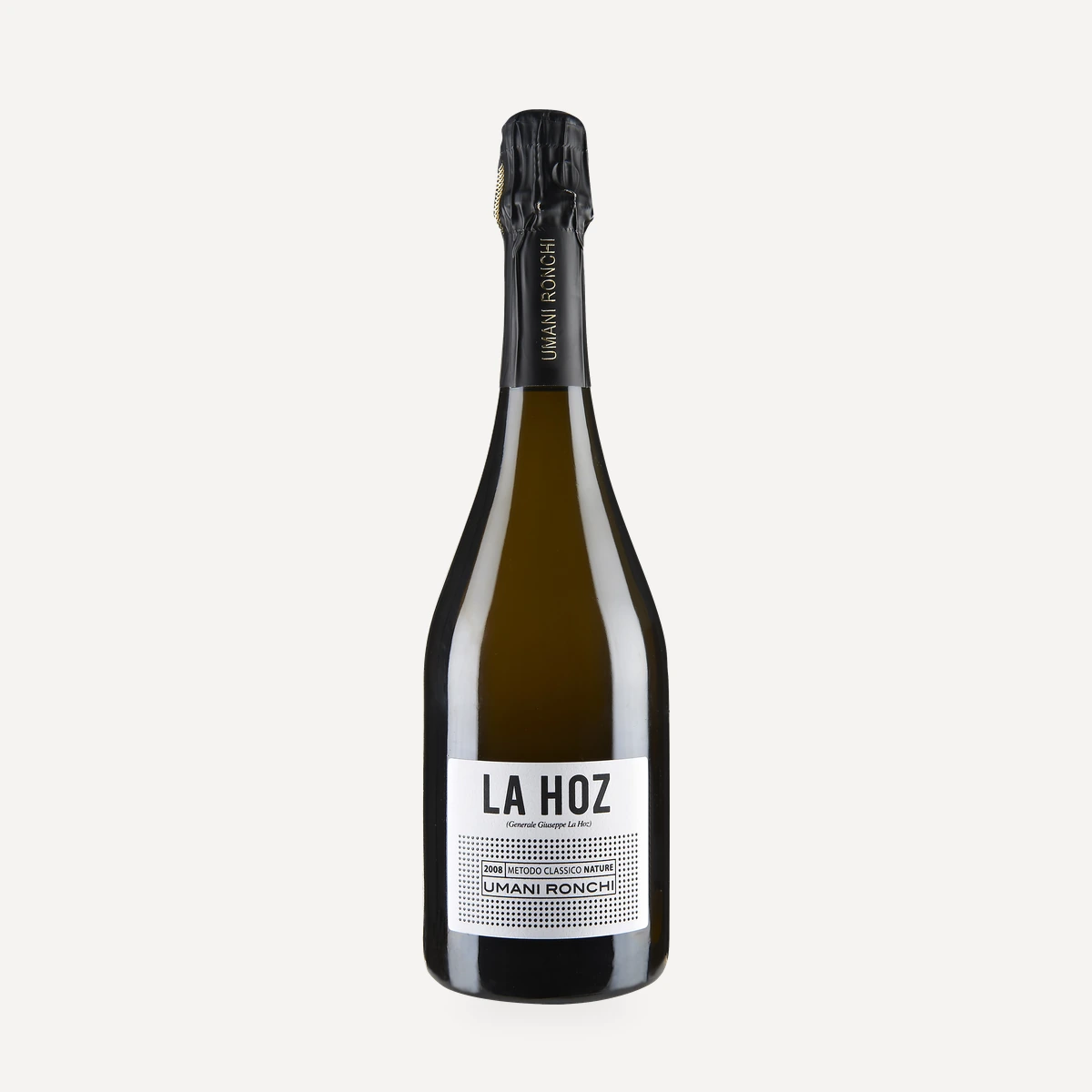
About this wine
Vineyard and terroir
The Verdicchio and Chardonnay come from Guyot-trained hillside vineyards in the Verdicchio Hills of Marche, at 200–350 metres above sea level in the Esino Valley. The vines are 8–30 years old. Their Plio-Pleistocene soils are very deep, loamy and moderately calcareous; the technical brochure describes the texture more specifically as clay loam. Exposures encompass south, west, north and east. Planting density ranges from 2,777 to 4,273 vines per hectare, while yields are limited to 60–70 quintals per hectare, equivalent to 6–7 tonnes. The grape-to-wine yield is 50%.
Grapes
80% Verdicchio and 20% Chardonnay from a single harvest year.
Vinification
The fruit is harvested by hand into boxes in two stages: Chardonnay in early to mid-August, followed by Verdicchio in mid to late August. Selection targets fruit at approximately 15–16° Babo with acidity around 9–10 g/L. After gentle pressing, the free-run must is quickly chilled and clarified by static settling. Verdicchio undergoes alcoholic fermentation in stainless steel or concrete, while Chardonnay is fermented in wood. The base wines are subsequently assembled, and the temperature-controlled prise de mousse lasts two months.
Ageing
Chardonnay matures in French-oak tonneaux for approximately 8–10 months; another version of the winery's technical description gives 10–12 months. Verdicchio ferments and matures for 10 months in stainless steel. Following tirage, the wine remains in contact with the lees in bottle for approximately 50–52 months, developing aromas associated with yeast autolysis. Riddling and disgorgement are followed by additional cellar rest: the English wine page specifies 2–3 months, while the technical brochure specifies 6–8 months.
Technical data
Residual sugar: 1.7 g/L. Available in 750 ml and 1.5 L bottles.
Tasting profile
Deep, luminous lemon-yellow in colour, with a fine, persistent stream of bubbles. The rich, complex bouquet combines floral and fruit aromas with citrus, pastry and toasted nuances. The palate is rounded and full, with a silky texture, savoury mineral character and a long finish marked by bitter almond and toasted hazelnut.
Serving and pairing
Serve at 6–8°C in a flute with a broader bowl and narrow rim, allowing the mature, tertiary aromas to develop without compromising the perlage. Pair with fish dishes, shellfish, raw seafood or sushi.
Label / history
After several years of trials involving different grapes, blends and secondary-fermentation methods, Umani Ronchi introduced its first Metodo Classico in 2011. La Hoz followed in late 2013 with the 2008 vintage. The wine is named for Giuseppe La Hoz, a general from the period of the Cisalpine Republic who led an uprising in the Marche and died in 1799 near Osimo and Ancona.