Storia
Beginnings in the early 1970s
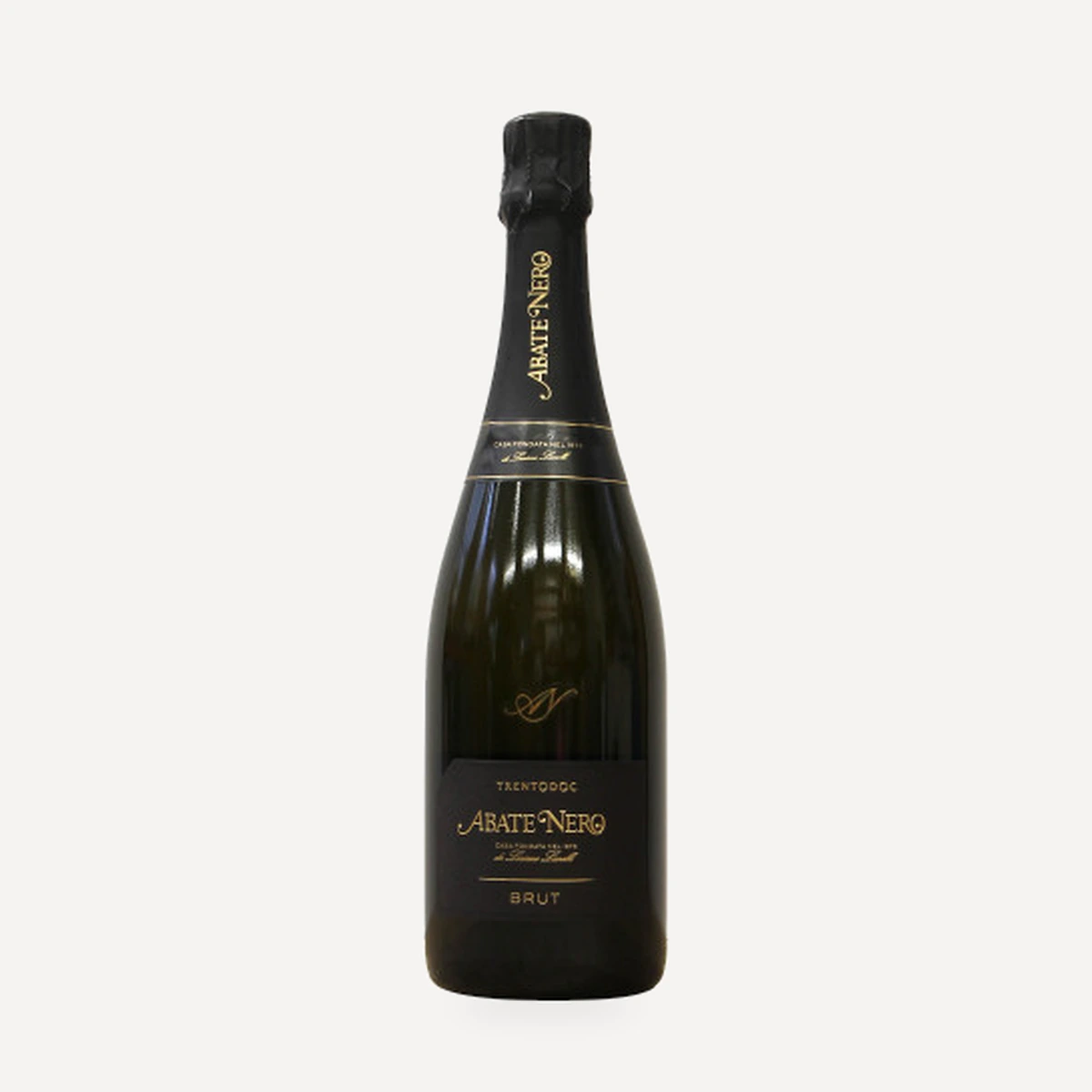
Abate Nero began in the early 1970s through the initiative of a group of friends, including oenologist Luciano Lunelli, who were all connected with agronomy and wine. Their purpose was to make increasingly distinctive and ambitious traditional-method sparkling wines. The name evokes the French abbot regarded as the father of Champagne.
The friends assembled their first cuvée almost as an experiment in 1973, driven by the idea of bringing a wine back to life through a second fermentation in bottle. The first disgorgements followed in 1976 and established the viability of the project.
From Palazzo de Schulthaus to San Lazzaro
Production initially took place in the deep cellar of Palazzo de Schulthaus in central Lavis. The cool underground space had previously witnessed some of Giulio Ferrari’s earliest sparkling-wine production. Although well suited climatically, the cellar became logistically inadequate as output grew from the first few thousand bottles to a more substantial volume.
In 1980 Abate Nero moved production to a larger, more functional cellar in San Lazzaro, which remains its production base. The move marked the transition from an experimental venture among friends to an established artisanal sparkling-wine operation.
The development of long lees ageing
The first vintage of Riserva Cuvée dell’Abate was bottled in 1988. During the 1990s, Abate Nero deliberately began extending the wines’ time on their lees from year to year. This required an increasingly exacting selection of base wines capable of supporting prolonged maturation.
The 2001 vintage of Cuvée dell’Abate became the first Abate Nero wine to receive Tre Bicchieri. In 2004 the house produced the first vintage of the millesimato Domini.
In 2008, encouraged by the reception of the vintage wines, Luciano Lunelli began a further project: a traditional-method blanc de noirs based on Pinot Nero and inspired by the French model. This became the millesimato Domini Nero. Domini Rosé joined it beginning with the 2012 harvest.
In 2010, Bibenda selected Cuvée dell’Abate Riserva 2004 as one of Italy’s three leading sparkling wines, taking it to the final of the Oscar del Vino.
Beginning with the 2018 harvest, the house’s former Extra Brut evolved into Trentodoc Dosaggio Zero, incorporating 20% Pinot Nero and receiving no added sugar.
The present approach
After approximately half a century, Abate Nero retains an artisanal scale of about 70,000 bottles per year. Production continues to centre on cuvée composition, selected yeasts, very slow secondary fermentation in bottle, unusually long maturation on the lees and manual oversight of every phase. Some releases consequently carry harvest dates from many years earlier.
The Collezione Luciano Lunelli preserves the intentions and oenological vision associated with Luciano Lunelli through three mature Trentodoc interpretations. It presents long ageing not merely as preservation, but as a means of allowing sparkling wine to change, lose its youthful sharpness and reach an intended point of maturity.
Terroir
Abate Nero connects its sparkling wines with Trentino’s Dolomite environment. Its imagery centres on steep vineyard rows within a mountain landscape shaped by clouds and beneficial winds. The wind is presented as a climatic influence on the vineyards as well as part of the working environment of the people who tend them. The Collezione Luciano Lunelli is framed as an expression of this Dolomite habitat and the energy of Trentino’s vineyards.
Vinificazione
Abate Nero works exclusively in the traditional-method sparkling-wine idiom represented by Trento DOC. White base wines are made by gently pressing the grapes and carrying out the first fermentation in stainless steel. The rosé wines follow a rosé vinification; the long-aged Collezione Rosé also documents brief skin contact before the first fermentation in steel.
The composition of the base cuvées and selection of yeasts are treated as decisive stages. After tirage, the wines undergo a deliberately slow second fermentation in bottle and remain on selected yeasts for extended periods. Current releases document maturation ranging from at least 20 months for the non-vintage wines to 48–60 months or more for the vintage bottlings and at least 120 months for Cuvée dell’Abate. The Luciano Lunelli collection takes this approach further with releases matured for more than a decade.
Every phase is carried out manually, allowing direct control of each bottle. Patience is integral to the production model: wines may remain in the cellar sufficiently long for labels to carry harvest years from well over a decade earlier.
Filosofia
Abate Nero’s philosophy rests on artisanal scale, patience and direct control. Its original ambition was to create sparkling wines with increasingly individual character, and that ambition developed into a rigorous interpretation of classical bottle fermentation.
Quality begins with the selection of material for the cuvées, continues through yeast selection and blending, and depends on allowing the second fermentation and lees maturation to proceed slowly. Long cellar ageing is not treated simply as a technical specification: it is intended to soften youthful sharpness while preserving the wine’s underlying energy and enabling its character to evolve.
The house combines fidelity to traditional sparkling-wine practice with the experimental impulse associated with Luciano Lunelli. The creation of progressively longer-aged reserves, the Chardonnay-based Domini and the Pinot Nero projects Domini Nero and Domini Rosé reflect this balance between continuity and innovation. Manual work and bottle-by-bottle control remain the practical expression of that philosophy.
Vini