Storia
Early settlement and the first record
The place now known as Dornach was inhabited approximately 5,000 years ago. The farm itself first appears by name in documentary records in 1288.
The Hausmann lineage
In 1577, Emperor Rudolf II of Habsburg granted a noble title to Hans Karl Hausmann. In 1675, Emperor Leopold I elevated Karl Franz Hausmann von Stetten to the rank of Baron and added the style Hausmann von Stetten, Freiyherr zum Stein unter Lebenberg, Lanegg und Greifenegg.
The Hausmann ancestral arms were divided red and silver, with two inverted crescents in alternating colours. The augmented arms added a silver bar in the second and third fields and a central shield.
The von Gelmini family and the acquisition of Dornach
In 1788, Emperor Joseph II of Habsburg-Lorraine ennobled the brothers Franz and Johann Peter Gelmini, who came from Sacco near Rovereto, and granted them the appellation “zu Kreuzhof.” Their arms remain visible on the façade of the house and survive in stylised form on the estate’s products. The shield is divided blue and red, with a yellow saltire above and a naturally coloured peacock displaying its tail below. Above it is a crowned helmet bearing a red bird marked at its centre by another yellow saltire.
Anton von Gelmini zu Kreuzhof purchased Dornach in 1836, beginning the estate’s continuing history as a family property. His son Max subsequently created the physical form that still characterises Dornach: individual terraced vineyards separated by dry-stone walls.
Inheritance and restoration
In 1980, the last descendants of the Hausmann line—three sisters—jointly inherited Ansitz Dornach. Over years of work, they restored and maintained the deteriorated buildings inherited from their grandfather Max von Gelmini zu Kreuzhof. The estate and vineyards are now cared for by descendants of both the von Gelmini and von Hausmann families.
Return to estate winemaking
For several decades Dornach concentrated exclusively on growing and selling grapes. Patrick Uccelli reversed that model with the 2008 harvest, resuming vinification, bottling and commercial sale under the estate’s own identity. The first renewed vintage comprised Xy from Pinot Bianco and Xx from Pinot Nero, establishing Dornach as a producer of certified-organic and biodynamic natural wines.
In 2012, Patrick introduced G., a skin-macerated Gewürztraminer. It was followed by 1.000cm³ in white- and red-PIWI versions, as well as ROUGE, BLANC and G without the full stop. The range later developed into several distinct profiles: approachable “wines of thirst,” wines from resistant PIWI varieties, longer-ageing selections, one-off wines created in particular vintages, and two zero-kilometre house wines sold only at Dornach.
Numbered bottlings and contemporary identity
A new label concept was introduced in 2019. Every bottling receives the next uninterrupted number in sequence: the first wine bottled in 2019 was number 1, the second number 2, and the sequence has continued from one bottling to the next. The system emphasises the belief that each agricultural product is shaped by its particular year and cannot be reproduced identically.
The numbered series had reached number 48 by the programme of eight “Dornach Wine Chapters” tastings held between October 2023 and May 2024. Each evening presented six wines, collectively revisiting the first five years of numbered bottlings.
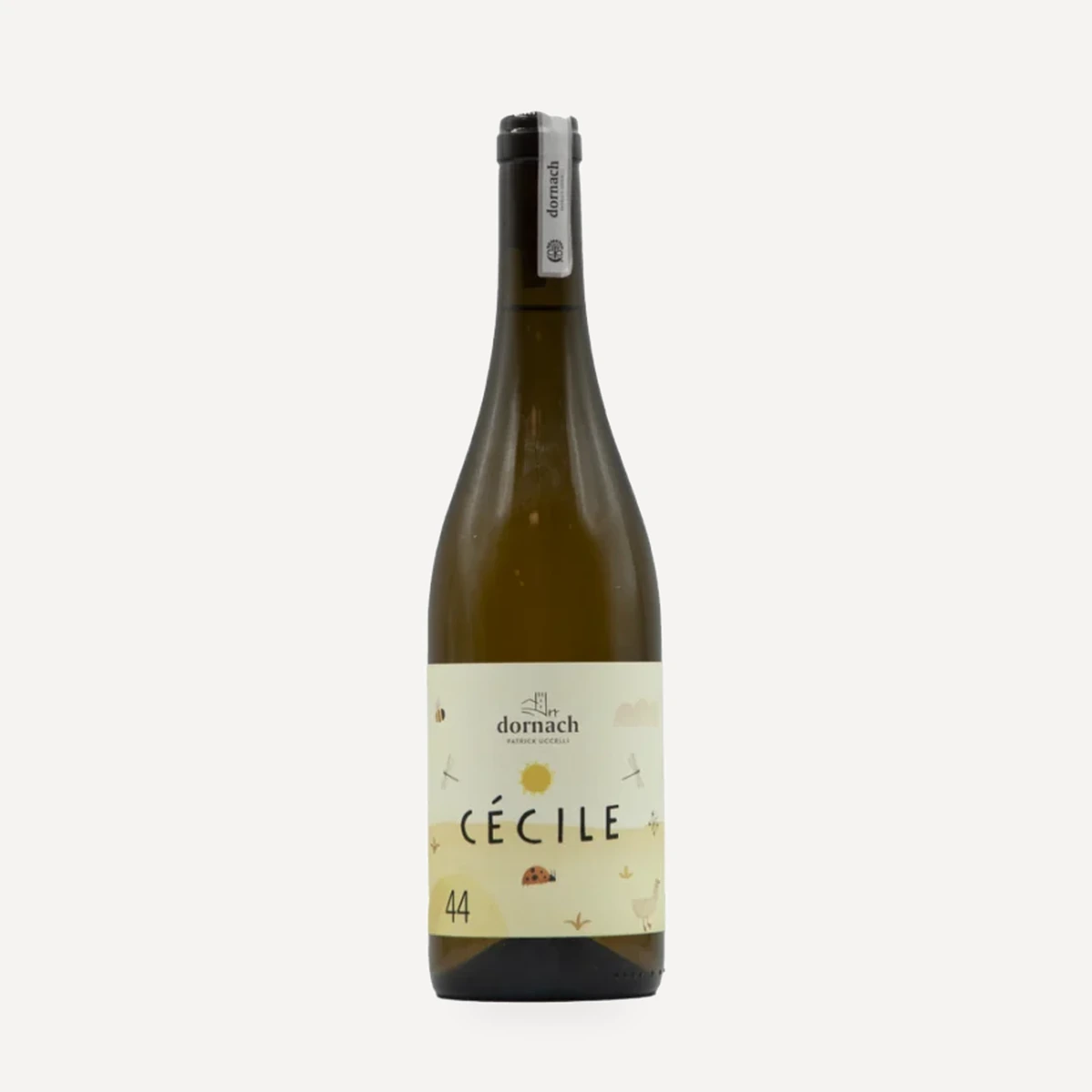
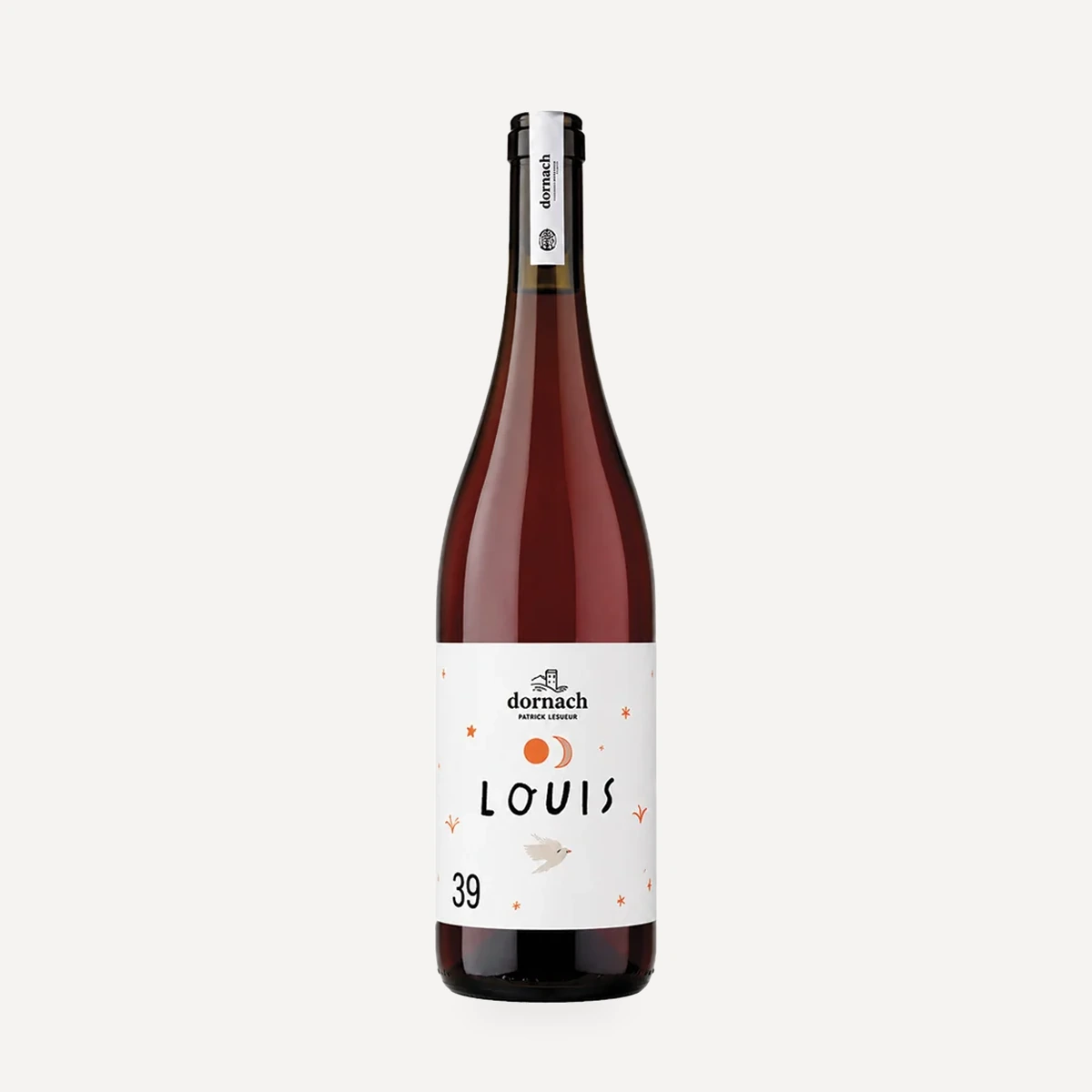
The contemporary names Aurélie, Louis and Cécile honour Karoline and Patrick Uccelli’s three children. Louis identifies the convivial, readily drinkable profile; Cécile identifies the PIWI range; and Aurélie identifies selections intended for extended ageing. In February 2024, artist and biologist Katharina Huth completed a scientific mural in the cellar devoted to the living soil beneath the vineyards.
Terroir
Ansitz Dornach occupies a 6 ha family farm above Salorno / Salurn, overlooking the southern part of the South Tyrolean Wine Road. Its historic landscape consists of individual vineyard terraces separated by dry-stone walls, a form established by Max von Gelmini zu Kreuzhof.
The estate connects its wines closely to place and vintage. Its Pinot Bianco selection is characterised through the image of rhyolite expressed through Pinot Bianco, while Pinot Nero material is associated with limestone and yellow clay. The separately cultivated Pinot Nero parcels at Montagna are presented as an expression of limestone.
Excavation for the new cellar exposed a layer of large rocks at approximately 2.05 m. The cellar’s scientific mural uses three Pinot Noir plants and their substrate to illustrate the soil environment: fine interception roots and much of the herbaceous rooting layer occupy roughly the first 30 cm, while larger taproots descend farther through the profile. It also portrays arbuscular mycorrhizal fungi penetrating cortical root cells and forming arbuscules where nutrients are exchanged with the vine. The mural’s subterranean fauna includes Niphargus tridentinus, an eyeless amphipod associated with caves, groundwater and water-filled soil pores.
Vinificazione
Dornach is managed as a certified-organic and biodynamic agricultural organism encompassing vineyards, vegetable gardens, animals and the people who live and work there. ABCert is the organic control body, under code IT-BIO-013, and the wines are also identified as Demeter-certified.
Biodynamics is treated as an evolving farm-wide process rather than an isolated vineyard technique. Work follows the agricultural year. Spring is the most intensive season: soils are prepared and planting takes place while the team observes the vines budding and growing. In summer, work begins at sunrise to use the cooler hours; haymaking occupies warmer periods, alongside work in the cooler cellar. Autumn brings the farm’s harvests and active fermentations. Winter shifts attention toward animal care, professional courses, tastings and fairs.
Biodiversity is part of Karoline Uccelli’s responsibility. The mixed farm includes goats, free-ranging or mobile-coop chickens, bees and a rooster, as well as vegetables, potatoes, maize or polenta, fruit, herbs and wild vineyard salads. Honey reflects forage from the vineyards, chestnut grove and surrounding woods.
Dornach also cultivates fungus-resistant PIWI vines in both white- and red-berried forms, including Souvignier Gris. The family regards resistant varieties as the most sustainable viticultural option currently available at its latitude. Harvest is presented as the culmination of the farm year, but the estate does not reduce organic farming to a set of field operations: it frames soil fertility, closed or regional cycles, resource conservation, nutritious food and animal welfare as connected responsibilities.
Dornach returned to vinifying, bottling and selling its own wines with the 2008 harvest, after decades devoted solely to growing and selling grapes. Patrick Uccelli supervises the entire progression from soil and vine through grape development, cellar work and bottling.
The production objective is wine made as naturally as possible, with each bottling understood as an unrepeatable product of its growing year. The estate describes the resulting output as certified-organic and biodynamic natural wine. A new cellar and tasting room now form part of the property, and cellar excavations exposed the large-rock layer represented in the scientific soil mural.
The range demonstrates the use of conventional white and red vinification, skin-macerated white wines, whole-bunch fermentation for a special Pinot Nero selection, and a bottle-refermented sparkling project. The estate also works with extended-ageing selections and with white, red and skin-macerated wines made wholly or predominantly from resistant PIWI varieties. Technical parameters common to the complete range—such as fermentation vessels, yeast policy, extraction regime, sulphur use, filtration and maturation times—are not defined at estate level.
Filosofia
Dornach places soil at the beginning of its agricultural philosophy: preserving the soil’s natural fertility and vitality is treated as a duty, and producing wine as naturally as possible as the objective. The farm is conceived as a living agricultural organism in which vineyards, gardens, animals and people participate in the same continuing process.
The family defines organic agriculture as an attempt to understand ecological components, natural cycles and their relationships, then protect the balance of the whole system. Karoline Uccelli emphasises that soil retains the consequences of human decisions for decades. Organic farming is therefore understood as continuous development rather than a fixed recipe. The family also supports stricter association standards beyond the baseline European organic rules, with priorities including soil fertility, reduced resource and energy use, regional cycles, nutritious food and animal welfare.
Agricultural identity is central to Dornach’s conception of wine. A wine cannot be recreated identically from one year to the next; each bottling is a singular expression of its vintage. The uninterrupted numbering introduced in 2019 makes that principle visible. Intuition, inspiration and imagination are presented as complementary forces in the farm’s development.
The same outlook extends beyond wine. The Uccellis advocate knowing how food is grown, how animals live and who produces what reaches the table. They favour farm-grown food, renewable materials, second-hand goods and certified-organic products whenever practicable, while acknowledging that no label can replace direct contact between producer and consumer.
Vini
Louis orange