Storia
Agricultural roots
The Moretti family’s agricultural activity in the sandy soils of Roero extends back more than a century. The holding was originally devoted to fruit, vegetables and grapes rather than being organized solely around wine. Strawberry cultivation later became a particular specialization, with more than 50 years of accumulated experience.
The name Bajaj comes from the local practice of assigning a stranom, or family nickname, to distinguish families bearing common surnames. Village elders associated the name with the Lenoris family, the maternal family of Giovanni Moretti: quiet, hardworking people who also sang and celebrated when the occasion called for it.
Adriano Moretti’s decision
Before committing himself to wine, Adriano Moretti worked as a waiter, bartender and model and considered politics. He also contemplated leaving Italy to open a venue in Australia with friends. He ultimately chose the history, nature and traditions inherited through his family and remained in Roero. His father, Giovanni, demanded a great deal from him while continuing to support him, as did the rest of the family.
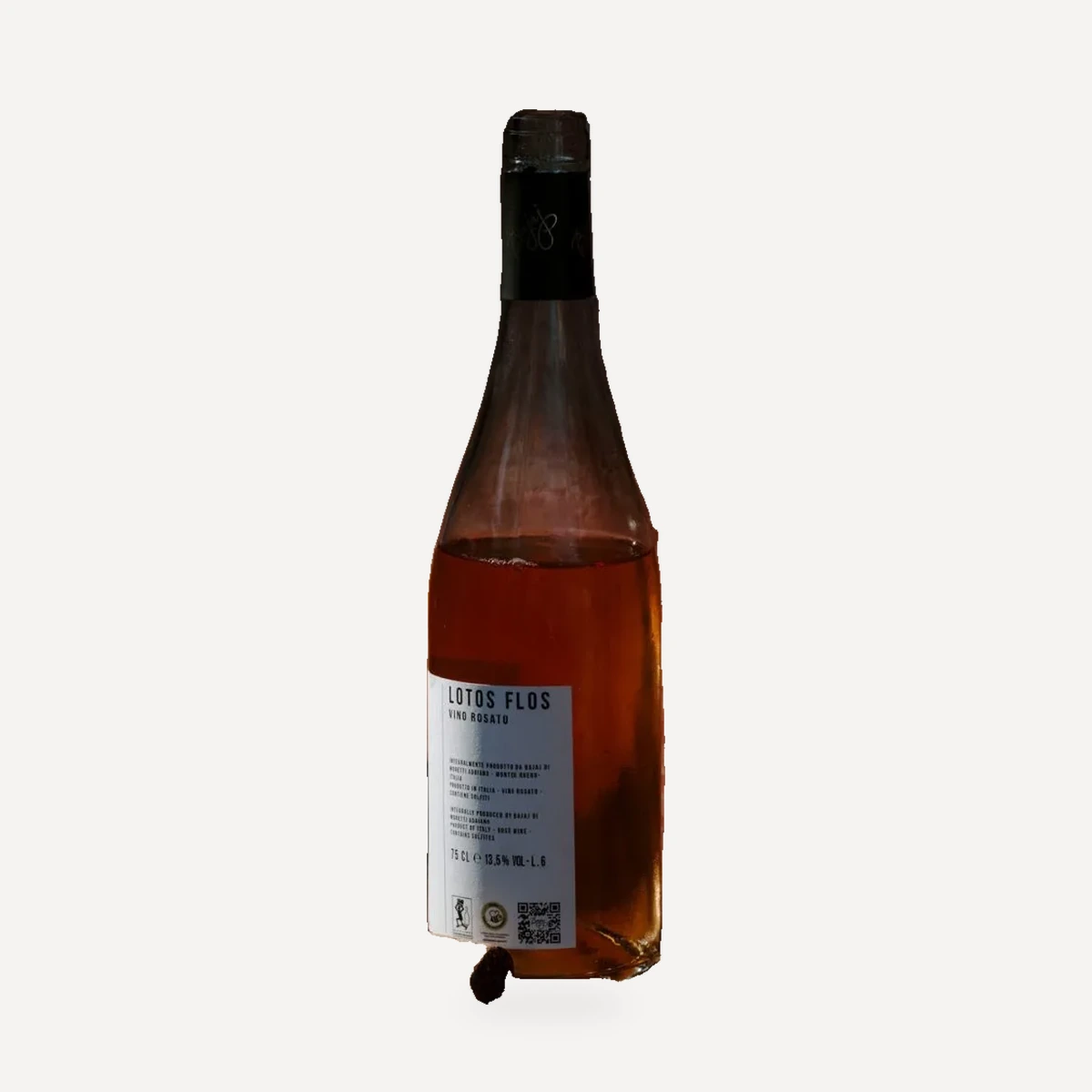
Adriano entered the business in 2014, initiating a period of development centred on native varieties and estate-bottled wine. The first wine he strongly championed was the rosé Lotos Flos. Giovanni initially opposed the idea because of the low status traditionally attached to rosé in Italy. Its first production comprised 300 bottles; average production subsequently rose to about 2,500 bottles.
The 2015 experiments
In 2015, Bajaj became one of the early Roero producers to experiment with terracotta amphora as an alternative maturation vessel. The first amphora wine was Pandorae Vas.
The 2015 vintage also produced the first Bajaj Roero DOCG. The inaugural release consisted of 300 bottles, after which demand increased.
Expansion of the range
The estate created Avanti Savoia in 2020, during the COVID-19 pandemic. The white vermouth resulted from a year of development and its first production was limited to 486 bottles.
In 2021, Bajaj made its first and only sparkling wine, Berenike. Conceived as an experiment, it is a rosé Traditional Method wine from Barbera, matured for 20 months on its lees and dosed Extra Brut. Adriano dedicated it to his partner, Veronica, who had moved from Liguria to Piedmont to be with him. Following the reception of the first release, production was repeated.
Before the 2021 harvest, the estate was still tasting its 2020 Langhe Nebbiolo, Pandorae Vas, Roero, Barbera d’Alba and Prometheus prior to bottling. Adriano’s position was that wine should not be hurried for commercial reasons and should be bottled only when ready. He characterized the 2020 whites as delicate, fresh and mineral and the reds as fine, approachable and elegant, with common vintage-derived traits across varieties.
Recent development
The agricultural holding now covers 22 ha, including 5 ha of vineyards, while fruit and vegetables occupy the balance. Annual wine production is approximately 25,000 bottles. Adriano manages the operation across vineyard work, cellar work, visitor hospitality and marketing.
The 2024 Nebbiolo harvest was deliberately delayed in pursuit of full phenolic maturity and finer tannins. Rain threatened the crop, while some bunches developed Botrytis cinerea rather than acid rot. The affected berries became highly fragile and difficult to pick, but the noble rot concentrated aromatic compounds. This decision reflected Adriano’s increasing emphasis on patience and precision in Nebbiolo production.
Terroir
Bajaj’s vineyards lie at Monteu Roero, among the hills and Rocche of Roero. The estate repeatedly identifies sand as a defining element of its land, but the three named vineyard areas show meaningful differences in soil and topography.
Gaiuccio is dominated by white, limestone-rich sand. It lies within a mixed landscape of woods and orchards, reinforcing the estate’s emphasis on biodiversity. The site is associated with mineral, iodine-like and saline expressions in its wines.
Bric Nota is a steep, fragile-soiled MGA. Its pronounced slopes, crumbly ground and narrow row spacing make mechanization difficult and require almost all work to be performed by hand.
San Vincenzo is a sunny, favourably exposed hill. Its heavier soils combine sand and clay over a silty matrix, contrasting with the lighter white sands of Gaiuccio.
The vulnerability of these soils became especially clear during the 2022 drought. Water stress was most severe on the sandiest ridges, where vines struggled to reach the third trellis wire, growth and fruiting concentrated near the trunk, terminal buds produced small non-fruiting shoots and yields were expected to decline. During the preceding six months, precipitation was 55% below the historical average; May was the second warmest since 1965 at 2.5°C above normal, the first ten days of June were 0.9°C above normal, and high-altitude snow cover stood 60% below normal.
Vinificazione
The estate regards respect for each vineyard and appropriate agronomic management as prerequisites for expressing its part of Roero. Its mixed-farming model integrates vineyards, orchards, vegetable plots, woods, open-field crops and greenhouses rather than treating vines as an isolated monoculture.
Biodiversity is the central principle of this model. Vineyard treatments are selected only after analysis and close monitoring, with two ecological consultants assisting the daily work. The intended result is healthy raw material obtained with careful environmental stewardship and the least unnecessary intervention.
Work intensity varies by site. Bric Nota is managed almost entirely by hand because of its steep gradients, friable soil and close row spacing; its old Barbera parcel is worked completely by hand. Vine age and favourable site position are treated as two of the principal qualitative assets of the approximately 5 ha under vine.
Adriano follows Nebbiolo maturity closely and is prepared to delay picking in pursuit of phenolic maturity and finer tannins. In 2024 this meant accepting considerable rain and crop-loss risk. The resulting harvest included delicate bunches affected by Botrytis cinerea rather than acid rot, requiring difficult handling while offering greater aromatic concentration.
The wider farm’s strawberry plots are weeded manually rather than with chemical herbicides, and only products permitted in organic agriculture are used on that crop. These statements apply specifically to the strawberries and do not establish an organic certification for the vineyards.
Adriano Moretti’s cellar approach is deliberately restrained. The aim is to intervene as little as possible so that vineyard, variety, vintage and the hand of the grower remain perceptible. He favours freshness, directness and approachability, generally preferring steel and avoiding excessive wood.
Terracotta amphora is a defining cellar vessel. Bajaj began experimenting with it in 2015 and was among the early Roero estates to adopt this form of alternative maturation. Approximately 60% of total production now passes through amphora. Adriano values the vessel for preserving freshness and the unforced character of the wine.
Across the range, fresh grapes may be destemmed before fermentation. Red-wine protocols include stainless-steel or terracotta-amphora fermentation, followed at peak temperature by an overnight délestage in temperature-controlled steel at 18°C. Pump-overs and punch-downs are used during the vigorous phase. Some lots are racked before alcoholic fermentation has fully completed.
White-wine methods include gentle pneumatic pressing, temperature-controlled steel fermentation for about 10 days, and frequent bâtonnage. For Arneis, one quarter of the principal lot receives a two-hour cold maceration in the press before an approximately ten-day steel fermentation. Maturation options range from steel alone and amphora to restrained barrel ageing. The Roero red protocol uses six months in medium-toast, third- and fourth-use French-oak barriques from Bordeaux, followed by at least one year in bottle.
Bottle ageing is not hurried to satisfy commercial schedules. The 2020 wines were still being tasted immediately before bottling in August 2021, with additional rest planned according to the needs of each wine. The Riserva Arneis is made from a single vineyard only in selected vintages, limited to 500 bottles and matured solely in bottle.
Traditional Method production began with Berenike in 2021. This Barbera rosé spends 20 months on its lees and is finished as Extra Brut.
Filosofia
Bajaj presents winegrowing as a way of life rooted in family inheritance and in Adriano Moretti’s decision to remain in Roero. His guiding principle is to let each vineyard speak in its own voice. Wines should be fresh, enjoyable and direct while retaining the distinctions of terroir, grape variety, vintage and the person who made them.
The approach balances tradition with experimentation. Steel and limited wood serve clarity and freshness, while terracotta amphora reconnects an ancient vessel with contemporary cellar control. Projects such as Pandorae Vas, Lotos Flos, Prometheus, Berenike and Avanti Savoia reflect a willingness to challenge familiar regional categories without severing the connection to Roero.
Environmental responsibility is expressed through biodiversity, mixed farming and carefully evaluated treatments. Viticulture, fruit growing, vegetable production, woods and orchards form a single agricultural system. Investment in Roero is framed not merely as commercial work but as a responsibility toward land that gives its best when treated with care.
Patience is equally important. Adriano resists rushing wine to bottle and accepts vineyard risk when he believes additional ripening will improve tannin quality. The desired balance is between natural processes and attentive human care rather than either complete passivity or heavy intervention.
Family hospitality extends the same philosophy beyond wine. Food, wine and personal welcome are treated as complementary ways of communicating the seasons, memories and traditions of Roero.
Vini