Storia
Family farming roots
Denis Montanar belongs to the fourth generation of a farming family. In the early twentieth century, his great-grandfather cultivated, under a sharecropping arrangement, many of the vineyards that would later be associated with the family holding.
1989: Denis takes responsibility for the vineyards
Denis began working in the agricultural business in 1989. He initially took charge of his grandfather’s holding by renting its vineyards. He subsequently bought 2 hectares of land and planted them with vines.
1995: expansion and the Borc Dodon project
In 1995, Denis expanded the property through the acquisition of another 10.5 hectares together with their rural houses. This purchase gave shape to an agricultural project and territorial identity named Borc Dodon, the Friulian form of the historic hamlet name Borgo Dodone.
The farm was conceived as a mixed agricultural holding rather than an exclusively wine-producing property. Part of its land was assigned to old varieties of wheat, maize and buckwheat for flour. Alfalfa entered the crop rotation as organic green manure, while sunflowers were grown for edible oil.
1996–2000: organic management
All vineyards came under organic management in 1996. Organic cultivation was extended to the arable land in 2000.
2013: the Denis Montanar identity
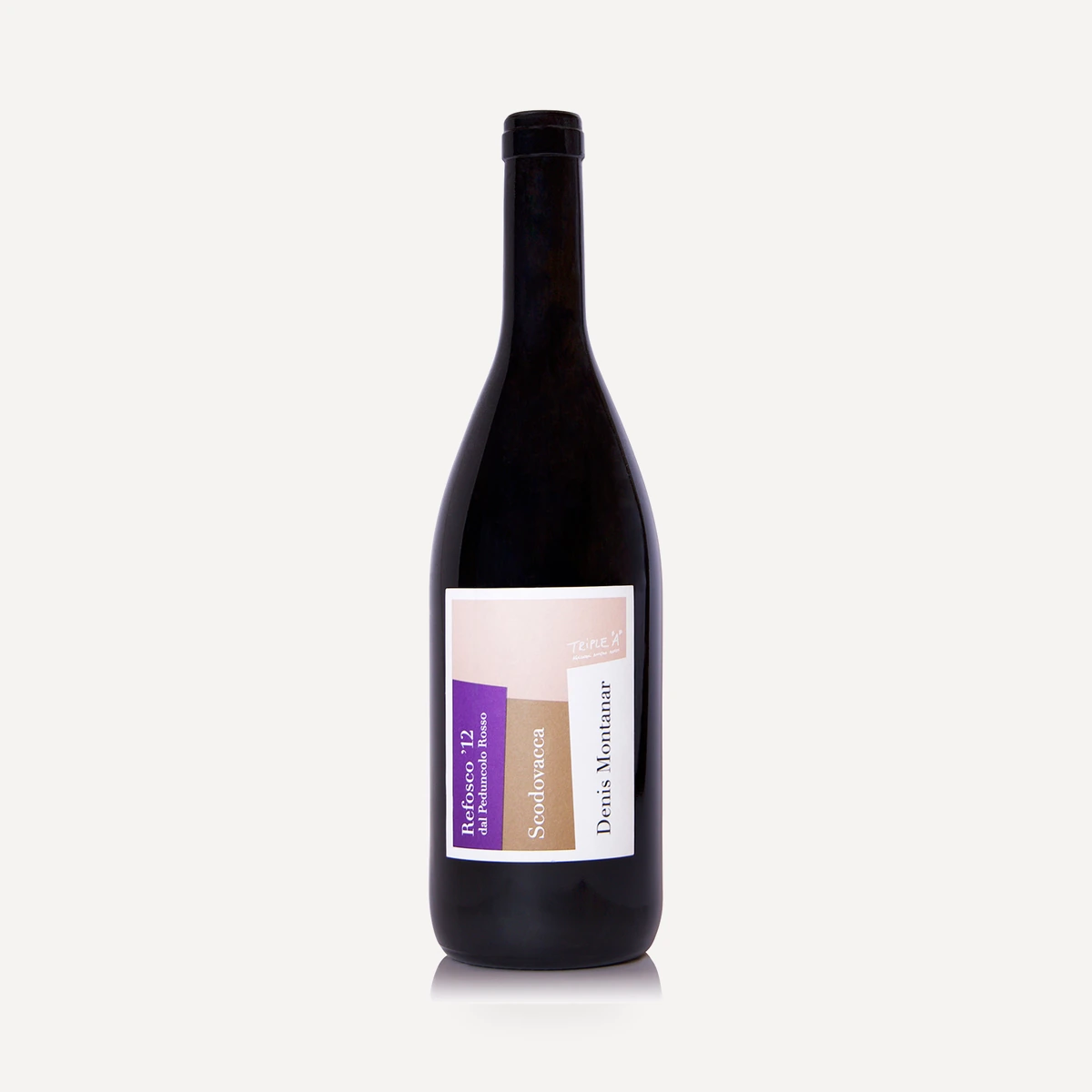
In 2013, Denis chose his own name as the principal identity of the estate. The names Borc Dodon, Borc Sandrigo and Scodovacca remained alongside it as the three toponyms of the lands where the farm grows its products. Wine labels and the wider visual identity were redesigned accordingly. Trapezoidal elements on the new labels evoke the shapes of cadastral vineyard parcels seen from above.
The estate also introduced Toy Wine to its bottled range in 2013: a traditional-method sparkling wine issued only in magnum. Its initial edition combined the 2009, 2010 and 2011 vintages.
Terroir
The estate is based at Borc Dodon in Villa Vicentina, in the province of Udine. Its agricultural identity is organized around three local toponyms: Borc Dodon, Borc Sandrigo and Scodovacca.
Borc Dodon and Borc Sandrigo include low-lying vineyards at approximately 9 metres above sea level. Their soils combine sand, silt and clay. The Borc Dodon Merlot parcel is described in the order sand–silt–clay, while the Borc Sandrigo mixed white parcel is described as silt–sand–clay.
Vinificazione
The vineyards have been managed entirely under organic cultivation since 1996, followed by the arable land in 2000. Vineyard work includes green manuring, fertilization with natural manure, minimal use of copper and sulfur, and manual harvesting into crates.
The estate’s Triple A affiliation commits its production to direct cultivation, the exclusion of synthetic chemicals, respect for the vine’s natural cycle, physiologically ripe and healthy fruit, and manual selection of future vines for genuine massal selection.
Its Renaissance du Terroir commitment adds soil tillage or permanent vegetation in place of herbicides; compost or organic fertilizers to support soil microorganisms; exclusion of chemical fertilizers; natural disease-control products compatible with organic farming; and exclusion of synthetic contact, penetrating and systemic products. Genetically modified vines are excluded. Manual harvest may take place in one or more passes, with the integrity of the grapes preserved before pressing. Massal selection is favored as a means of maintaining and increasing vineyard biodiversity.
The wines ferment spontaneously with their natural or indigenous yeasts. Selected exogenous yeasts are excluded, as are fining and filtration. Grapes are harvested manually into crates.
Under the Triple A production rules followed by the estate, must receives neither sulfur dioxide nor other additives; sulfur dioxide may be used only in minimal quantities at bottling. Chemical or physical intervention before or during alcoholic fermentation is excluded apart from temperature control, and concentration techniques are prohibited. Wines mature on their fine lees until bottling, without correction of chemical parameters.
The Renaissance du Terroir protocol further excludes enzymes, added bacteria, synthetic fermentation products, nitrogen, vitamins, thiamine, yeast hulls and aromatic additives. Cryo-extraction, vacuum evaporation, osmosis and other concentration processes are excluded. Where vintage conditions permit, the natural balance of must and wine is left unchanged, without acidification, deacidification or added sugar.
The range includes still red, white, skin-contact white and rosé bottlings. Since 2013 it has also included a traditional-method sparkling wine made only in magnum. That initial sparkling cuvée was refermented with grape juice, disgorged without freezing and aged on its yeasts in steel for between 12 and 24 months.
Filosofia
Denis Montanar’s approach joins farming, place and wine under a single agricultural project. The three names Borc Dodon, Borc Sandrigo and Scodovacca keep the individual lands visible within the broader estate identity.
Through Triple A—Agricoltori, Artigiani, Artisti—the estate aligns itself with three principles: the producer should directly cultivate the vineyard through natural agronomic work; production should preserve rather than reshape the original structure of grape and wine; and the grower’s personal sensitivity should express both site and variety. The movement rejects standardization driven by vineyard chemistry and laboratory-selected yeasts and favors minimally interventionist vinification.
The Renaissance du Terroir charter treats wine as the expression of the relationship among heat, light, water conditions and geology. Living soils and foliage free from synthetic chemicals are regarded as prerequisites for transmitting terroir and microclimate. Healthy organic or biodynamic farming is paired with restrained cellar technology so that the wine can retain its origin, ageing potential and transparency of production.
These commitments translate into organic cultivation, massal selection, manual harvest, spontaneous fermentation, exclusion of corrective and concentration techniques, maturation on fine lees, and bottling without fining or filtration.
Vini