Storia
The family’s arrival at Il Castagno
In the early 1970s, Fabrizio Dionisio’s father, Sergio, purchased an estate of approximately 7 hectares at Il Castagno, on the hills facing Cortona. It included an olive grove and a vineyard. Initially used as the family’s holiday home, the property became the focus of a longer-term ambition to establish roots in Tuscany, preserve the surrounding landscape and eventually create a winery capable of expressing the area’s aptitude for viticulture.
1992: the estate takes shape
The purchase of a second property, Poggio del Sole, in 1992 transformed the family holding into a wine estate and established its present two-property structure. Il Castagno and Poggio del Sole lie a few kilometres apart on the hills of the historic Chiuso della Valdichiana.
Replanting at the turn of the millennium
Fabrizio’s wine project became concrete in the late 1990s. The old vineyards, which had produced a small quantity of simple wine for family consumption, were uprooted. Beginning in 2000, the vineyards on both properties were gradually replanted with new materials, techniques and viticultural criteria. Planting density rose from approximately 1,300 to 5,000 vines per hectare, and the project initially concentrated exclusively on red grapes considered suitable for the site.
Syrah became the central variety. At Poggio del Sole, part of the Syrah vineyard was planted in 2000 and another part in 2003. The approximately 3 hectares of Syrah at Il Castagno were planted in 2001. Rootstocks and clones were selected in France’s Rhône Valley for low productivity and high fruit quality, while taking Cortona’s particular soil and climatic conditions into account.
The first wine and early recognition
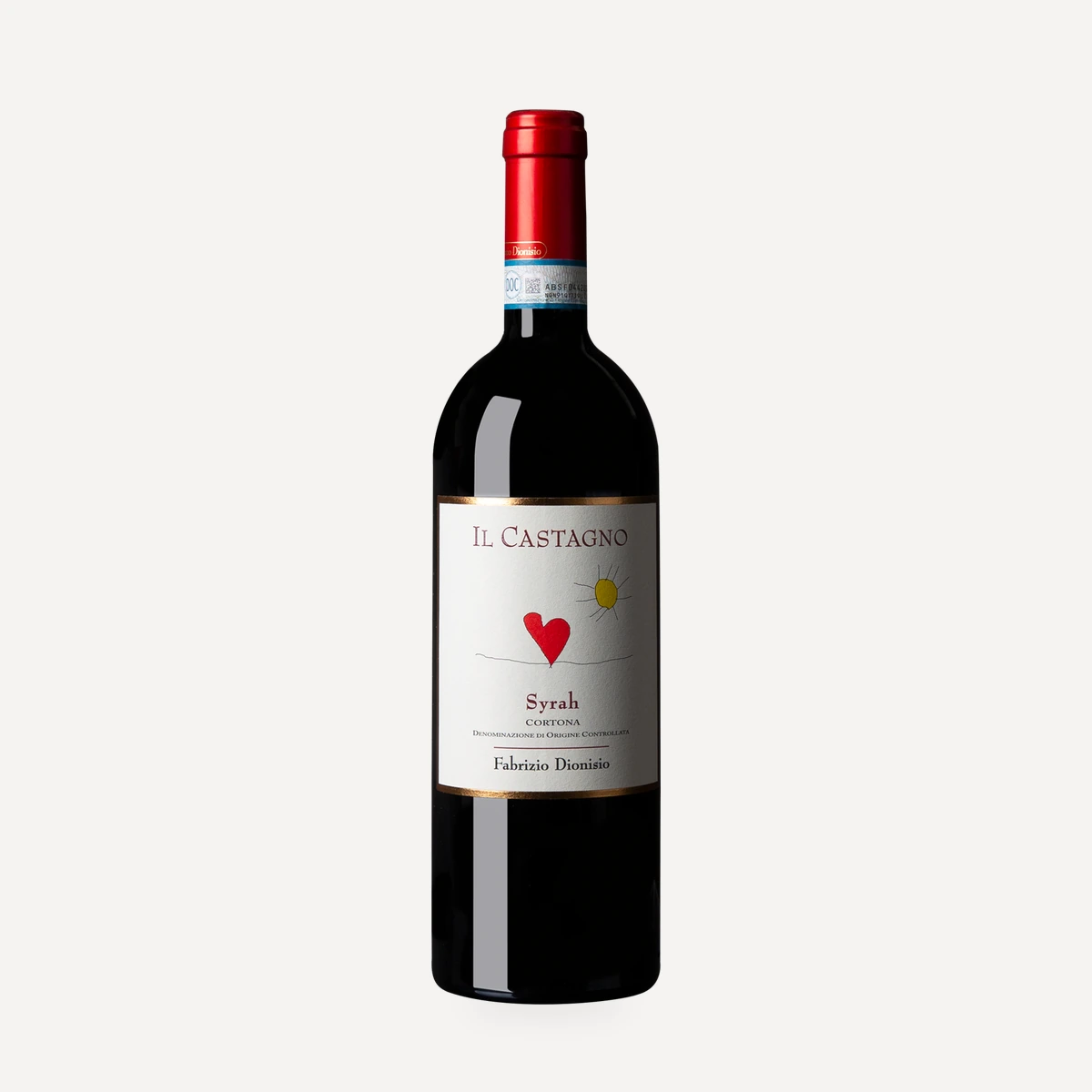
The first Il Castagno Syrah Cortona DOC was made from the 2003 harvest. Named for the original family estate, it became the winery’s symbolic wine. The 2003 vintage was released in 2005 and brought the first recognition from Italian wine guides, including Gambero Rosso’s Vini d’Italia, La Guida de L’Espresso, I Vini di Veronelli and Luca Maroni. Later coverage came from Duemilavini/Bibenda, Slow Wine and Vitae, followed internationally by Wine Enthusiast, James Suckling, Wine Advocate, Vinous and Falstaff. An early Vinitaly Grand Mention diploma was also received.
Organic farming and continuing experimentation
Beginning with the 2014 vintage, the vineyards were managed with organic methods. The team first undertook an experimental period of approximately five years to establish that it could work successfully without resorting to conventional products. Formal organic certification was subsequently sought and obtained for the 2021 vintage.
The project has remained deliberately small and artisanal while expanding its interpretations of Syrah. Its current production comprises seven labels and approximately 50,000 bottles per year. Alongside six Syrah expressions, a small Viognier planting and corresponding micro-production broadened the range without displacing Syrah as the estate’s defining variety.
Terroir
Cortona and the Chiuso della Valdichiana
Il Castagno and Poggio del Sole stand a few kilometres apart on Cortona’s gently rolling hills, within the historic Chiuso della Valdichiana. Their broader setting has an average elevation of approximately 300 metres, while both vineyard properties lie above 250 metres. The landscape combines woods, olive groves and fields of wheat, sunflowers and tobacco with old villages, villas, parish churches and Etruscan remains.
The properties occupy a plateau framed by the Casentino highlands, the elevations bordering the upper Tiber Valley and the Val d’Orcia. Cortona rises on the slopes of Monte S. Egidio above the vineyards, with views extending toward Lake Trasimeno, Monte Cetona, Montepulciano and Monte Amiata. All of the estate’s vineyards face Cortona.
The local growing season is characterised by substantial warmth and light during spring and summer and a marked difference between daytime and nighttime temperatures.
Il Castagno
Il Castagno lies at the southeastern limit of the Cortona DOC on an undisturbed hillside of Oligocene formation. Its loose, fine sandy-loam soil contains abundant skeletal material, including galestro and clay schists, marls and fine calcareous quartz-feldspathic sandstones.
Poggio del Sole
Poggio del Sole occupies an undulating fluvial terrace of Pleistocene formation. Its medium-textured, fine-loam soil has an important component of clay-rich sands and silt.
Neither property borders cultivated land at a higher elevation. Woodland lies above them, providing physical separation from possible chemical contamination originating in neighbouring agriculture.
Vinificazione
The vineyards were designed around low yields and fruit quality. Syrah rootstocks and clones were selected in France’s Rhône Valley in relation to the soil and climate of Cortona. Planting density is 5,000 vines per hectare, compared with approximately 1,300 vines per hectare in the old vineyards.
At full production, the target average yield is approximately 1 kg of grapes per vine, equivalent to 50 quintals per hectare or 5 t/ha. Depending on the vintage, bunches are preselected during summer. This intervention has become progressively less necessary as the vineyards have matured.
Chemical inputs have been severely restricted from the outset. Organic management began with the 2014 vintage, followed by an approximately five-year trial during which the team tested its ability to work without conventional fallback products. Formal organic certification was achieved for the 2021 vintage.
Every vineyard operation is performed by hand apart from spring shoot topping. Harvesting is manual, and grapes are placed exclusively in small perforated crates to protect their integrity. Harvest dates, selection decisions and the allocation of grapes are planned according to the intended character of each label. Woodland above both estates and the absence of higher neighbouring cultivated plots further limit exposure to chemical drift.
Vinification and maturation take place at Il Castagno, which contains both the production cellar and barrique cellar. The work is deliberately small-scale, manual and non-standardised. Decisions are adapted to the conditions of each harvest and to the character of individual vineyard parcels; every parcel is vinified separately throughout production.
Hand-harvested grapes arrive in small perforated crates. Destemming is careful but not universal: a measured proportion of stems may be retained when appropriate to the fruit and the intended wine. The berries are kept as intact as possible.
Harvest timing, grape selection, vinification, maceration length, time on the lees and maturation are varied according to the desired expression. The cellar employs barrels and both small and large wooden casks, including French and Slavonian oak, as well as cement vessels and terracotta amphorae. Maturation periods differ both in the cellar and in bottle. Only estate-grown grapes are used.
Filosofia
Fabrizio Dionisio describes the project through the ideas of craftsmanship, naturalness, curiosity and constant improvement. Respect for the environment, the land and the integrity of its fruit is combined with restrained human intervention. Methods and technology are accepted when they preserve cleanliness, soundness and purity, but they must remain subordinate to the character of the grapes.
The approach rejects fixed protocols and standardisation. Each vintage is treated as unrepeatable, and the work is tailored to the season and to the character of each parcel. Sensitivity and practical judgement take precedence over dogma. “Natural” wine is understood not as an ideological category but as careful, handmade production supported by meticulous attention at every stage.
Small quantities, rigorous work in vineyard and cellar and the exclusive use of estate-grown fruit form the basis of the quality philosophy. The estate intends to remain an artisanal workshop rather than pursue volume.
Syrah is the principal vehicle for expressing Cortona. The aim is to produce wines that can stand alongside established international examples while remaining recognisably Tuscan and specifically Cortonese. Minerality, character, elegance and finesse are prioritised over sheer power. Multiple interpretations of the variety allow the team to explore different harvest dates, vinification choices, macerations, vessels, lees contact and maturation regimes.
The project treats experimentation as continuous rather than conclusive. Its guiding idea is that the best wine will be the next one: perfection may not exist, but it remains the standard toward which the work should aspire.
Vini