Storia
Ancient settlement and the first buildings
Casa Sola’s agricultural roots are traced to an Etruscan community established around 500 BC. The oldest surviving part of the present complex was built in the 1500s as a watchtower and military outpost. Florentine militia used the position to defend the frontier during the prolonged conflicts between Florence and Siena.
The name “Popolo di Casasola” appears on a 1560 map prepared by the Capitani di Parte Guelfa and preserved in the Podesteria of Barberino Val di Pesa. Between the 1500s and 1600s, Casa Sola developed into the centre of a rural agricultural community. By the 1600s, this was an organized and largely self-sufficient farming settlement producing grapes and olives alongside wheat and vegetables for neighbouring communities.
The Gambaro family
The Count Gambaro family acquired the estate in 1958, initially regarding Casa Sola as a place for holidays and rest. Its agricultural activity nevertheless continued, and the family became progressively more involved in managing the land and making wine and olive oil. The family project originated with Giovanni Gambaro, continued through Giuseppe Gambaro and is now carried forward by Giuseppe’s son, Matteo.
Giuseppe Gambaro led the estate through its principal phase of development. He moved into full-time management, bringing managerial and real-estate experience together with an interest in wine. He studied viticulture and oenology, examined the methods behind the wines of Burgundy and introduced new techniques. His work included renewing vineyards, machinery and production facilities. He also renovated the estate’s farmhouses, laying the foundations for hospitality and wine tourism.
Vineyards, bottling and cellar development
New vineyards were planted in 1965, followed by Casa Sola’s first bottling in 1968. A new winery was constructed in 1985. Cabernet Sauvignon and Merlot entered the Casa Sola project during the late 1980s: the Montarsiccio blend has combined them with Sangiovese since 1987, while the historical chronology records experimental Cabernet Sauvignon and Merlot plantings in 1988. Those 1988 plantings accompanied vineyard renewal informed by the Chianti Classico 2000 research project.
The estate buildings were renovated for hospitality and wine tourism in 1990. In 2000, the winery itself was renewed and fitted with new equipment. A long programme of vineyard and olive-grove replanting then ran from 2005 through 2022.
Matteo Gambaro and the present estate
Matteo Gambaro spent his childhood in Genoa, where the family’s wine interests focused particularly on Burgundy, but Casa Sola was the setting for his holidays, early harvests and developing interest in wine. He studied Agriculture and Oenology at university and used the estate as a practical testing ground for his studies. He subsequently completed a two-year MBA, adding economics, marketing and management to his technical training.
Before returning to the estate, Matteo worked for a French retail multinational, first in a department store and later at its headquarters as a buyer and category manager with responsibility for international projects. In 2002, he left that career to manage Casa Sola full time as a winegrower and winemaker, applying an environmentally and socially responsible approach to the family business.
Casa Sola now comprises 80 ha: approximately 20 ha of vineyards, 8 ha of olive groves, and additional fields and woodland. Its villa, offices and tasting rooms occupy the centre of the property, beside the fermentation and ageing cellars.
Terroir
Location and landscape
Casa Sola lies in the municipality of Barberino Tavarnelle, approximately 30 km from Florence and 28 km from Siena. The estate occupies the western part of Chianti Classico within the San Donato in Poggio area. Its vineyards form part of a single contiguous property, although individual sites differ in soil, exposure and altitude.
The vineyards extend across hills between 280 and 340 m above sea level; the estate-wide average is approximately 330 m. The prevailing exposure is south-west. Vineyards and olive groves are interspersed, while fields, forests and extensive Mediterranean maquis surround the cultivated ground. The woodland cools the summer microclimate, supports biodiversity and acts as a carbon reservoir. Cypress, juniper, tree heath and broom are characteristic components of the natural vegetation.
Maritime influence and climate
The estate’s openness toward the Mediterranean and proximity to the Tyrrhenian Sea bring breezes that moderate temperature and slightly extend ripening. Winters are relatively mild and can advance flowering, but less intense summer heat means that ripening and harvest are not necessarily early. Harvest normally falls between late September and the first two weeks of October.
Temperatures rarely fall below freezing and range approximately from 0°C to 31°C over the year. Annual precipitation is around 850 mm, concentrated principally in spring and autumn, especially April and November.
Soils
Soil conditions vary substantially across the property. Galestro is prevalent in the general estate description, while vineyard soils are also characterized as medium-textured and stony. Alberese and flysch formations alternate in certain areas. The western part of the estate is more loamy and fertile, and other zones combine clay-rich, fertile ground with distinctly rockier soils. These variations in soil, altitude and exposure give the individual vineyards separate identities despite their position within one estate.
Vinificazione
Casa Sola follows an organic approach across the production cycle, and all estate vineyards and olive groves are cultivated organically. The estate is pursuing organic certification, favouring mechanical work and natural treatment substances in place of synthetic chemicals.
Vineyards and olive groves alternate across the property, forming reciprocal natural barriers against disease. Surrounding forests and Mediterranean vegetation provide further ecological separation, sustain biodiversity, store carbon dioxide and help preserve a cooler summer microclimate.
Each vineyard receives site-specific care reflecting its soil, altitude and exposure. New plantings are planned by matching soil and microclimate with grape variety, clone and rootstock. Planting densities range from 3,500 to 5,500 vines/ha. Guyot and spur-pruned cordon systems are both used.
The estate avoids forcing young vines into production and values vegetative maturity. Older vines are considered more stable across vintages because their deeper roots make them less sensitive to climatic variation and better adapted to local conditions, disease pressure, pathogens and other stresses. Present vine ages extend from 1 to 50 years.
Harvest timing is based on sugar, pH, acidity and polyphenol development. During final ripening, grapes undergo daily chemical monitoring and visual assessment; portable refractometers are used in the vineyard to measure sugar concentration. Harvest generally takes place from late September through the first weeks of October. Manual harvesting permits cluster-by-cluster selection, retaining the best bunches and moving them rapidly to the cellar. The production description also explains mechanical collection and transport, without presenting it as the exclusive estate method.
Sangiovese normally ripens slowly and is picked from late September into early October. Merlot ripens earlier and is generally harvested about ten days before the other red varieties. Petit Manseng is late-ripening and is usually collected after the main harvest period.
Fermentation and lot separation
The cellar stands beside the central villa, offices and tasting rooms and contains separate fermentation and ageing areas. A range of vessels, materials and capacities provides the flexibility to process small selections and respond to the needs of individual grape lots. Each vineyard is fermented separately to preserve the character of its parcel.
Fermentation relies exclusively on the indigenous yeasts found on the grape skins. Apart from small quantities of sulphites, no additions are identified. Temperature is controlled below 35°C as the native yeasts convert sugar into alcohol. After separation from skins and pomace, every Casa Sola wine completes malolactic fermentation.
Maturation and cellar capacity
Following fermentation, wines mature in wooden vessels or concrete tanks to stabilize, integrate and develop complexity. The cellar contains 1,170 hl of stainless-steel capacity in tanks ranging from 10 to 130 hl; 1,500 hl of concrete tanks ranging from 50 to 125 hl; 600 hl of 20- and 30-hl Slavonian oak casks; and up to 350 hl of small French oak tonneaux and barriques.
Cleanliness and hygienic control are treated as essential throughout fermentation and ageing. The cellar also includes a large temperature-controlled area for bottle maturation. Bottle ageing ranges from about six months for simpler wines to three years for Montarsiccio.
For Vin Santo, freshly harvested Malvasia and Trebbiano bunches are hung in a dedicated ventilated room and dried for approximately four months to concentrate their sugars. After gentle pressing, the must ferments and ages for five years in small caratelli.
Filosofia
Casa Sola defines the winegrower as a custodian of the environment, traditions and shared resources—including landscape, water and vegetation. Its broader working framework is based on ethics, solidarity and sustainability.
The estate’s aim is to make artisanal wines that express the elegance and distinctive character of Chianti Classico in each vintage, with particular emphasis on Sangiovese. Its approach combines respect for Chianti’s history with a willingness to experiment with new projects, native grapes and international varieties. This balance is described as both traditional and innovative.
Wine is regarded as originating in the vineyard. Site-specific care, patient development of vine age, separate fermentation of individual vineyards and flexible lot handling are intended to retain distinctions among soils, exposures and elevations. Vineyard work is paired with a low-addition cellar approach based on indigenous yeasts, limited sulphite use and responsible winemaking.
Environmental measures extend through the entire production cycle: organic farming, electricity exclusively from renewable sources, rainwater storage for gardens and the vegetable plot, lightweight glass bottles, woodland conservation, separated waste collection and reduction of waste. The family also places value on transparent communication, responsible consumption and sharing knowledge about the estate and its territory.
Vini
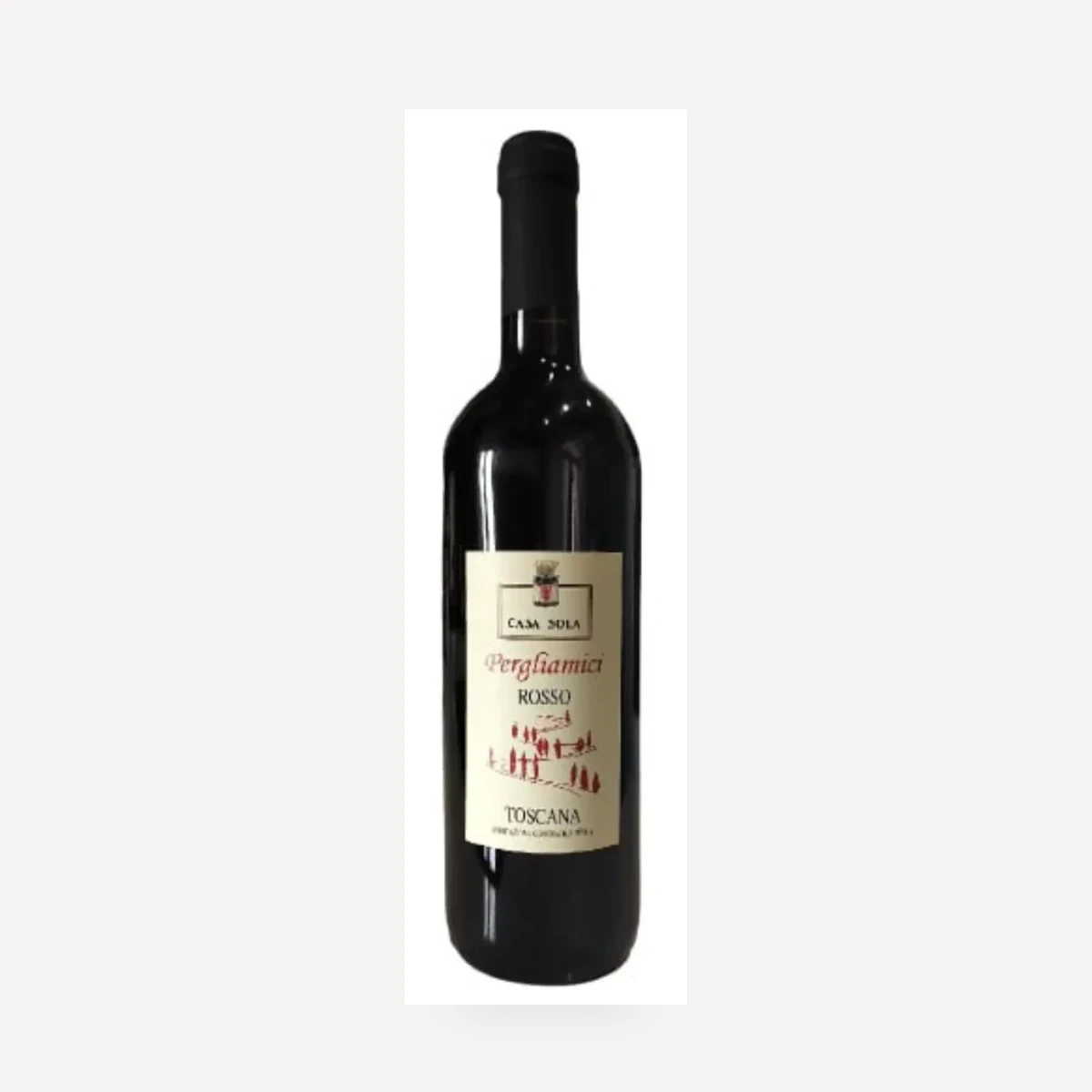
Pergliamici Rosso