Storia
Napoleonic origins and the Mancini purchase
Around 1810, the Napoleonic administration identified the cool coastal hills and calcareous-sandstone soils around Focara as suitable for Pinot Noir. Under Viceroy Eugène de Beauharnais, Napoleon’s adopted son, the variety was introduced into estates that had been expropriated from the Church.
In 1861, the Mancini family acquired one of these properties. The family preserved and propagated the Pinot Noir inherited from the period of French rule, maintaining it through five generations of winegrowers. Two centuries of adaptation produced material distinct from the French clones from which it originated.
Reconstruction in the early 1970s
In the years immediately preceding the early 1970s, Luigi Mancini—the grandfather of the present Luigi and an engineer who had sold his construction company—and his son Ettore invested in rebuilding the agricultural estate. They constructed a new winery, the family’s fourth since the mid-nineteenth century, and planted approximately 40 hectares of vineyards in Roncaglia and Focara.
The new facility was conceived as a rational, innovative winery for its period. For many subsequent years the business remained largely unchanged. Bulk wine sold to local customers represented the principal activity, while bottled wine contributed only a modest part of turnover. Those first bottled labels nevertheless became the foundation of the later range.
Roncaglia, based principally on Albanella with white-vinified Pinot Noir, had already been produced since the early 1970s. After more than two decades of production, it received the Colli Pesaresi DOC Roncaglia designation in 1994.
Luigi Mancini and the technical renewal
Luigi Mancini, the fifth generation, arrived at the estate at the end of 1995. His father Ettore, then the only family member directly involved in managing Fattoria Mancini, had sold the family villa in Fano and moved to the house beside the winery. Luigi was studying engineering and initially knew little about the winery or its land, having been deliberately kept away from the business by his father.
His interest in mechanics drew him into the winery. He began assisting with its renovation during increasingly long returns from university and eventually committed himself to the estate. The rational structure built by his father and grandfather provided the basis for a substantial technical overhaul. Luigi travelled first within Italy, then frequently to France and subsequently to Pinot Noir regions in Burgundy, New Zealand, Oregon and California. Within a few years, both the facility and the direction of the business had changed significantly.
The family decided to move away from dependence on bulk wine and concentrate on bottled production. Pinot Noir, long valued by Ettore and earlier generations, became the central focus. Research also became a defining element of the estate’s philosophy and a practical means of refining its production processes.
Research, new labels and clonal selection
In 1998, Fattoria Mancini began a research project with the Viticulture Chair of the Institute of Tree Crops at the University of Milan. The work sought to isolate and propagate the best Pinot Noir clones created through almost two centuries of adaptation to Focara. Research later expanded to Albanella, the local white variety associated with Pesaro.
The 1998 harvest also produced the first Impero Blanc de Pinot Noir. It built on the family’s long experience of vinifying Pinot Noir as a white wine and became the estate’s flagship label. In the same year, Luigi Mancini began vinifying fruit from an old Ancellotta vineyard separately. The resulting wine became Blu, named after the persistent blue-purple stains left on the winery floor.
An experimental section of the Rive vineyard was established with the University of Milan in 2000 to study and reproduce the selected Pinot Noir material. In the same year, the Focara Pinot Noir received recognition within the Colli Pesaresi DOC. The adapted variety was registered nationally as Pinot Nero Pesaro in 2001, recorded in Gazzetta no. 280 of 1 December 2001.
Alongside the clonal work, Luigi developed and tested a particular vine-training system, which he presented to colleagues internationally. The experimentation attracted attention within the Pinot Noir community.
International recognition and parcel development
Fattoria Mancini began exhibiting at Vinitaly in 1998. In 2003 it received the Cangrande Prize, “Benemeriti della Vitivinicoltura Italiana,” recognizing merit in Italian winegrowing and winemaking.
In 2004, the estate was invited to the International Pinot Noir Celebration in Oregon, becoming one of only ten participating wineries from outside the United States. The invitation followed the estate’s work with Pinot Noir, its clonal research and Luigi Mancini’s international exchanges.
From 2005, the selected family Pinot Noir clones were used for every new estate planting. Terracing work in the Rive vineyard was also undertaken in 2005.
Beginning with the 2007 harvest, Rive Monte was vinified separately and bottled as Rive di Focara. The small vineyard contains three areas that ripen at different times. In particularly successful vintages, the western sector—where ripening is longer and the fruit produces greater structure—is separated again for i Terrazzi di Focara. Blu also reached a stable composition of 100% Ancellotta from the 2007 harvest, having begun as a blend containing at least 50% of the variety.
Recent development
The range has continued to evolve around site-specific Pinot Noir, white vinification of Pinot Noir and the estate’s other historic varieties. Raje was first produced from the 2024 vintage, combining the former classic Sangiovese expression with fruit from Rive Monte, previously bottled separately as Rive Sangiovese.
From the 2025 harvest, the estate added a rosé interpretation of Ancellotta. By this period Fattoria Mancini produced eleven wines, seven described as Pinot Noir-based. The estate’s work and vineyards were featured in the 26 October 2025 episode of the RAI programme Linea Verde.
Terroir
Fattoria Mancini’s vineyards occupy approximately 20 hectares inside the Monte San Bartolo Natural Park, at the northernmost end of the Marche region and around the historic Pesaro villages of Roncaglia and Focara. Monte San Bartolo forms a high coastal stretch between Gabicce Mare and Pesaro and is described as a physical and climatic boundary between northern and central Italy.
The Focara promontory rises steeply above the Adriatic Sea. Estate production zones range from the immediate coastal edge to approximately 1 km inland, generally at 100–150 m above sea level. Rive lies on the Focara cliff, 1.3 km south of Fiorenzuola di Focara, while Tenuta Quarta occupies the top of one of the park’s highest hills.
The coastline faces north and is exposed to winds arriving from Northern Europe. Warm sea currents moving north from the Mediterranean do not reach this part of the coast, making northern Marche markedly cooler than other parts of the region. The Rive sector is described as one of the coldest stretches of the Adriatic coast. Its western side permits longer ripening than the vineyard’s other sectors.
Calcareous sandstone is the dominant soil, commonly with a high silt component. Tenuta Quarta is distinguished by an exposed vein of gypsum within the calcareous sandstone of the Focara cliff. The combination of cool coastal conditions, north-facing slopes, altitude and calcareous sandstone is associated with gradual ripening, retained acidity, freshness, salinity and the capacity for long-lived wines.
Vinificazione
Viticulture is organized around the estate’s position inside the protected ecosystem of the Monte San Bartolo Natural Park. New vineyards are designed so that soil management can be carried out entirely by mechanical means, eliminating chemical herbicides. Fertility is maintained with manure or compost from local livestock farms, with the stated aim of respecting natural soil fertility and encouraging biodiversity.
Yields are deliberately restricted, and agronomic work is adjusted to the needs of individual vineyards and varieties. Each site can be managed and vinified separately to preserve its identity. Tenuta Quarta uses a training system designed to counter the effects of global warming through more gradual ripening and improved acid retention. Luigi Mancini also developed and internationally presented an experimental training system during the period of the University of Milan clonal work.
The estate maintains family selections of Pinot Noir that developed through approximately two centuries of adaptation to Focara. Research with the University of Milan began in 1998; an experimental Rive section followed in 2000. The selected clones have been used for all new estate Pinot Noir plantings since 2005. Research later extended to Albanella.
Harvesting is entirely manual. Grapes are collected in ventilated 15 kg crates and cooled with mobile refrigerated units. Depending on variety and intended style, picking runs from mid-August for early Pinot Noir through mid-September for Albanella, Sangiovese and Ancellotta.
Fattoria Mancini vinifies only fruit grown in its own vineyards. The cellar is arranged to maintain control over each stage, and individual vineyards receive targeted agronomic management followed by separate vinification. The approach combines contemporary cellar technology with close handling of the raw material.
The estate has more than forty years of experience in vinifying Pinot Noir as a white wine as well as making traditional reds. White-wine processing includes the pressing of chilled whole clusters, static settling of the must and temperature-controlled fermentation at approximately 18°C. Fermentation may take place in tanks or 228 L French oak barriques. Depending on the intended expression, malolactic fermentation is either prevented or completed fully. Maturation takes place in stainless steel, concrete or French oak, with barriques of different ages used in defined proportions.
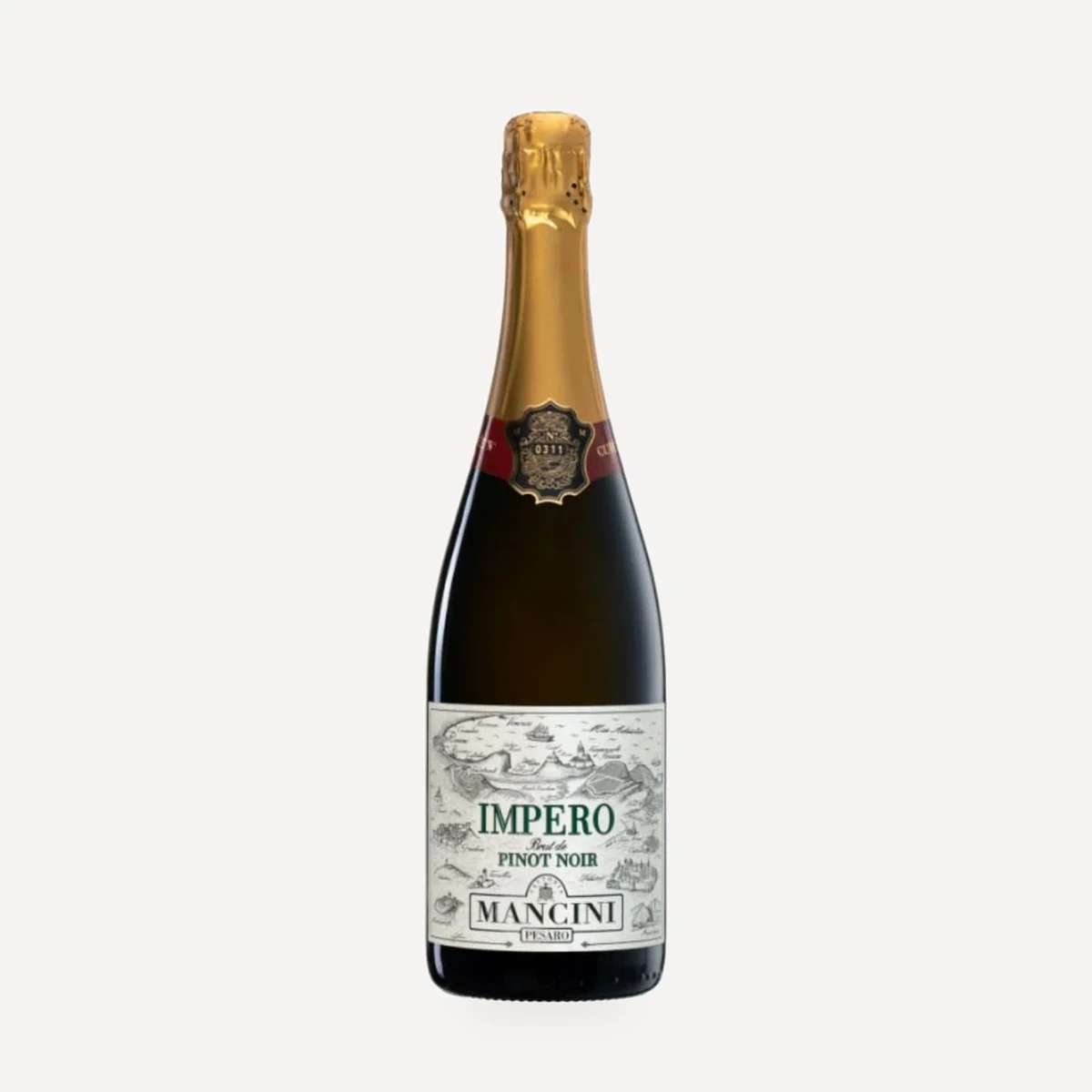
Traditional-method sparkling production begins with gentle pressing of whole Pinot Noir clusters. The base wine is fermented in barrique, matured in wood for approximately seven months on its lees with bâtonnage, and undergoes full malolactic fermentation. Secondary fermentation takes place in bottle in the estate cellar, followed by 24–36 months on the lees.
Red-wine methods include low-temperature destemming and crushing, cold pre-fermentation maceration, controlled-temperature tank fermentation, pump-overs and, for Ancellotta, délestage. Maceration length is adjusted to the raw material: newer Pinot Noir vineyards receive shorter extraction and complete fermentation off the skins, while Ancellotta may undergo approximately seven days of cold maceration and about twelve days of fermentation with délestage and pump-overs. Malolactic fermentation is completed for the documented red styles.
Red maturation may combine stainless steel and French oak or take place entirely in barrique. The cellar uses 228 L French barriques, including Allier and Tronçais oak, with the proportion of new wood varied according to the parcel and intended structure. Site selection continues into the cellar: Rive Monte is vinified separately, and in exceptional vintages its later-ripening western sector is isolated as a further parcel selection.
Filosofia
Fattoria Mancini presents research as a central part of its identity: a means of understanding its land, varieties and production processes rather than an end in itself. Luigi Mancini describes the objective as interpreting the character of the estate’s territory and grapes through a personal style, supported by continual technical refinement.
The production philosophy gives individual vineyards priority. Targeted agronomic work and separate vinification are intended to express the identity of each site and the relationship among variety, terroir and house style. Technical expertise is paired with interpretive sensitivity rather than used to standardize vintage or parcel differences.
Environmental responsibility follows from cultivating within the Monte San Bartolo Natural Park. The estate’s declared principles include mechanical soil management, elimination of chemical herbicides in new plantings, local organic manure, support for natural fertility and biodiversity, low yields and manual harvesting.
Tradition and innovation are treated as complementary. The family has preserved its historic Pinot Noir material for five generations while working with the University of Milan on clonal selection, redesigning training systems for a warming climate, modernizing the cellar and developing separate cru expressions. The same approach extends to Albanella, Sangiovese and Ancellotta, varieties valued for their connection to the estate’s history and locality.
Vini
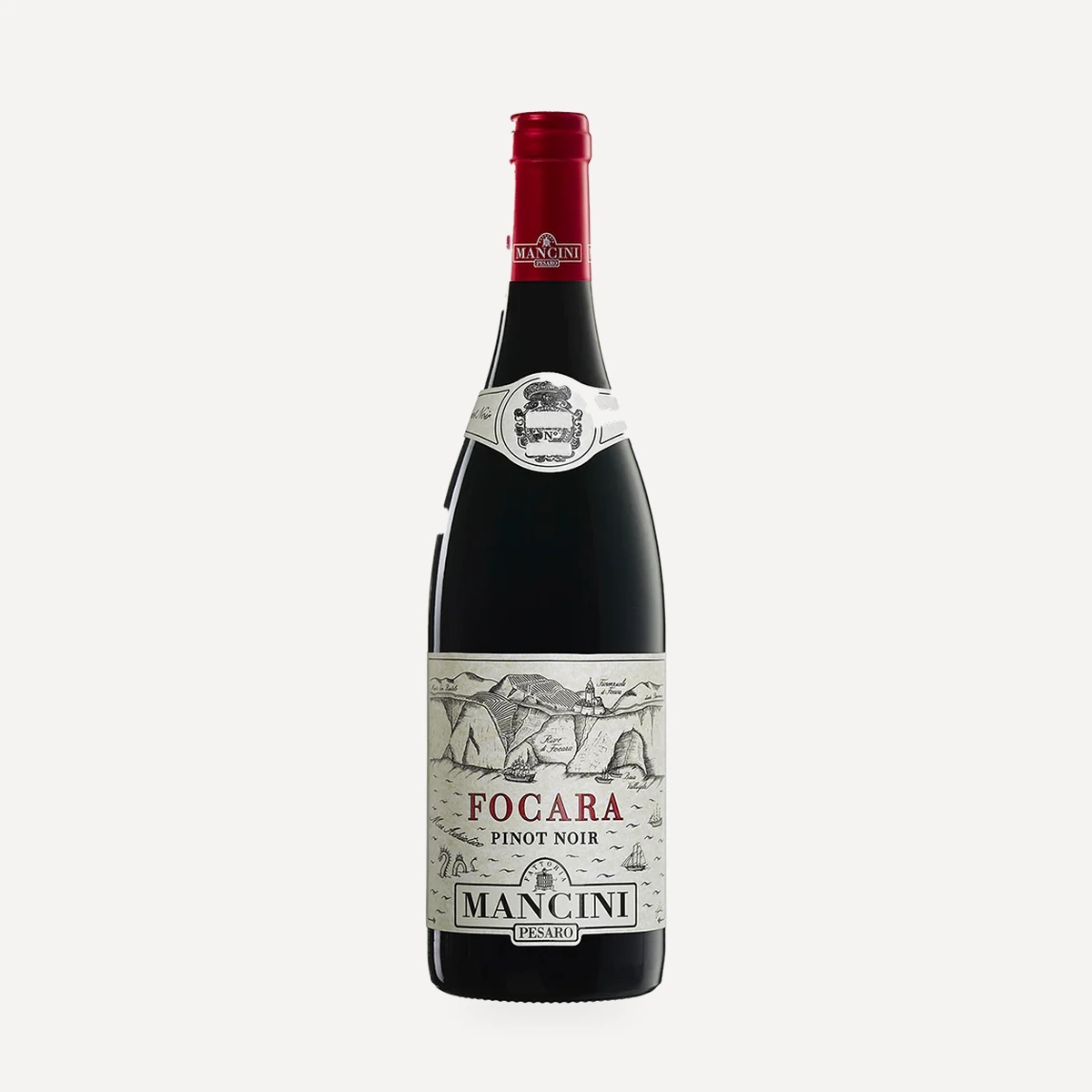
FOCARA Pinot Noir
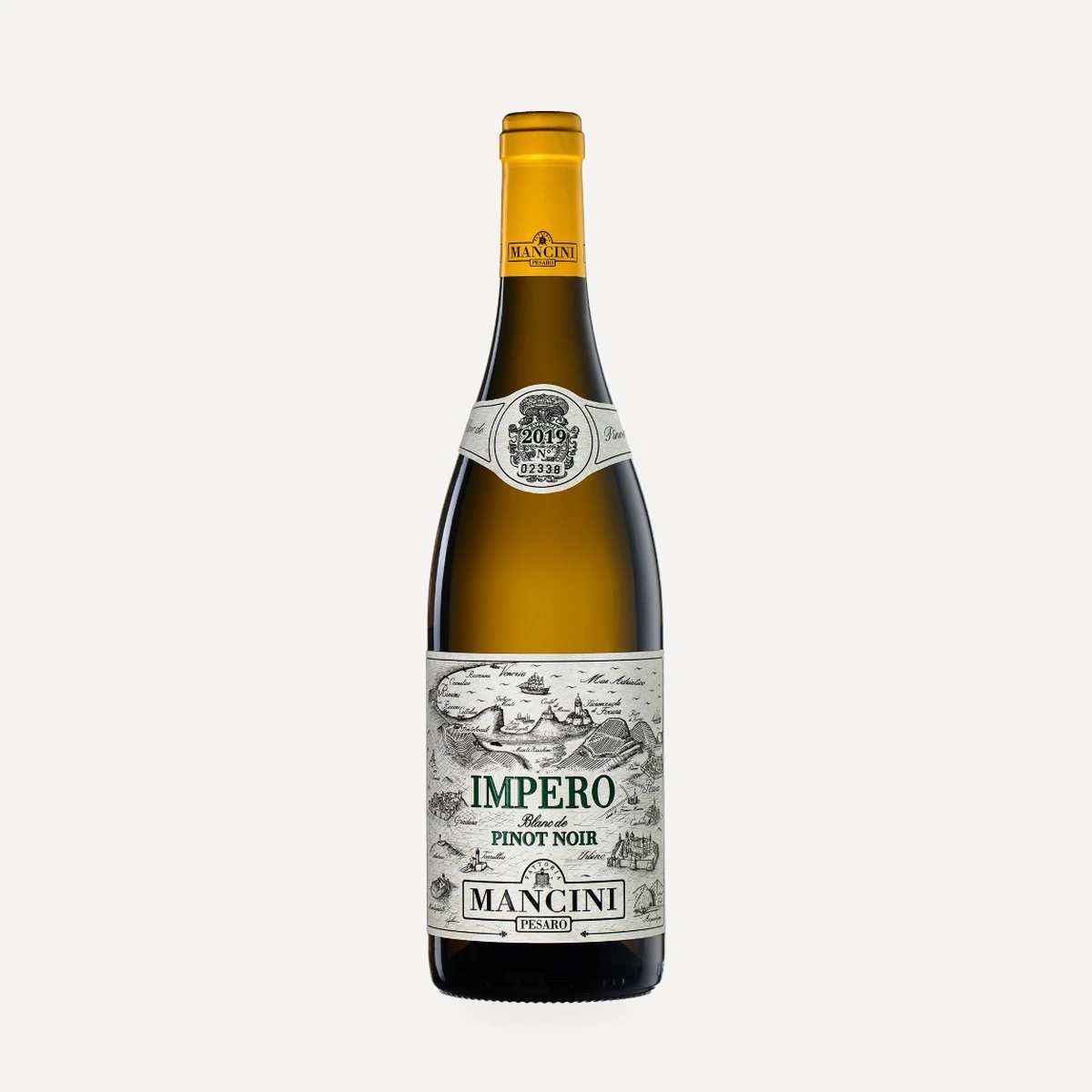
IMPERO Blanc de Pinot Noir
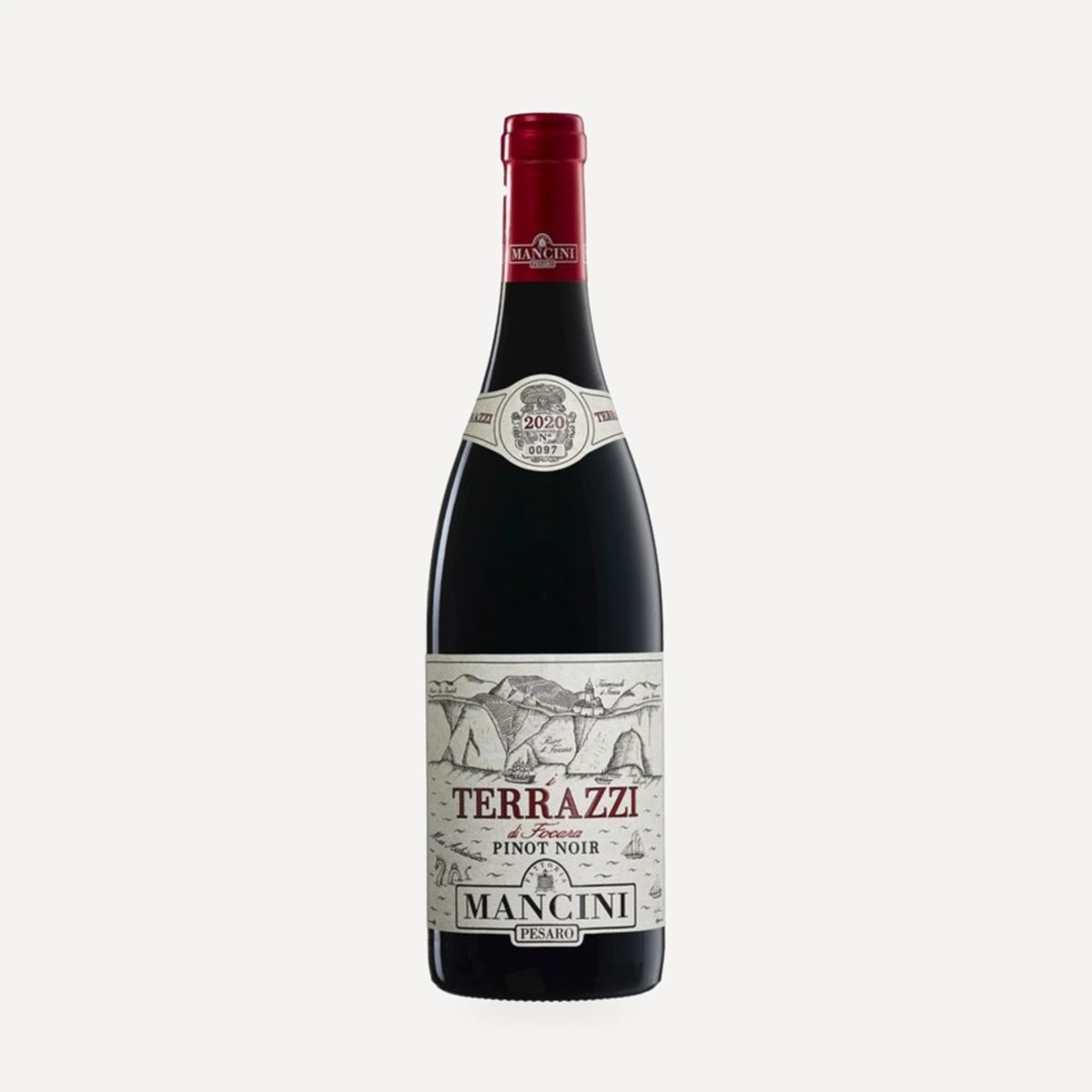
i Terrazzi di Focara Pinot Noir