Storia
1919 — foundation
Kettmeir was founded in Caldaro in 1919. Its identity developed within South Tyrol’s mountain-wine culture, with production drawing on vineyards at markedly different elevations and on long-term relationships with growers across the region.
1964 — Charmat sparkling wine
In 1964, Kettmeir began producing sparkling wine by the Charmat Method. This established a dedicated sparkling-wine vocation nearly three decades before the cellar took up bottle-fermented sparkling wine.
1986 — entry into the wine-estate group
Kettmeir became part of HERITA MARZOTTO WINE ESTATES in 1986. The operating company is now KETTMEIR SpA, wholly owned by HERITA MARZOTTO WINES SpA.
1992 — the Traditional Method project
In 1992, Kettmeir began producing sparkling wine by the Traditional Method. Athesis Brut was the first expression of this new phase, conceived as a relaunch of South Tyrolean bottle-fermented sparkling wine and as a vehicle for the character of high-altitude vineyards.
2011 — “1919” Riserva Extra Brut
The first vintage of “1919” Riserva Extra Brut was produced in 2011. The cuvée is matured on its lees for at least five years and takes its name from the cellar’s foundation year.
2018 — international recognition
In 2018, Athesis Brut received the “Best Italian Sparkling Wine” distinction from the Champagne & Sparkling Wine World Championships. The milestone became part of Kettmeir’s chronology of Traditional Method development.
2026 — renovation, expansion and reopening
A substantial renovation and expansion was completed in April 2026. The project created additional spaces designed specifically for ageing Traditional Method sparkling wines and a larger underground press room. The renovated estate reopened with an immersive visitor itinerary combining permanent art, interactive projections and aromas associated with fermentation and yeast autolysis.
Environmental systems formed an integral part of the expansion. Groundwater supplies a geothermal installation that cools the floors and ceilings of the ageing rooms, protecting stacked bottles from temperature fluctuations. Photovoltaic panels power the geothermal pumps; the combined system operates without net energy consumption. The development made the Carbon Neutral-certified cellar energy self-sufficient.
The new visitor route also gives a central place to Kettmeir’s grape suppliers and their Masi. A limited release named “Edition Baustelle” commemorated the works: a construction accident had splashed cement onto stacked bottles, and the marked bottles and their wooden cases were retained as a symbol of renewal.
Terroir
A mountain territory
Kettmeir works across South Tyrol, beneath the Dolomites, using vineyards that range from the valley floor to high mountain sites. The principal named locations are Pochi di Salorno, Castelvecchio, Caldaro and Soprabolzano. Their different elevations, exposures, slopes, soils and temperature patterns provide distinct environments for individual varieties.
Pochi di Salorno and Maso Reiner
Maso Reiner lies at Pochi di Salorno, at 350–500 metres above sea level. Its slope has calcareous, richly structured soils with clay and organic matter. Pinot Nero, Chardonnay and Pinot Grigio are grown here. The coordinates presented for Pochi di Salorno are 46°24′47″N, 11°14′46″E.
Castelvecchio
Castelvecchio is among the highest parts of the municipality of Caldaro. The vineyards reach 700 metres, on steep, east-facing slopes with porphyry-rich soils. Pinot Bianco is cultivated here for Athesis Brut Metodo Classico, while the higher vineyards supply Athesis Pinot Bianco. The coordinates are 46°30′00″N, 11°21′00″E.
Caldaro
The Caldaro sites lie at 250–400 metres. Lake Caldaro and its microclimate, the gently level valley, protection from the surrounding hills and limestone soils create the conditions used for Chardonnay, Sauvignon and Moscato Rosa.
Soprabolzano and Maso Ebnicher
Maso Ebnicher at Soprabolzano reaches 1,221 metres above sea level. Strong day–night temperature changes, breezes descending from the Dolomite peaks and sandy, freely draining soils characterize this high-altitude site. Müller Thurgau and Pinot Nero are grown here. The coordinates presented for Soprabolzano are 46°31′40″N, 11°24′20″E.
Vinificazione
Kettmeir has established long-term partnerships with 70 winegrowers distributed across South Tyrol. The relationships are intended to give growers a secure future in their Masi—the traditional local farmsteads comprising a residence and its surrounding land—and to sustain cultivation on steep slopes where machinery cannot operate.
Supplier vineyards are required to comply with strict integrated pest-management protocols. Kettmeir and its growers also share a commitment to manage the land under the South Tyrolean Wine Consortium’s 2030 Agenda protocol.
The resulting viticulture spans valley sites and very high elevations. Some of the steepest vineyards depend on manual work, while vineyard placement is matched to variety through elevation, exposure, soil structure, drainage and local temperature patterns.
Traditional Method since 1992
Kettmeir began its Traditional Method project in 1992. The range comprises Athesis Brut, Athesis Brut Rosé, Pas Dosé and “1919” Riserva Extra Brut, all under Alto Adige DOC.
Cuvée and tirage
Base wine is prepared in autumn. In spring, it is combined with yeast and approximately 24 g/L of sugar and filled into bottles. The cellar calculates that each 4 g of sugar generates roughly 1 bar of pressure, with a target of about 6 bars after fermentation. Bottles are closed with crown caps and stacked in the cellar.
Secondary fermentation begins within a few days and lasts approximately five to six weeks, depending on the vintage and the behaviour of the base wine.
Lees ageing and autolysis
Once the available sugar has been consumed, the yeast settles in the bottle. Autolysis then gradually releases yeast-derived compounds into the wine. Longer contact produces a greater autolytic contribution. During this period the bottles remain motionless in their stacks. The first vintage of “1919” Riserva Extra Brut was designed for at least five years on the lees.
Remuage
At the end of ageing, the bottles are removed from their stacks and shaken to detach the deposit. They are placed on pupitres and turned by one-quarter or one-half each day in a slight spiral movement, progressively collecting the yeast in the neck. This stage takes approximately one month to 40 days.
Dégorgement, dosage and final ageing
The bottle neck is immersed in a glycol solution and frozen. Removing the crown cap allows the internal pressure to eject the plug of ice and yeast. Liqueur d’expédition is then added when dosage is required, adjusting the final sugar level. The bottle receives its mushroom-shaped cork and rests for several further months in the cellar before release.
Expanded production spaces
The 2026 expansion added dedicated spaces for Traditional Method ageing and a larger underground press room. Groundwater-driven geothermal cooling in the floors and ceilings protects ageing bottles against temperature fluctuations. Photovoltaic power runs the geothermal pumps, allowing the combined cooling system to function without net energy consumption.
Filosofia
Kettmeir’s motto, progressio in traditione, expresses an approach in which established South Tyrolean practices are continuously re-examined rather than treated as fixed formulas. Respect for time, attachment to place and the courage to experiment are presented as complementary principles.
Oenological experimentation is central to this outlook. Traditional Method production is treated as an old discipline that must be made relevant to the present through technical research, patience and close attention to high-altitude fruit. Josef Romen’s objective is for the origin to be immediately recognizable: Kettmeir’s bottle-fermented wines are intended to evoke South Tyrol from their first aromatic impression.
The cellar seeks to express both indigenous varieties and grapes adapted to South Tyrol’s differing elevations. Its stylistic aims are aromatic clarity, elegance and fidelity to origin. The different sites—from Caldaro and Pochi di Salorno to Castelvecchio and Soprabolzano—are valued for their distinct combinations of altitude, soil, exposure and climate.
Responsibility also extends to the growers. Stable partnerships with 70 suppliers, support for manually worked steep vineyards and continuity for the Masi are part of Kettmeir’s social model. Environmental commitments include integrated pest management, the South Tyrolean Wine Consortium’s 2030 Agenda protocol, Carbon Neutral certification and energy-self-sufficient cooling and ageing facilities.
Vini
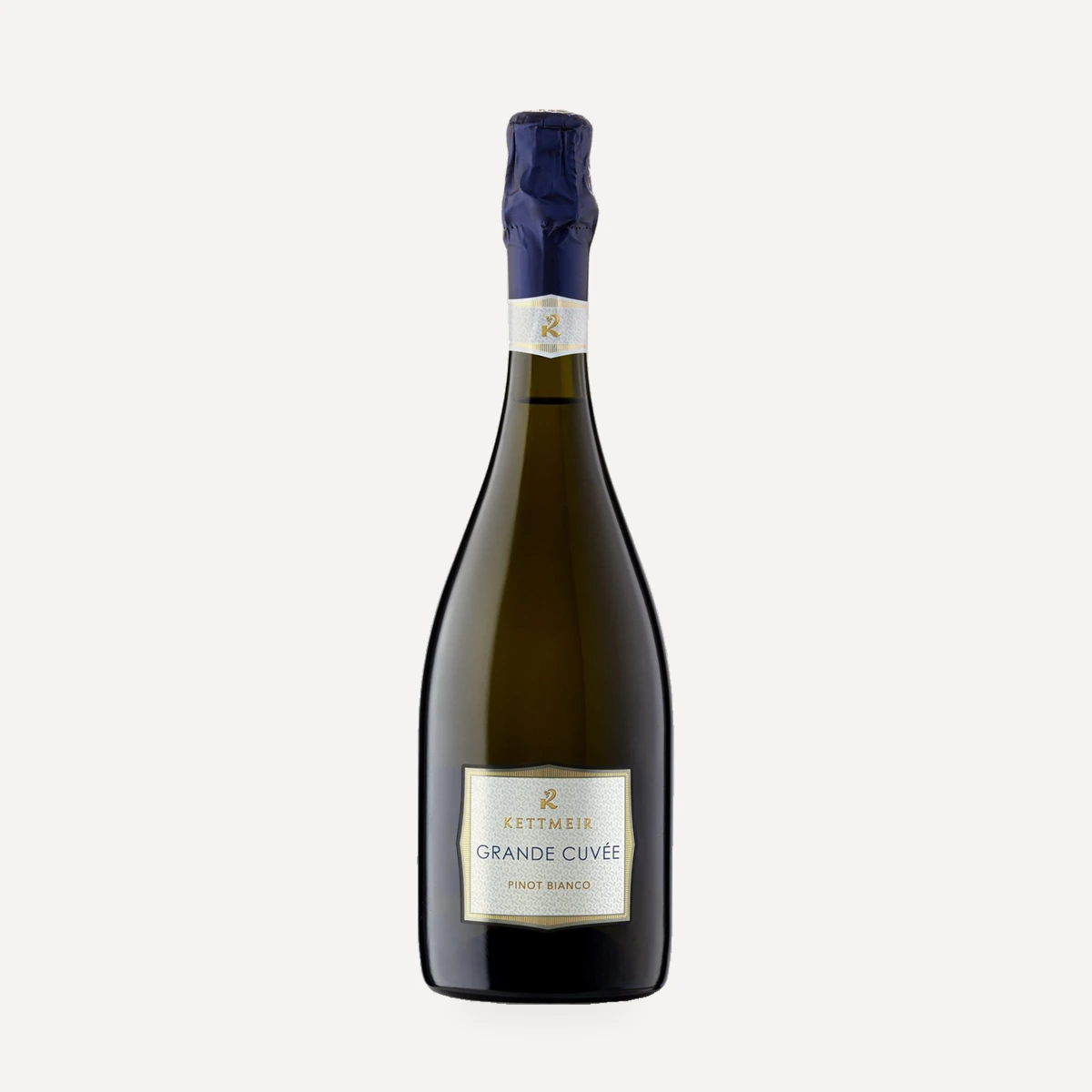
Grande Cuvée Brut