Storia
The wider history of viticulture in Cupramontana
Viticulture was already established around ancient Cupra Montana in the Roman period, from the fourth century BC to the fourth century AD. The name Cupra evoked a divinity associated with the earth’s fertility, while a contemporary bas-relief depicts a cherub and a cornucopia filled with grapes and other fruit.
The presence of monastic communities from the ninth through the thirteenth centuries brought a substantial expansion of agriculture and viticulture, both around monasteries and farther afield. In Contrada San Michele, the tradition is associated particularly with Camaldolese monks and a hermitage founded near the present church by San Romualdo during the first decade of the eleventh century. The monks cleared wooded land—terre silvate—for vineyards and arable farming.
The Cupramontana cadaster of 1471 recorded 1,010 hectares: 596 hectares of grain fields, 87.7 hectares of woodland, 85.7 hectares of pasture, 46.7 hectares of vines and 41 hectares of olive trees. Between 1471 and 1474, migrants from Lombardy settled houses and land abandoned after plague devastated Santa Maria Nuova and parts of the Esino Valley. These farmers, artisans and small entrepreneurs probably introduced the grape later called Verdicchio, a name documented from the early sixteenth century and subsequently identified genetically with Trebbiano di Soave.
Sixteenth- and seventeenth-century cadasters record expanding vineyards under the category of tree-planted land with vines. A 1544 register documents the arbulu system in Barchio-Esinante and Alvareto, with vines married to field maples. Verdicchio coexisted with other varieties and contributed to the area’s abundant eighteenth- and nineteenth-century wine production. Extensive planting of Verdicchio followed between the late nineteenth and early twentieth centuries, when its quality and value became increasingly recognized.
From private vineyard to ecclesiastical benefice
The earliest record connected with La Distesa’s present land is the 1471 cadaster, which mentions vineyards belonging to Nocenzio dè Giovanni near the church of San Michele, although their exact correspondence with the present parcels cannot be established.
The Old Land Registry of 1658 assigns the identifiable property to Marc’Antonio Torelli. Between the end of the seventeenth century and the beginning of the eighteenth, it became an ecclesiastical benefice. The 1714 cadaster names the benefice for Francesco Giandalini, whose surname was recorded as Giandolini in later registers. An ecclesiastical benefice gave church land or real property to clergy in usufruct as compensation for their duties.
Francesco Giandalini, who lived from 1645 to 1715, had been an important bass singer in the musical chapel of Rome’s hospital of Santo Spirito in Saxia. He probably worked in Rome until 1676, then became chapel master in Cupramontana and remained there until his death. His will left his property for the benefit of the chapel master of San Leonardo, specifying that the beneficiary should be a suitable local musician who was a subdeacon or otherwise approved by the Ordinary. After Giandalini’s death, successive chapel musicians of San Leonardo enjoyed the benefice.
The benefice survived the political changes of the nineteenth century and Italian unification. In 1885 it was still recorded as parcel 46, entirely planted with vines and without buildings. The 1886 Rustic Land Register again described it as the ecclesiastical benefice of Francesco Giandolini, then enjoyed by the cleric Giovanni Battista Boccetti.
Pietro Paolo Coppari and the construction of the cellar
Ownership is thought to have passed to Pietro Paolo Coppari between 1887 and 1920. Coppari was born in Cupramontana on 11 November 1874 and died in Ancona on 9 September 1957. A farmer and landowner, he also maintained a cellar opposite the hospital on Via M. Ferranti, at the present site of the Raul Bartoli Hall.
The building at Via Colonara 1 first appears in a cadastral change registered on 23 July 1927, when the land use changed from arable land to rural building. Because cadastral inspections occurred on five-year cycles, the cellar is thought to have been built by Coppari between 1922 and 1927. He retained the land and cellar until his wine business was declared bankrupt by the Royal Court of Ancona on 9 June 1931.
The Dottori family and Cantine Aurora
Engineer Domenico Dottori became interested in acquiring the bankrupt property. A deed dated 13 May 1934 records a purchase for 54,000 lire made through his attorney Augusto Fazi while Dottori was working in Sardinia. Final allocation appears to have occurred at a five-party public auction on 18 February 1935, where Fazi represented him and the final price was 60,000 lire. The maps indicate that Dottori acquired all sections of the vineyard land as well as the cellar. The Dottori family has owned the building since that date. A surviving certification records a 1941 Verdicchio vintage in Domenico Dottori’s name.
Domenico spent many years working independently in Sardinia and invested his savings in parcels around his home town, managed chiefly through sharecropping. Chosen by the National Liberation Committee as Cupramontana’s first post-war mayor, he entered the wine business again after retirement.
Cantine Aurora began in the early 1950s as Aurora di Bolletta, Cerioni e C. In 1958 it became Cantina Aurora dell’Ingegner Dottori e C. The business initially served central Italy, followed by Rome, Milan and the wider national market. Exports to the United States, Switzerland, France and England began in 1958. Modern equipment supported production of still and sparkling Verdicchio, red wine and Aurora rosé, with quality favored over volume when the two conflicted.
Pasquale Bolletta left the company in 1969. Domenico Dottori and Gianni Cardinali began its early liquidation in 1971. At that time it operated two processing sites: a sparkling-wine facility with four autoclaves on Corso Leopardi and a table-wine facility on Viale G. Spontini.
Aurora used a distinctive amphora bottle for Verdicchio and rosé. More sinuous than the familiar Verdicchio amphora, it had an obliquely cut neck whose silhouette recalled the pinnacles flanking the church of San Leonardo. A gold thread around the neck ended in a small fish-shaped cutout whose tail passed into the label. Limited bottles were painted by hand, and examples still survive in Cupramontana.
Cupramontana’s twentieth-century transformations
The Sagra dell’Uva grape festival began in 1928, and Cupramontana was designated the “capital of Verdicchio” in 1939. After the Second World War and during the 1950s, some landowners intensified Verdicchio cultivation. Vines were planted densely and trained low without mechanization; Trebbiano, Malvasia and Albanella also remained in the vineyards.
Traditional Verdicchio production began with brief skin contact to start fermentation. After the skins were removed, the must rested in large oak barrels until spring. The colder climate produced acidic wines. Harvest generally began after the grape festival on the first Sunday in October and continued until All Saints’ Day on 2 November. Some bunches were left until Christmas, then pressed and added to the must to increase alcohol and aroma.
The commercial success of amphora-bottled industrial Verdicchio during the 1960s weakened the farmer-producer model. Vineyards became larger and more productive, cellars adopted new technology, prices fell and many producers struggled. The Verdicchio dei Castelli di Jesi DOC was established in 1968.
Succession, new vineyards and La Distesa
Domenico Dottori died in 1973. The land and vineyards passed to his son Nazareno “Neno” Dottori, who retained the Cupramontana property with his wife Daniela despite living elsewhere. Corrado’s parents and his grandmother Leonilde Rossi, who owned the land, entrusted the San Michele farm to Pietro and Elena Branchesi, previously sharecroppers in nearby Follonica.
Two vineyard plots were planted in 1980 and 1983, and a small trade in bulk wine began in Milan. Pietro made artisanal Verdicchio in large oak barrels, leaving it on the skins for several days. His approach continued during a regional crisis dominated by light, industrial wines.
By the late 1980s and early 1990s, more terroir-focused, ageworthy Verdicchio was returning through the work of Amplio Bucci at Villa Bucci in Montecarotto, Lucio Canestrari at Gaiospino in Staffolo, the Bonci family and the Colonnara cooperative, respectively associated with San Michele and Cuprese.
As Pietro approached retirement, Corrado helped his parents with the first small-scale bottling of his wine. The 1996 vintage produced La Distesa’s San Michele. In 1997, the VAT registration was opened as Azienda Agricola La Distesa di Dottori Corrado.
While harvesting olives from a century-old Carbonella tree, Corrado resolved to leave his life in Milan and become a winegrower. At New Year 1999, he and Valeria travelled to France. In Cannes, they committed themselves to a shared future built around a home, vineyard, dog, farm, manual work and a different relationship with the land. La Distesa’s first harvest followed in 1999.
Twenty-first-century developments
The red-vine project later called Le Derive brought together La Distesa and friends Andrea, Daniele, Danilo, Fabrizio and Giovanni. They jointly financed a steep, approximately one-hectare San Michele vineyard planted in 2009 with Montepulciano, Sangiovese and Vernaccia Nera.
Renovation of the historic San Michele cellar began in 2015. The project prompted detailed research into the building and vineyard records and marked the beginning of a new phase for the estate.
Terroir
Le Marche and Castelli di Jesi
La Distesa lies in the inland hills of Le Marche, in the Province of Ancona, between the Adriatic Sea and the Apennines. The simultaneous influence of the shallow, enclosed Adriatic and nearby mountain systems—including Monte Catria, Monte Cucco and the Sibillini—shapes the area’s conditions.
The landscape retains the imprint of Marche sharecropping: small parcels, mixed crops, surviving woodland and dispersed farmhouses. Historically self-sufficient farms combined arable crops, vegetables, vineyards, olive groves and livestock, helping preserve ecological and agricultural diversity.
The Castelli di Jesi form a horseshoe around Jesi. They are fortified medieval and Renaissance towns rather than individual aristocratic castles. Their surrounding hills have a long agricultural tradition centered on durum wheat, extra-virgin olive oil and wine.
Cupramontana
The vineyards surround Cupramontana, whose village stands on the area’s highest hill at 505 metres. La Distesa manages 8.5 hectares, mostly planted with vines between 25 and 45 years old. The sites lie within Cupramontana or just beyond its boundary in San Paolo di Jesi, no more than 4 km in a straight line from the San Michele cellar.
Changing slopes, exposures and soils have encouraged a tradition of site-specific wines known locally as contrade. The practice has roots in the organization of Marche sharecropping farms and has informed a municipal vineyard-zoning project.
Cupramontana belongs geologically to the Umbrian-Marche Apennines. Its foundation is a sequence of marine sedimentary rocks. Beginning in the Miocene about 23 million years ago, tectonic forces compressed, faulted, folded and uplifted these sediments from the ancient Tethys proto-Mediterranean ocean. The hills around Cupramontana took shape in the final phase of uplift and deformation during the Lower Pliocene, approximately 4–5 million years ago.
Contrada San Michele
San Michele is traditionally regarded as a natural cru of Cupramontana. It is a sunny, well-ventilated district without persistent humidity. Its elevation produces meaningful day-to-night temperature differences, and its vineyards are harvested earlier than those of other local districts.
The soils are poor and calcareous, dominated by clay, marl and chalk. Sandstone occurs in smaller quantities and is concentrated toward the upper ridge. The combination is associated with structured, savory wines: warmer years emphasize body and fullness, while cooler years can produce iodine and maritime aromas. Aromatic herbs and orange peel are recurring local sensory markers.
Vinificazione
All farming activities follow organic practices certified by CCPB. The approach extends beyond vines to olive trees, arable land, fodder crops and woodland across two country estates.
Biodiversity is encouraged by sowing fava beans, vetch, peas and alfalfa between rows while allowing spontaneous plants to flower. The estate avoids monoculture: woods, hedges, trees, reeds and grass alternate with vineyards, untreated olive groves and arable fields. Crop rotation and light cultivation maintain fertility in the arable ground.
Vine growth is allowed to follow its natural physiology. Shoots are not hedged, pruning respects the vine’s tendency to branch, and leaves are not removed. Soil beneath the vines is not tilled; excessive weeds are flattened underfoot or cut manually. No fertilizer is applied.
Plant protection is limited to sulfur and small doses of copper. Nettle and horsetail teas are also used. Biodynamic preparation 500, made from horn manure, and Maria Thun’s Fladen preparation from the Foundation Le Madri are sprayed in autumn and spring.
The guiding aim is a balanced living ecosystem in which cultivated land and wild vegetation coexist. Healthy, naturally grown fruit is also treated as the principal means of reducing risk once grapes enter the cellar.
The historical winery stands at Via Colonara 1 in Contrada San Michele. The rural cellar building dates from approximately 1922–1927 and has belonged to the Dottori family since 1935. Renovation began in 2015, initiating a new phase in its use while preserving the early twentieth-century rooms.
Vineyard and cellar work are understood as a continuous process rather than separate activities. The cellar is treated as a microbiological entity connected to its immediate environment, allowing the wines to retain a relationship with their place of origin. Must is regarded as a living medium containing numerous substances and microorganisms, and winemaking as a creative response to the character of each season and batch of grapes.
The portfolio demonstrates the use of large cement tanks, steel tanks, 10–12 hl oak casks, used barriques and long cask aging. Applied techniques include skin contact, co-fermentation of white and red grapes, whole clusters, fine-lees aging, solera blending, bottle fermentation and prolonged lees aging before disgorgement. These choices vary by project rather than forming one standardized cellar recipe.
Filosofia
La Distesa presents itself as both a rural community and a custodian of the Marche agricultural landscape. The landscape is understood as a living organism shaped by centuries of interaction between people, crops, animals and uncultivated land. Organic cultivation is intended to communicate the land’s character without distorting it.
Winegrowing is framed as an inherently uncertain and creative act. Better vineyard work and healthier fruit reduce—but do not eliminate—the risks of transformation. Once pressed, must remains alive and can follow many possible paths; consequently, every wine and every season demands attention rather than a fixed formula.
The estate seeks to recount the complexities of its territory and the differences between seasons. Wine is not treated simply as a commercial bottle but as a cultural artifact tied to a specific origin. Corrado Dottori’s stated ambition is to communicate Italy, Le Marche, Cupramontana, the Marchigiano farming tradition and his own experience while holding together apparent opposites: city and countryside, progress and conservation, manual and intellectual work, technology and humanism.
Ecological and cultural biodiversity are inseparable within this outlook. La Distesa sees agriculture as an ecosystem balanced between wild energy and human action, and the grower as part of nature rather than an external agent manipulating it. Its economic outlook similarly favors direct relationships, small-scale distribution, solidarity purchasing groups and the idea of consumers as co-producers.
Vini
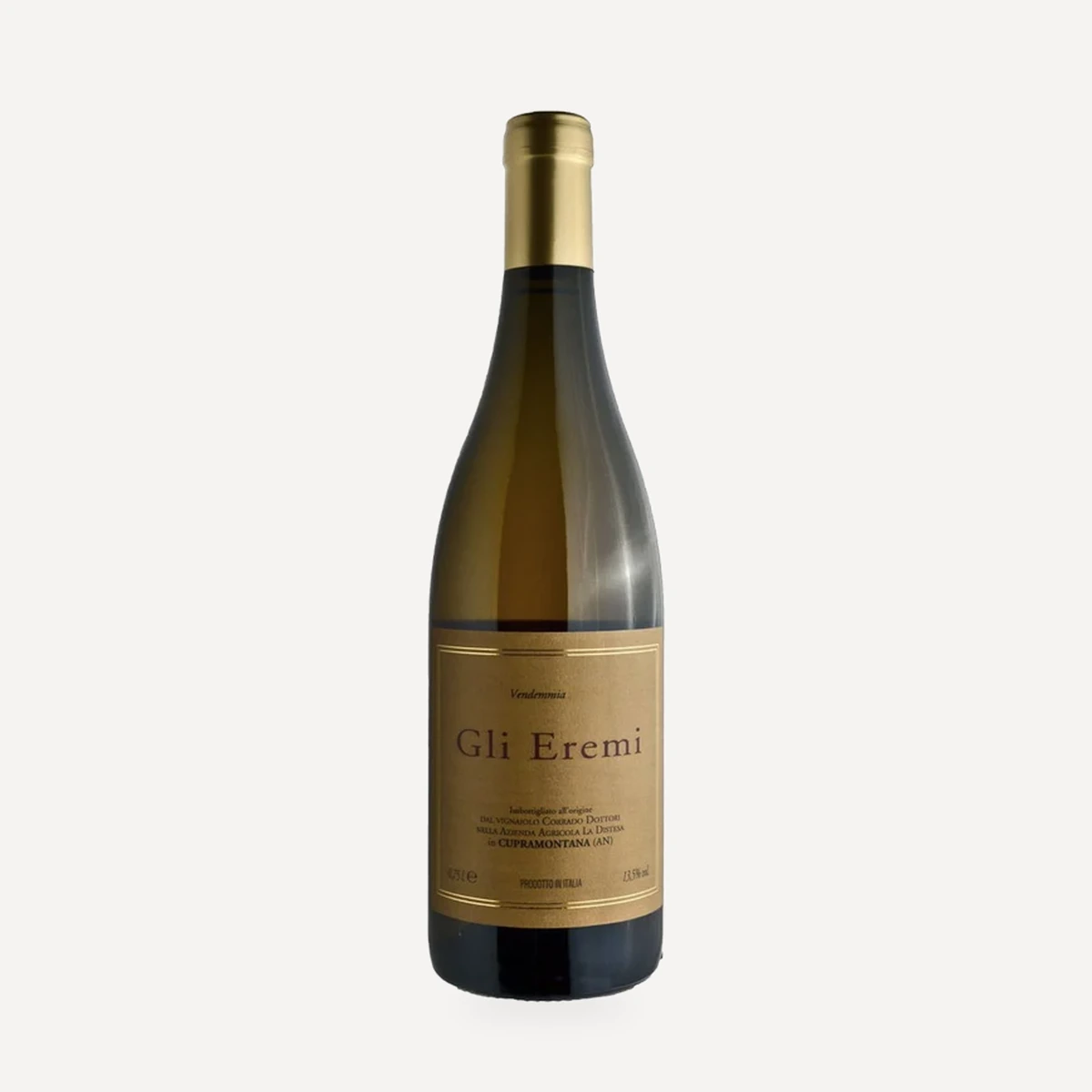
Gli Eremi
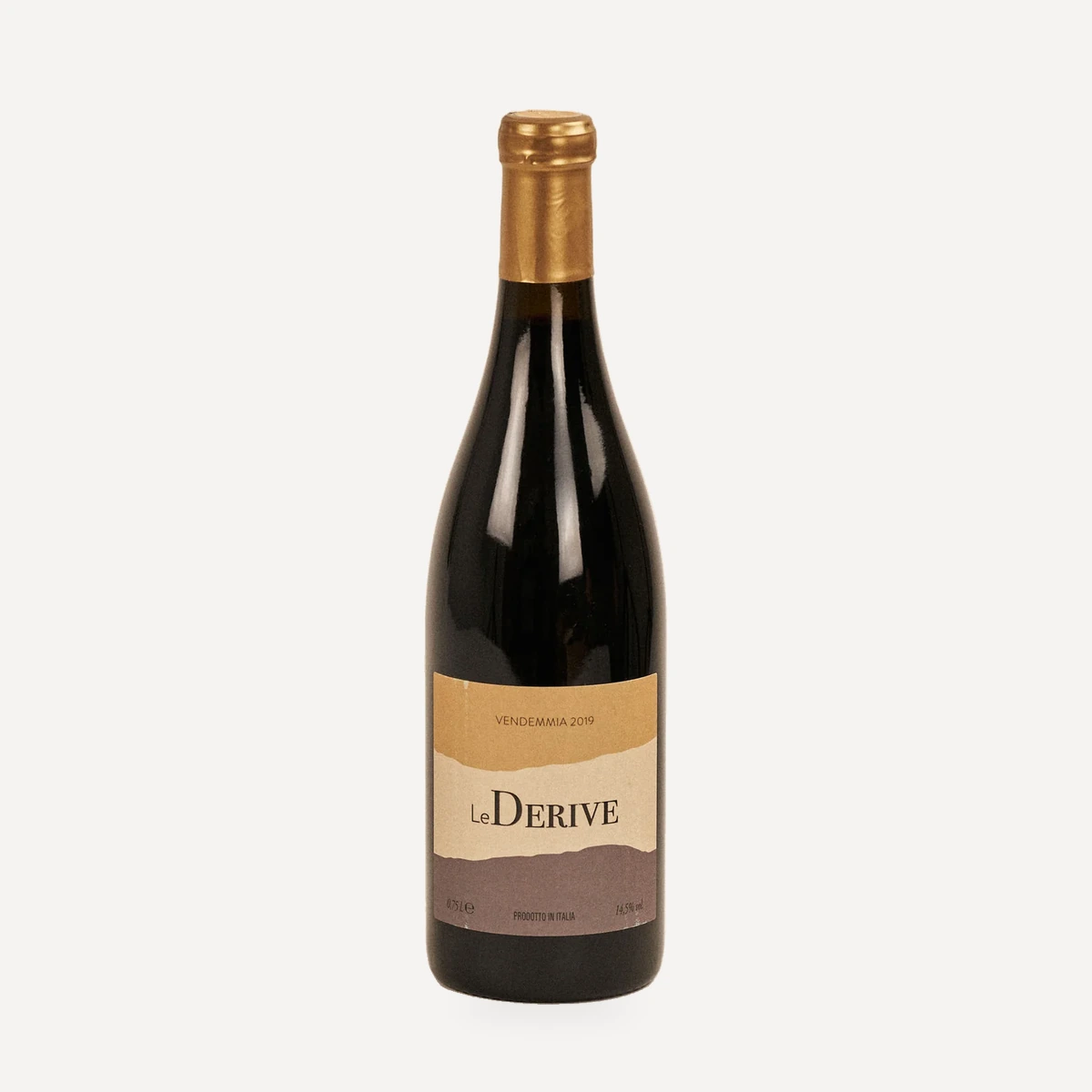
Le Derive