Storia
A historic winegrowing landscape
Viticulture in the area predates Levii by many decades. In 1887, Don Lorenzo Guetti, founder of the Trentino cooperative movement, praised the vineyards of Dorsino and San Lorenzo for the advanced standard of their cultivation. This testimony forms part of the historical context for Levii’s work in the Giudicarie.
Post-war abandonment and recovery
Successive waves of emigration after the Second World War left parts of the traditional winegrowing landscape around Stenico and Bleggio in a state of semi-abandonment. Cesare and Riccardo later brought together complementary skills in a project intended to restore both the agricultural landscape and its environment. Their work focused on returning historically suitable sites to viticulture and rebuilding the connection between farming, territory and the local community.
Establishment in 2012
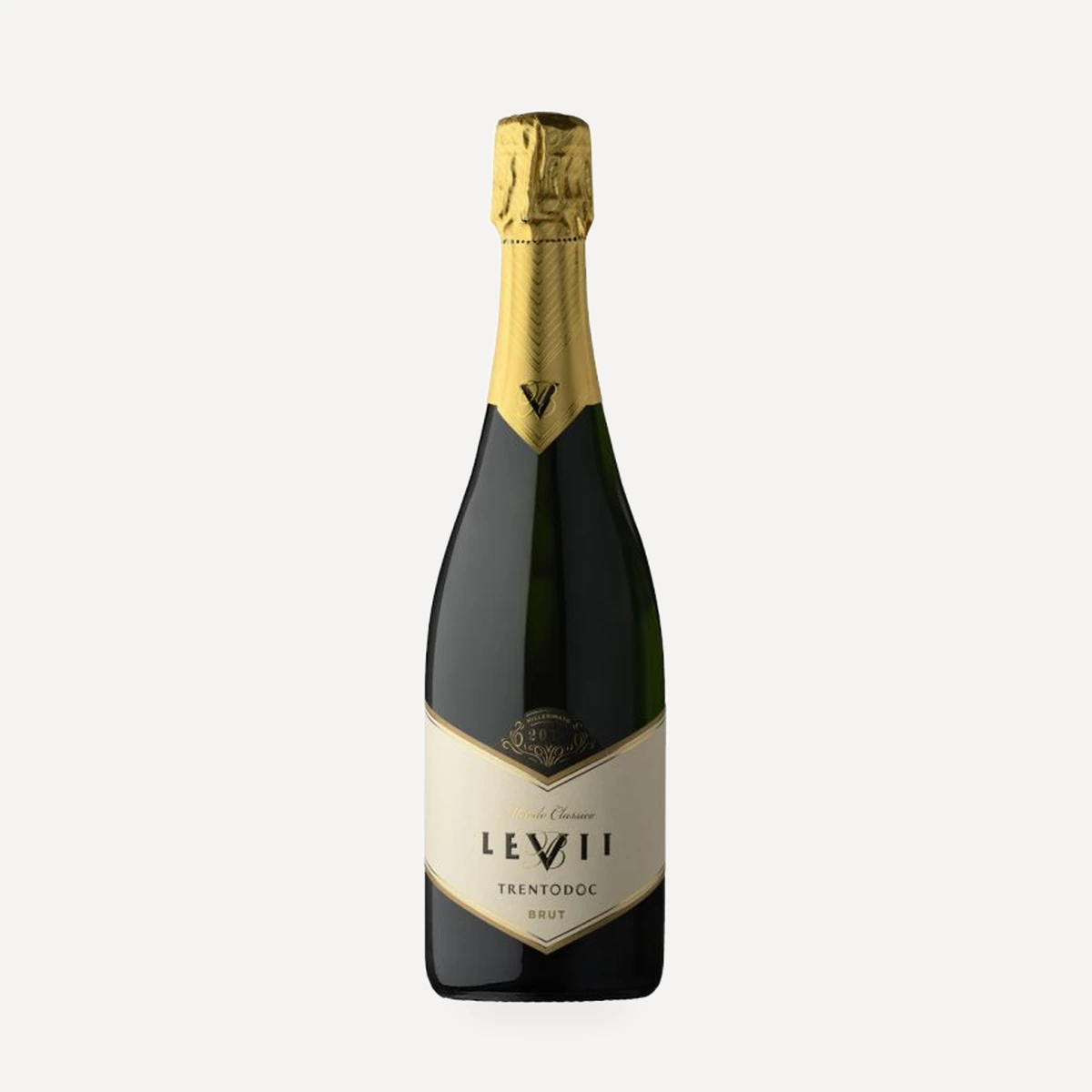
Cantine Levii was established in 2012. The name comes from the local expression or place-name Le Viti, meaning “the vines.” The identity of the business is also tied to the Berasi family: the golden letter B at the centre of the mark represents the Berasi name.
Levii today
The recovered land has been developed as a modern, rationally planned mountain-vineyard operation on the steep slopes above the Sarca. Its vineyards extend through the territories of Stenico and Bleggio at the foot of the Brenta Dolomites. Levii concentrates on Traditional Method Trento DOC sparkling wines, with altitude, long maturation and the recovery of the Giudicarie winegrowing landscape at the centre of the project.
Terroir
The Giudicarie Esteriori
The vineyards lie in the Giudicarie Esteriori in western Trentino, between the Brenta Dolomites and Lake Garda. This UNESCO Biosphere Reserve comprises the areas of Banale, Lomaso and Bleggio, with the thermal springs of Comano on the valley floor. The absence of polluting factories and the presence of diversified agriculture help preserve the valley’s flora and fauna. Vineyards occupy the positions considered most suitable for sparkling-wine grapes, while other parts of the valley support apples, cherries, berries, potatoes, vegetables, medicinal herbs and livestock forage.
Mountain and lake influences
The Brenta Dolomites dominate the valley and provide the elevation, solar conditions and daily temperature variation associated with Levii’s sites. Lake Garda exerts a contrasting influence through the Ora del Garda, a warm afternoon wind that travels north through the Valle dei Laghi and the Limarò canyon before reaching the vineyards. It ventilates the canopy, discourages fungal disease, increases daily temperature variation and moderates severe winter conditions. At night, cool air descends from the Brenta Dolomites.
The interaction of the warm Ora and the cool mountain breeze produces pronounced day-to-night temperature changes. These conditions help the grapes retain acidity at full maturity and encourage the accumulation of aromatic compounds.
Altitude, exposure and slopes
The average vineyard elevation is approximately 650 metres. Different sections describe the wider holdings between 650 and 800 metres, while the principal production sites are generally placed at 650–700 metres. Slopes range from 15% to 45% and are predominantly exposed to the south. The combination of inclination and exposure keeps the bunches in sunlight from morning until sunset, promoting ripening in the mountain environment.
Soils and vine–soil interaction
The soils are described as naturally low in fertility. Together with the mountain climate, this limits yields and concentrates grape components. Planting at more than 7,000 vines per hectare creates competition between vines, encouraging deeper rooting, improving resilience to water stress and strengthening interaction with the underlying rocky matrix. Calcareous high-altitude soils are also associated with the Stenico fruit used in the collection, although no detailed geological profile is given.
Vinificazione
Levii follows integrated pest management, with particular attention to downy mildew and powdery mildew. The Ora del Garda provides natural ventilation after midday and helps limit fungal pressure. Anti-botrytis treatments are not used.
Canopy work includes shoot thinning, early leaf removal and topping. Shoot thinning and leaf removal expose the bunches to sunlight and moving air, while topping controls canopy growth. High planting density—more than 7,000 vines per hectare—reduces individual-vine vigour, encourages deeper roots and lowers production per vine. Average vineyard yield is approximately 70–80 quintals per hectare, attributed to low soil fertility, dense planting and the mountain climate.
Harvest dates are determined separately for each vineyard through daily grape analysis. Picking is entirely manual, with individual bunch selection in the vineyard and the removal of damaged fruit. Grapes are placed in small containers; the detailed production protocol specifies bins with a maximum capacity of 200 kg. This limits crushing and berry breakage, prevents premature juice release and reduces oxidation during the short journey to the cellar.
Pressing and must preparation
Whole bunches undergo slow, gentle pressing at between 0.3 and 1.2 atmospheres. A pressing cycle lasts approximately 3.5–4 hours. The juice is fractionated, separating the free-run portion from the pressed fractions. The resulting must is settled statically for 24 hours at 8°C, then racked.
Primary fermentation and base-wine maturation
Fermentation is initiated with selected yeasts and lasts about 12–13 days. After fermentation, the wine is racked to separate the coarse lees from the fine lees. The base wine then remains in stainless steel on its fine lees until May following the harvest. Bâtonnage resuspends the fine lees, encourages the extraction of mannoproteins and develops viscosity and body, with the objective of supporting a fine, persistent perlage. The best free-run juice from the best grapes and parcels is reserved for the Riserva wines.
Tirage and secondary fermentation
In May following the harvest, the base wines are clarified, sterile-filtered and cold-stabilised. The cuvées are assembled, after which cane sugar and selected yeasts are added for tirage. Secondary fermentation takes place in bottle and lasts approximately two months.
Lees ageing
The bottles remain in containers for roughly one year and are subsequently stacked, with the yeasts brought back into suspension. Both secondary fermentation and ageing take place at a constant 12°C. Lees ageing begins at a minimum of about 30 months for the core range and reaches 60 months or more for the Riserva wines. During this period, yeast-cell autolysis gradually releases compounds formed and absorbed during fermentation, contributing to the texture and aromatic development of the sparkling wine.
Riddling, disgorgement and release
At the end of lees ageing, the bottles undergo slow remuage so that sediment collects in the neck. The neck is frozen and the plug containing the lees is removed during disgorgement. A dedicated liqueur d’expédition is prepared for each bottling; the dosage is intended to remain subordinate to the base wine so that the vintage and place of origin remain perceptible. The finished bottles rest for another two to three months before release.
Filosofia
Levii places four ideas at the centre of its work: territory, mountains, time and commitment.
Territory is understood both as the source of the grapes and as a social system in which agricultural activity should create a positive shared effect. The recovery of formerly neglected vineyards in Stenico and Bleggio is therefore both an environmental and a community-focused project.
Mountain viticulture is accepted as technically difficult, economically demanding and labour-intensive, but Levii associates those conditions with greater aromatic definition and elegance. Steep slopes, high density, altitude and southern exposure are treated as interconnected quality factors rather than obstacles to be removed.
Time is regarded as indispensable to Traditional Method production. The house’s “without haste” principle is expressed through long lees ageing, beginning at about 30 months even for the core range and extending beyond 60 months for reserves. Dosage is designed to respect the base wine and preserve the expression of the vintage and terroir.
Commitment completes this approach: favourable sites and suitable varieties are considered insufficient without sustained attention in both vineyard and cellar. The wider corporate principles encompass legal compliance, transparency, workplace safety, environmental monitoring, sustainable development, respect for people, non-discrimination, fair competition, product traceability and responsible relationships with customers and suppliers.
Vini
Levii Extra Brut Millesimato Trento DOC