Storia
From the fiefdom to the Baroque estate
In 1616, Carlo Emanuele I di Savoia granted the fiefdom of San Martino to Urbano Alfieri.
The estate’s wine history is dated from 1696. That year, Carlo Antonio Massimiliano Alfieri commissioned engineer Antonio Bertola to transform the property in the Baroque taste. The project created a modern cellar, the castle and a park formed by levelling an adjoining hill. Bertola’s castle was built between 1696 and 1721.
Nineteenth-century transformations
In 1815, Prussian landscape architect Xavier Kurten converted the castle’s formal garden into a Romantic English garden. During the same year, architect Ernesto Melano began rebuilding the south façade and central body of the castle in a neo-Baroque style.
In 1851, Giuseppina Benso di Cavour, niece of statesman Camillo Benso di Cavour, married Carlo Alfieri di Sostegno. Camillo Benso di Cavour stimulated the Alfieri family’s wine production, working to improve wine quality and introducing Pinot Nero to Piedmont. The variety subsequently established a century-long history in the family’s vineyards.
The end of the Alfieri di Sostegno line
In 1924, Giovanni Visconti Venosta, son of Luisa Alfieri di Sostegno, married Margherita Pallavicino Mossi. Their marriage produced no children, and the Alfieri di Sostegno line ended with Giovanni.
In 1982, Margherita Pallavicino Mossi bequeathed the castle and winery to Casimiro San Martino di San Germano, a relative whom she also held in deep esteem. Casimiro, a former member of the Accademia di Agricoltura, set about relaunching wine production on the estate.
The three sisters and the modern winery
Casimiro died in 1988. His daughters Emanuela, Antonella and Giovanna San Martino di San Germano then assumed responsibility for the winery.
In 1990, Marchesi Alfieri produced its first 10,000 bottles under their leadership. Confronted by that initial production, the three sisters famously wondered who would drink them all; the episode marks the beginning of the modern Marchesi Alfieri venture.
In 1996, the estate adopted selective bunch thinning. Marchesi Alfieri was among the early local practitioners of this agronomic technique, using it to lower yields and concentrate quality in the remaining bunches.
Oenologist Mario Olivero arrived in 1999. That year coincided with the first Tre Bicchieri awarded by Gambero Rosso to Alfiera Barbera d’Asti Superiore DOCG; the wine received the distinction again in each of the following two years. These were the winery’s first major recognitions.
New vineyards, hospitality and Metodo Classico
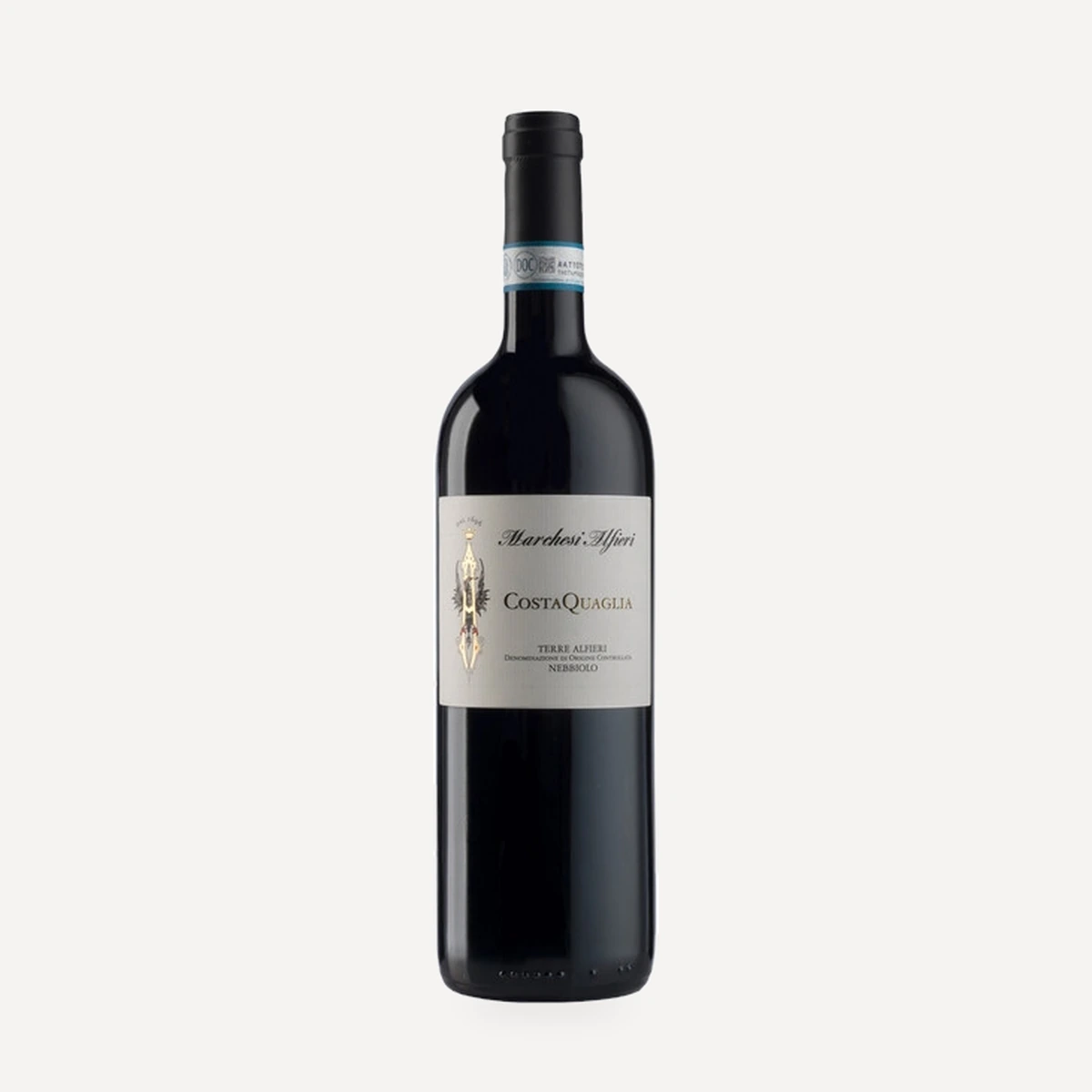
The first Nebbiolo vineyard on the Quaglia hill was planted in 2003. In the same year, four rooms opened within the historic village, beginning the estate’s hospitality activity. Three further rooms and Cascina Margherita followed.
A project devoted to a traditional-method sparkling wine made entirely from Pinot Nero began in 2012. Part of the Alfieri family’s eighteenth-century stables was adapted for secondary fermentation in bottle and lees ageing of the vintage Extra Brut Blanc de Noir.
The first vintage of that Metodo Classico Extra Brut Millesimato Blanc de Noir was produced in 2014, exclusively from estate-grown Pinot Nero.
In 2015, five hectares of suitable estate land were selected and planted with hazelnut trees, establishing another branch of agricultural production.
Restoration and diversification
In 2018, work began to restore the historic kitchen rooms and build a second barrel cellar beneath the castle. A collaboration with the Terre di Tartufi association also began, converting several hectares of woodland into an educational truffle ground. That year brought two further vineyard projects: a new Pinot Nero planting on the northern side of Quaglia and Vigna del Castello, a new Barbera vineyard near the residence.
In 2022, Marchesi Alfieri presented Carlo Alfieri from the 2015 harvest. Conceived only for exceptional years, it resulted from selecting the Barbera fruit judged to express the vintage and variety most successfully, followed by long maturation in wood and bottle.
The family today
Emanuela, Antonella and Giovanna San Martino di San Germano now work alongside younger generations of the family, who are contributing new ideas and projects to the estate’s future.
Terroir
Setting
The estate lies at San Martino Alfieri in the Terre Alfieri, where Roero, Langhe and Monferrato meet. Hills and mountains surround the property, while woodland occupies the valley floor. The Tanaro River forms one of the area’s natural boundaries.
The landscape is a mosaic of vineyards, woods, hazelnut groves and fields historically planted with maize and wheat. The soils vary markedly between hills and within individual sites, ranging from red and white sands and clay to silt and limestone-rich white earth.
Vineyard soils and exposures
Sansoero combines clay with red sand, becoming whiter toward the west. Quaglia has a mixture of sand, clay and silt, with high proportions of sodium, potassium and calcium; these conditions are associated with thicker, more resistant grape skins. Its southern side supports Barbera, while Pinot Nero is planted to the north.
Calandrina has white sands and clays, east and north-east orientations and a gentler gradient than Quaglia. These conditions enable later, slower and more even ripening. Vigna del Castello faces west and has sloping white earth containing sand and limestone.
Vinificazione
Marchesi Alfieri describes its approach as “low-intervention” viticulture, founded on guiding natural balance rather than forcing it. Vineyard work uses low-impact phytosanitary treatments and sustainable agronomic practices.
Intervention is limited to what is considered necessary: the number of treatments is reduced to the essential minimum, heavy vehicles are avoided and weeds are controlled mechanically.
Selective bunch thinning has been practised since the 1990s and was formally introduced in 1996. Removing bunches reduces crop quantity and concentrates quality in those retained. Following this selection, fruit is harvested only when fully ripe, through a long, precise process conducted vine by vine and parcel by parcel. A final quality check takes place on the sorting table in the cellar.
Polyculture and biodiversity form part of the wider agricultural setting. Vines grow beside woodland and alternate with agricultural fields. Large abandoned or uncultivated plots were reforested during the 1990s, creating two substantial wooded areas with oaks, cherry trees and hornbeams. The estate also maintains hazelnut plantings and, since 2018, an educational truffle ground created from several hectares of woodland in collaboration with Terre di Tartufi.
Parcel selection and vinification
Fruit is allowed to reach full ripeness and is selected vine by vine and parcel by parcel after bunch thinning. A final inspection is made on a sorting table at the winery. Each parcel is vinified separately so that its grape variety and terroir can retain an individual expression before any final composition.
Ageing philosophy
Ageing is managed through careful timing and a balanced use of wood. Decisions are tailored to the character of each vintage and wine, with the stated aim of retaining clarity, recognisability and complexity rather than obscuring the fruit or site.
The historic and modern cellars
The first historic barrel cellar lies beneath the Orangerie. Designed with modern solutions from its construction, it houses approximately 250 French-oak barriques from Allier and Tronçais, together with several large casks.
A second barrel cellar was created beneath the castle perimeter beside the historic kitchens. It contains 500-litre tonneaux and large casks in the Piedmontese tradition. Its construction formed part of the work begun in 2018 alongside the restoration of the old kitchen rooms.
The former eighteenth-century stables contain spacious, functional maturation rooms. These rooms are partly underground and temperature-controlled, providing conditions for wines to develop in bottle until maturity. Since the launch of the sparkling-wine project in 2012, part of the stables has also accommodated secondary fermentation in bottle and extended lees ageing for the estate’s vintage Metodo Classico Blanc de Noir.
Filosofia
Marchesi Alfieri articulates its production philosophy through four ideas: timeliness, purity, refinement and elegance.
Timeliness begins with patience in the vineyard. After bunch thinning, each vine’s fruit is harvested only at complete ripeness, with decisions made vine by vine and parcel by parcel. Time is treated as an essential component of quality.
Purity means respecting the expressive character of each grape variety and the imprint of its terroir. Separate vinification of each parcel is intended to carry the cleanest possible expression of vineyard fruit into the bottle.
Refinement is understood as working by subtraction. Rigorous maturation and balanced wood use should reveal rather than manufacture individuality, producing wines whose voices are clear, recognisable and complex without becoming complicated.
Elegance depends on a tailored response to vintage conditions. The family presents winemaking as a combination of listening, sensitivity and technical skill: choices change according to the harvest so that each wine can develop its own style.
The same principle of restraint extends into the vineyard, where nature is guided rather than forced and interventions are reduced to those judged essential. Protection of the landscape and biodiversity is also treated as a family responsibility, expressed through polyculture, reforestation and the preservation of woodland alongside the vines.
Vini
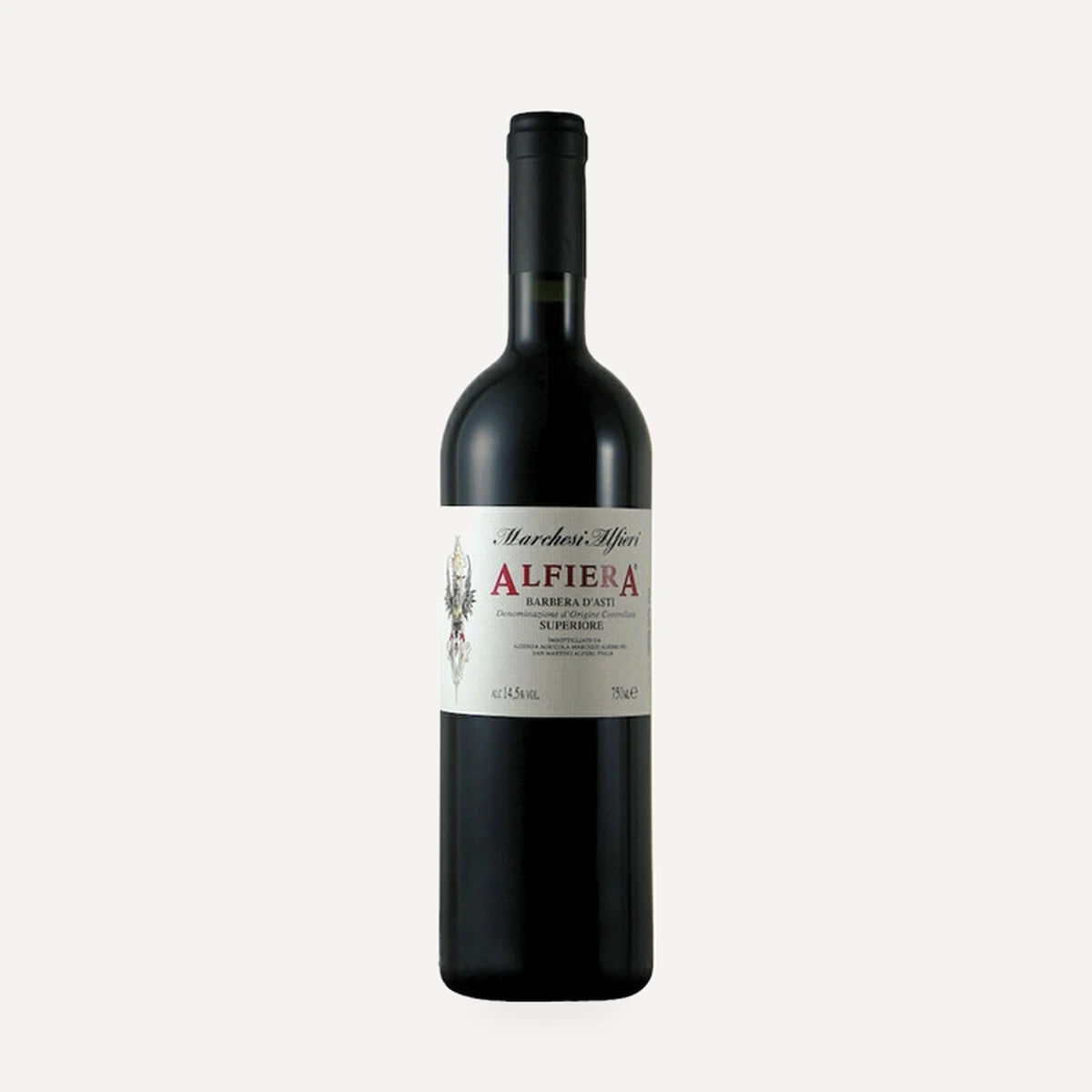
Alfiera Barbera d'Asti Superiore DOCG