Storia
Ancient vineyard landscape
The estate occupies land where a Roman vineyard existed approximately 2,000 years ago. Its built heritage includes a 10th-century friary with a tower and courtyard.
1990: from New York to Tuscany
Ferenc Máté, an internationally successful author, and his wife Candace Máté, a painter, left New York City for the Tuscan countryside in 1990. In the Montalcino wine zone they acquired an ancient, abandoned farm containing a canyon, waterfalls and the medieval friary.
Restoration and creation of the vineyards
The Mátés undertook what they described as a museum-quality restoration of the friary. Their neighbours included winemakers Angelo Gaja and Gianfranco Soldera. The family commissioned Fabrizio Moltard, identified as Angelo Gaja’s agronomist, to design the vineyards, while the vine clones were selected by the French specialist Pierre Guillaume.
Seven campi were established across two private hills. The vineyards now total 7 ha and contain Sangiovese, Merlot, Cabernet Sauvignon and Syrah, each assigned to soils considered appropriate for the variety. An older account described a 28 ha property with slightly more than 6 ha under vine, indicating that the planted surface subsequently increased.
During the estate’s early division of responsibilities, Ferenc worked in the countryside, Candace looked after the cellar and their son Peter assisted them. Roberto Cipresso was responsible for the oenological work during this period.
First releases and recognition
Recognition followed the debut releases: the first Merlot received 90 points from Wine & Spirits, while Michael Apstein rated the Syrah 92 points. Later Brunello releases reached 95 points from both Wine Spectator and James Suckling.
Terroir
The estate lies at Santa Restituta on the sea-breeze-ventilated side of Montalcino. Its seven campi occupy two private hills and are surrounded by Mediterranean woodland, herbs and wild fruit. The planted surface totals 7 ha.
The varieties are matched to distinct soils: Sangiovese grows in fossil-bearing tufo; Merlot in sandy clay; Cabernet Sauvignon in marl; and Syrah on mineral-rich southern terraces.
The Santa Restituta Sangiovese vineyards have west and south-west exposures at 320–410 m. Their soils combine marl and galestro with limestone, calcareous sandstone and marine deposits. The more narrowly defined Veltha selection occupies west- and south-west-facing terrain at 390–410 m on marl and galestro.
Vinificazione
Fabrizio Moltard designed the vineyards, and Pierre Guillaume selected the clones. The four varieties were assigned to separate soil types and planted at the high density of 6,200 vines/ha.
Yields are deliberately restricted through three green-pruning passes each year. Vineyard work is performed by hand. Harvest waits for full physiological maturity; only carefully selected, fully ripe grapes are picked, using 20 kg crates for the Sangiovese harvest described in the technical material.
The Santa Restituta Sangiovese vines are trained to spurred cordon and Guyot, while the Veltha selection uses spurred cordon. Wines from the 2016–2018 vintages are identified as coming from organically grown grapes, and the 2016 Brunello di Montalcino Riserva is identified as certified organic.
Grapes are selected and harvested by hand at full maturity. Fermentation takes place in small temperature-controlled stainless-steel vats or, for some lots, new wooden vessels. Indigenous yeasts are used for the documented Sangiovese fermentations.
Extraction combines pump-overs with manual punch-downs. The must is kept cool to retain fruit and spice aromas. A 40 hl vat is used for the Veltha selection, with délestage performed halfway through fermentation.
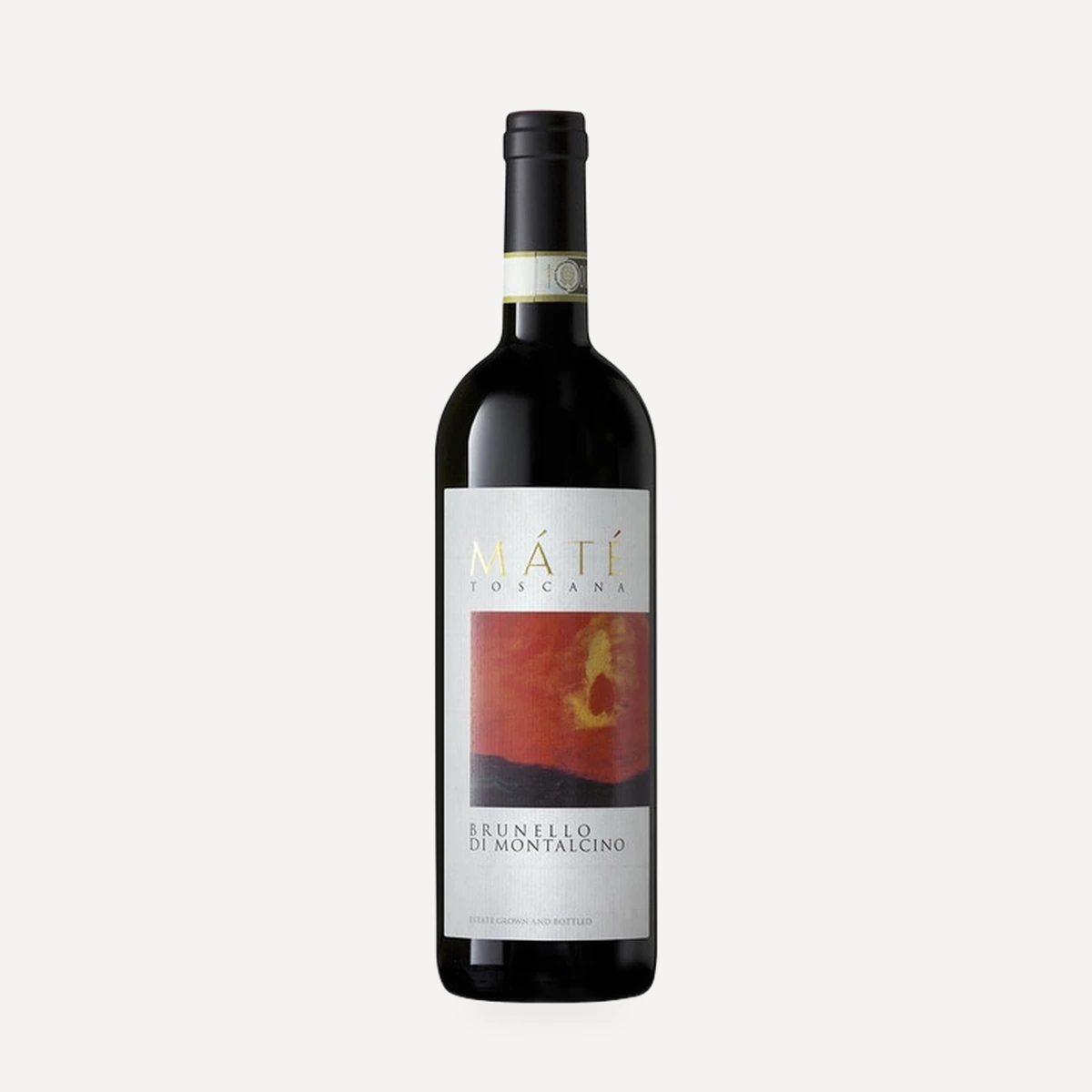
Maturation varies by cuvée. The general cellar regime includes up to two and a half years in Allier French-oak barriques and tonneaux. Brunello may mature for as long as three years in 500- and 4,000-litre French-oak vessels, followed by at least six months in bottle. The Veltha regime combines one year in 500-litre French oak with two years in 4,000-litre French oak, again followed by a minimum of six months in bottle.
Filosofia
The Máté approach centres on detailed manual work in both vineyard and cellar. Vineyard density, repeated green pruning, late selection at full maturity and variety-specific soil placement are intended to favour concentration and aromatic definition. In the cellar, small temperature-controlled fermentations, manual extraction and extended French-oak maturation support the family’s stated aim of producing refined wines with persistent fruit and spice character.
Vini
Brunello di Montalcino