Storia
From the city to Monferrato
Monfrà was conceived by Sara Leila Castagnella and Paolo Cirio, both born and raised in Turin. Their backgrounds were in the arts rather than inherited winegrowing: Sara studied theatre and performing arts at the University of Turin, while Paolo studied plastic arts at Université Paris 8 Vincennes–Saint-Denis and spent several years abroad working in video and cinema. They left their established routines in search of a life capable of bringing together art, nature, viticulture and oenology.
2016 — foundation and the first vineyards
Monfrà took shape in 2016 from the meeting of wine, art and nature. It was conceived both as a farm and as a broader experimental project: a place for researching creative agricultural and cultivation techniques that respect people and the natural world.
Organic management of the vineyards began that year. One of the founders’ earliest undertakings was the recovery of the neglected Grignolino vineyard that would become their first vineyard. When they first saw it in February, its long shoots were dry and tangled, the rows were wind-beaten, broad areas of soil had turned to mud, and the site had been abandoned. Their immediate priority was the health of the vineyard rather than its prospective yield. They pruned the tangled growth, tended damaged areas, cut the grass between the rows and brought the vines back toward their traditional form, then allowed them time to recover without imposing a production target.
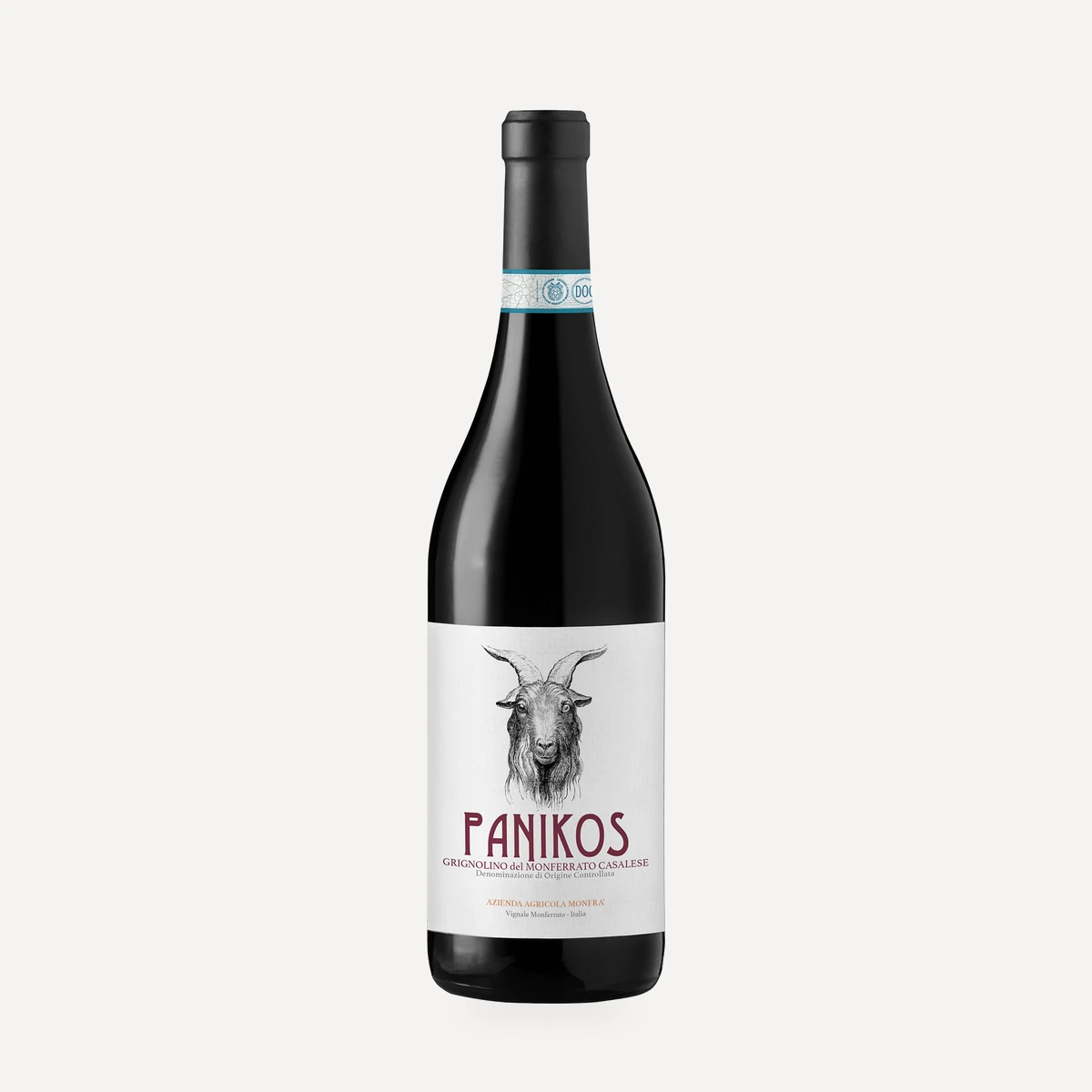
Within months, the vines had regained vigour. Long shoots and a moving canopy returned, while ladybirds, pollinating insects, spontaneous herbs, flowers and animals reappeared among the rows. This recovery became the founding story of Panikos and an early expression of Monfrà’s approach to farming.
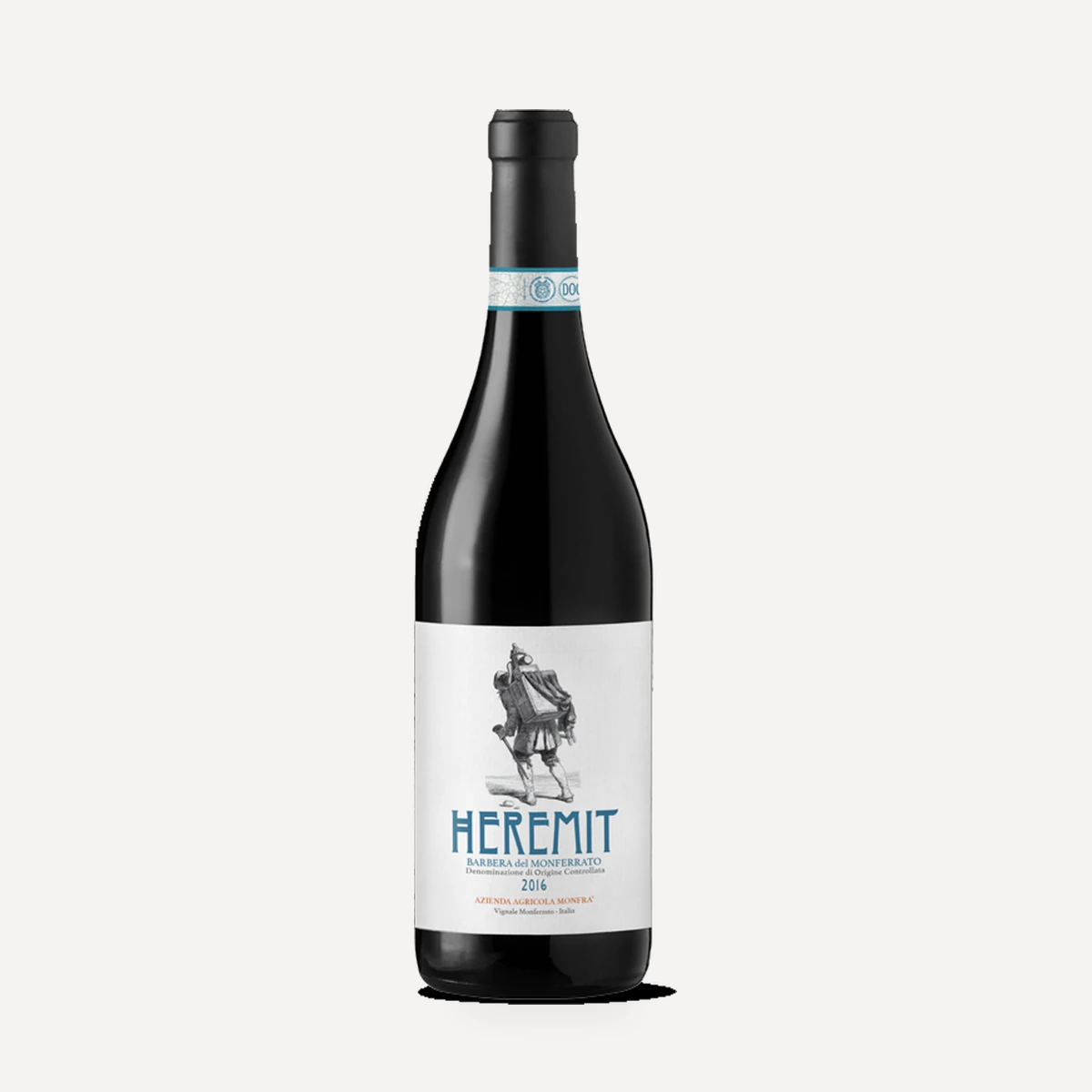
A separate account of the old vineyard behind Heremit recalls the founders’ conviction that the wines arising from those vines should be treated like characters in a story: their essential traits were to remain intact, their inclinations followed and their identities clarified. The significance of that idea became particularly apparent during the first harvest.
An early profile described the farm as three hectares, including a one-hectare, thirteen-year-old vineyard, and recorded plans to plant another hectare the following spring. Heremit and Panikos were the first two wines, made with the guidance of oenologist Andrea Buzio.
2018 — wine and art in public
In 2018 Monfrà organized and curated the first edition of Calici Sonori with the Enoteca Regionale del Monferrato. The festival joined wine with experimental and avant-garde music through six evenings at the Castello dei Paleologi in Casale Monferrato between April and June.
The same period brought plans for PAN — Polo dell’Arte e della Natura, a rural cultural centre intended for performances, concerts, exhibitions, workshops and artist residencies. The project involved recovering an old hay barn and giving it a new cultural use within the farm.
2019 — organic certification
After managing its vineyards organically from 2016, Monfrà obtained organic certification in 2019. Organic farming became part of a wider estate model in which vineyards and an olive grove coexist with woodland, ponds, an orchard, a vegetable garden, flowers, aromatic plants and habitat for insects, birds, amphibians and small mammals.
Expansion of the range and creative projects
The initial range of Heremit and Panikos was subsequently joined by La Ru, a Barbera del Monferrato Superiore DOCG. La Ru also became the focus of a collaboration with Salgari Records and Voz de La Frontera. The musicians created the previously unreleased track Decanto, and a limited series of La Ru bottles carried a QR code through which the track could be downloaded and heard as part of a combined wine-and-music experience.
By 2024, event presentations included Estreja alongside Heremit, Panikos and La Ru. In 2025 the range presented at fairs also included a limited edition of Panikos and the newly introduced Ekhos.
Terroir
Monfrà is based at Strada Comunale Cà Boschetto in Vignale Monferrato, in the hills of Monferrato. The country property overlooks the surrounding hills and lies among vineyards, an olive grove, fields and woods.
The geological identity presented for Monferrato begins with an ancient ocean. White shells preserved in clay soils remain as evidence of that marine past. The former ocean floor and its sinuous dunes gradually became the present hilly landscape, now occupied by woods, fields and vineyards.
The recovered Grignolino vineyard lies on a windy hill with a particularly favourable exposure. During the founders’ first February visit, the rows were exposed to cold sun and strong wind. By spring, a lighter breeze moved through the regenerated canopy, and spontaneous vegetation once again covered the soil beneath the vines.
Vinificazione
The vineyards have been managed according to organic methods and standards since 2016, and the farm has held organic certification since 2019. Respect for living systems is the central criterion behind Monfrà’s production choices.
The rehabilitation of the first Grignolino vineyard illustrates this approach. Faced with an abandoned and visibly weakened site, the founders prioritized recovery rather than yield. They pruned tangled shoots, tended the vines’ wounds, cut the grass and guided the plants back toward a traditional form. The vines were then left time to recover without immediate production demands.
The regenerated vineyard developed a soft, green floor of spontaneous vegetation, including wild mint, dandelion, borage, cornflowers, wild orchids and other herbs. Ladybirds and other pollinating insects returned to the canopy, while hares, small rodents, foxes and green lizards found cover among the rows.
Biodiversity is cultivated across the wider property. The small wood contains mature oaks, lindens, horse chestnuts, laburnums, black locusts and hackberries, together with Mediterranean shrubs such as broom, wild roses, bay, cornelian cherry and hawthorn. The vegetation supports tits, woodpeckers, blackbirds, magpies, jays and robins; hoopoes and bee-eaters arrive during the migratory season. Two woodland ponds provide habitat for small amphibians and dragonflies and water for passing birds and mammals.
The vegetable garden is sheltered by fruit trees. Its beds are planted largely with old vegetable varieties, aromatic shrubs, flowers and spontaneous herbs that provide food and shelter for bees, butterflies, green lizards and small mammals. Numerous types of roses—English, tea, alba, Chinese, botanical and rugosa—flower from May into late autumn and produce berries during the colder season.
Monfrà describes its wines as handmade products created through natural methods. The production philosophy combines Piemonte’s winegrowing tradition with a contemporary, experimental outlook and seeks genuine expression rather than stylistic standardization.
The founders’ first encounter with the old vineyard behind Heremit established an important working principle: the resulting wines should retain their essential traits, be allowed to follow their natural inclinations and develop clearly recognizable identities. The same preference for patience appears in the treatment of the first Grignolino vineyard, where recovery of the vines took precedence over immediate production.
The estate’s creative experimentation has also extended to amphora-related projects and collaborations joining wine with other art forms. La Ru/Decanto paired a limited series of Barbera del Monferrato Superiore DOCG bottles with an original musical track accessible through a QR code attached to the bottle.
Filosofia
Monfrà defines itself as more than a wine label: it is a farm, a creative project and a place for experimentation at the meeting point of wine, art and nature.
Respect for life and affection for the natural world are presented as the foundation of the estate. Nature is intended to guide every production decision, while agricultural work should respect both people and the environment. This principle is expressed through organic farming, the rehabilitation of a neglected vineyard and the creation of habitats for plants, insects, birds, amphibians and mammals across the property.
The founders understand philosophy in its literal sense as a love of knowledge. They look to both tradition and technology for ideas and tools capable of improving their products, their creative work and the environment in which they live. Their concept of resistance means retaining human agency: thinking independently, making things with one’s hands, pursuing personal aspirations and defending nature.
Inspiration is closely tied to place—the sound of cicadas, the curves of the hills, dew on grapes, fermenting wine and the farm’s trees and gardens. Poetry provides another model: its verses offer a structure for daily life, and the founders seek to carry a similar internal structure into what they make.
This approach also treats wine as a medium for relationships and artistic exchange. Exhibitions, readings, performances, music sessions and artist residencies are intended to coexist with vineyard work rather than operate as a separate activity.
Vini
Heremit